Tax Revenue vs. GDP: A Global Comparison
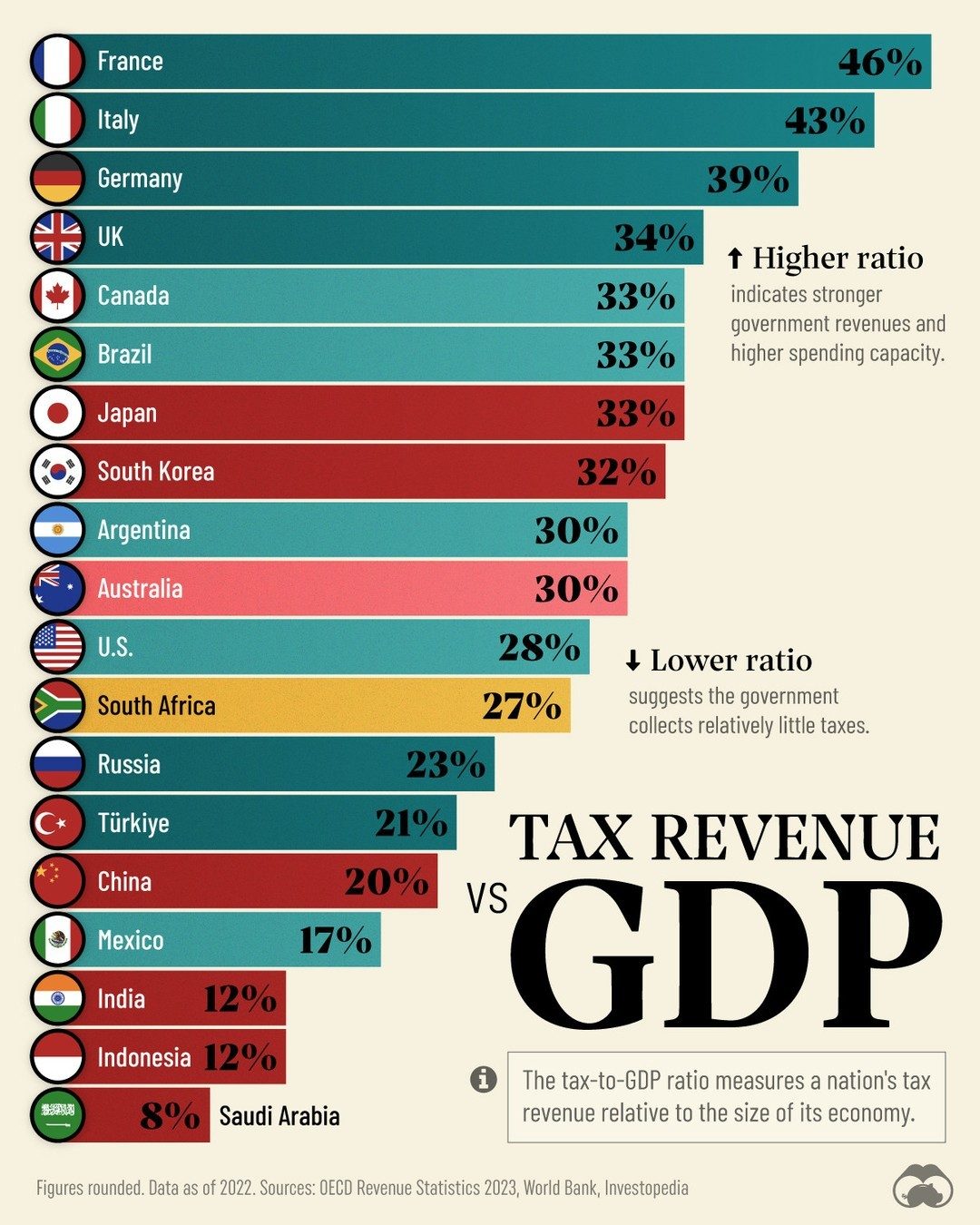
Tax revenue as a percentage of Gross Domestic Product (GDP) is a critical metric for understanding a nation's fiscal health and its capacity to fund public services and social security. This ratio, known as the tax-to-GDP ratio, provides insights into how effectively a government can generate revenue to support its economic and social programs. Here, we delve into the tax revenue performance of major economies worldwide, focusing on the data from OECD Revenue Statistics 2023.
The Significance of the Tax-to-GDP Ratio
The tax-to-GDP ratio measures a nation’s tax revenue relative to the size of its economy. A higher ratio indicates that a country collects a larger proportion of its economic output in taxes, which can translate into more substantial government revenues and higher spending capacity. Conversely, a lower ratio suggests that the government collects relatively little in taxes compared to the size of its economy.
According to the World Bank, a tax-to-GDP ratio of at least 15% is often considered critical for economic growth and poverty reduction. This threshold generally ensures that governments have sufficient revenue to fund essential public services and social security programs. However, the ideal ratio can vary depending on a country's economic context, social policies, and developmental goals.
Global Rankings: Tax Revenue vs. GDP
Top Performers
France and Italy lead the pack with tax-to-GDP ratios exceeding 40%. France tops the list with a ratio of 46%, followed by Italy at 43%. These high ratios reflect robust tax collection systems and significant public spending commitments in these countries. Their governments use these revenues to fund extensive social welfare programs, healthcare, education, and infrastructure development.
Middle Ground
Several other countries also perform well in terms of tax revenue relative to their GDP:
- Germany and the United Kingdom, both at 34% and 33% respectively, maintain strong tax-to-GDP ratios.
- Canada, Brazil, and Japan all have ratios of 33%, indicating a balanced approach to tax collection and public spending.
- South Korea, Argentina, Australia, and the U.S. each have a ratio of 30% and 28%, respectively, reflecting a moderate level of tax collection.
Lower Ratios
Countries with lower tax-to-GDP ratios generally have less extensive public services or different economic models:
- South Africa, Russia, Türkiye, and China have ratios ranging from 21% to 23%, which suggests that these countries have smaller public sectors relative to their GDP.
- Mexico, India, Indonesia, and Saudi Arabia have the lowest ratios, with Saudi Arabia at just 8%. These countries either have lower public spending needs or rely more on non-tax revenues such as natural resource exports.
Understanding the Implications
For Countries with High Ratios
For countries like France and Italy, a high tax-to-GDP ratio means they can invest heavily in public services. This often translates into better healthcare, education, and social security systems. However, it also means higher tax burdens on their citizens and businesses, which can sometimes deter economic growth.
For Countries with Lower Ratios
Conversely, countries with lower tax-to-GDP ratios may struggle to fund comprehensive public services. They might rely more on private sector solutions or have limited social safety nets. On the other hand, lower tax burdens can encourage private investment and economic activity.
Practical Tips for Policymakers
For policymakers looking to optimize their country's tax-to-GDP ratio, several strategies can be considered:
Balancing Act
Striking a balance between tax revenue and economic growth is crucial. Policies that promote economic efficiency, such as reducing tax evasion and simplifying tax codes, can help increase revenue without stifling growth.
Targeted Taxation
Implementing targeted tax policies, such as progressive taxation or carbon taxes, can help raise revenue while promoting social equity or environmental sustainability.
Public Spending Efficiency
Efficient allocation of public spending can maximize the benefits of tax revenue. Investing in infrastructure, education, and healthcare can yield long-term economic gains and social benefits.
International Comparisons
By studying the tax systems of countries with similar economic contexts, policymakers can gain valuable insights into best practices and potential reforms.
Important Takeaways
- France and Italy lead with the highest tax-to-GDP ratios, exceeding 40%.
- A 15% tax-to-GDP ratio is generally considered a threshold for economic sustainability and poverty reduction.
- Countries with lower tax-to-GDP ratios may have different economic models or lower public spending needs.
- Balancing tax revenue and economic growth is crucial for sustainable development.
- Efficient public spending and targeted taxation can enhance the benefits of tax revenue.
- International comparisons offer valuable insights for policymakers.
By understanding the tax-to-GDP ratios of major economies, policymakers and citizens can gain a clearer picture of their nation's fiscal health and the potential for economic growth. This information is vital for making informed decisions about public spending, taxation, and economic policy.
Watch the Reel
Questions readers ask
What is the tax-to-GDP ratio and why is it important?
The tax-to-GDP ratio is a financial indicator that shows how much tax revenue a country collects as a percentage of its total economic output, or GDP. It's important because it provides a snapshot of a nation's fiscal health and its ability to finance public services, infrastructure, and social welfare programs. A high tax-to-GDP ratio can indicate a government's capacity to invest in its citizens and economy.
Which countries have the highest tax-to-GDP ratios?
According to recent data, France and Italy lead the way with tax revenues exceeding 40% of their GDP. Other countries with notably high tax-to-GDP ratios include Denmark, Belgium, and Sweden, each collecting substantial portions of their GDP in taxes to support extensive public services and social security programs.
How does the tax-to-GDP ratio reflect a country's fiscal health?
The tax-to-GDP ratio is a key indicator of fiscal health because it shows the proportion of a country's economic output that is collected in taxes. A higher ratio can suggest that a government has strong revenue-generating capabilities, which can be crucial for funding economic and social programs. Conversely, a lower ratio might indicate limited fiscal capacity or over-dependence on borrowing or external financing.
Why do some countries have lower tax-to-GDP ratios compared to others?
Countries with lower tax-to-GDP ratios may have less developed tax systems, rely more heavily on other forms of revenue (e.g., natural resource exports), or have lower levels of public spending. For instance, Saudi Arabia has a relatively lower tax-to-GDP ratio because of its significant oil revenues, which reduce the need for high tax collection.
What are the global rankings for tax revenue as a percentage of GDP?
Global rankings for tax revenue as a percentage of GDP can vary, but typically, countries like France, Italy, and the Nordic nations top the list. These rankings are often compiled by organizations like the OECD and provide valuable insights into how different economies approach public financing and social welfare. The latest OECD Revenue Statistics 2023 provides detailed data on these rankings.
How does tax revenue as a percentage of GDP impact social security programs?
A higher tax revenue as a percentage of GDP generally means more funding is available for social security programs. This can lead to more comprehensive benefits, such as healthcare, pensions, and unemployment support. Countries with robust tax systems, like those in Scandinavia, often have strong social safety nets as a result of their high tax-to-GDP ratios.
Recent articles
Fresh deep dives from the latest Reels we unpacked.




Comments
Be the first to comment.