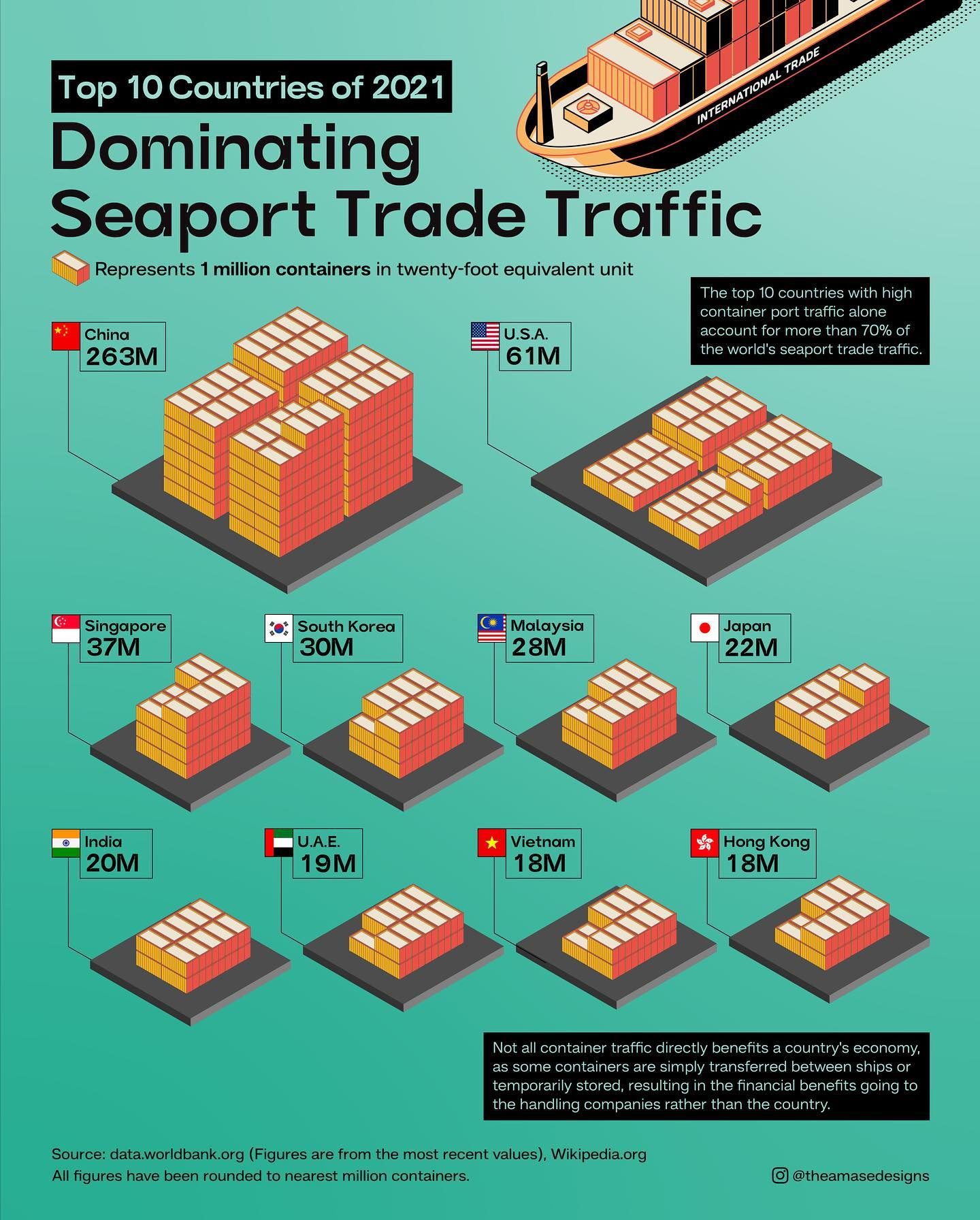
Seaport Trade Statistics
The global seaport trade traffic hit a staggering 841 million twenty-foot equivalent units (TEUs) in 2021. This monumental figure underscores the critical role that seaports play in international trade. China stands out as the leader, with a third of the world’s total seaport trade traffic flowing through its numerous ports.
Why This Matters
Seaport trade is the lifeblood of global commerce, facilitating the movement of goods and raw materials across continents. Understanding the trade patterns and the key players in this domain is essential for businesses, governments, and financial institutions. The data highlights not only the volume of trade but also the economic and strategic importance of seaports.
Main Discussion
The Top 10 Countries Dominating Seaport Traffic
China: The Unrivaled Leader
China tops the list with an astonishing 263 million TEUs. This massive volume is a testament to China's robust manufacturing sector and its strategic position as a global trade hub. The country's extensive network of ports, coupled with its economic policies, has cemented its status as the world's leading seaport trade nation.
United States: A Major Player
The United States follows with 61 million TEUs. The U.S. has a diverse range of ports, from the West Coast's busy ports of Los Angeles and Long Beach to the East Coast's savvy ports of New York and New Jersey. These ports handle a wide array of goods, from consumer electronics to agricultural products. The country's strategic location and economic influence make it a crucial player in global trade.
Singapore: The Global Hub
Singapore, with 37 million TEUs, is a vital link in the global supply chain. Its strategic location and efficient port management have made it a critical transshipment hub. Singapore's Port of Singapore handles a significant portion of the world's maritime trade, serving as a gateway for goods moving between Asia and the rest of the world.
Other Key Players
South Korea, Malaysia, and Japan are also significant contributors, with 30 million, 28 million, and 22 million TEUs, respectively. These countries are known for their advanced manufacturing capabilities and strategic locations, making them essential nodes in the global trade network.
India, U.A.E., Vietnam, and Hong Kong
India, with 20 million TEUs, the United Arab Emirates with 19 million TEUs, and Vietnam and Hong Kong, each with 18 million TEUs, round out the top 10. These countries have seen significant growth in their seaport trade volumes, driven by factors such as industrialization, increased foreign direct investment, and strategic trade agreements.
The Economic Impact of Seaport Trade
While the volume of container traffic is impressive, it's essential to consider who benefits from this trade. Interestingly, a significant portion of the financial benefits often go to the handling companies rather than the countries themselves. This dynamic highlights the importance of understanding the economic considerations and strategic implications of seaport trade.
Practical Tips
For Businesses
- Strategic Location: Choose a port location that aligns with your supply chain strategy. Proximity to key markets and trade routes can significantly reduce transit times and costs.
- Efficient Handling: Work closely with port operators to ensure efficient handling and storage. This can minimize delays and reduce overall logistics costs.
- Technology Integration: Leverage digital tools and technologies for real-time tracking and management of your cargo. This can improve transparency and efficiency in your supply chain.
For Governments
- Infrastructure Development: Invest in port infrastructure to enhance capacity and efficiency. This includes upgrading terminals, expanding storage facilities, and improving connectivity.
- Regulatory Framework: Create a favorable regulatory environment to attract foreign direct investment in port operations and related logistics services.
- Trade Agreements: Negotiate strategic trade agreements to facilitate smoother trade flows and reduce tariffs and other barriers to trade.
Important Takeaways
- Diverse Trade Patterns: The top 10 countries account for over 70% of the world's seaport trade traffic, illustrating the concentration of global trade in key regions.
- Strategic Importance: Seaports are not just logistics hubs but also strategic assets that influence a country's economic and geopolitical standing.
- Financial Considerations: The financial benefits of container traffic often go to handling companies, underscoring the need for strategic partnerships and agreements.
- Growth Opportunities: Countries like India, Vietnam, and the United Arab Emirates are emerging as significant players, offering growth opportunities for businesses and investors.
Conclusion
The global seaport trade landscape is dynamic and complex, with China leading the way while other countries like the United States, Singapore, and India also playing pivotal roles. Understanding the volume and distribution of seaport trade is crucial for businesses, governments, and financial institutions. By leveraging strategic locations, efficient handling, and digital technologies, stakeholders can navigate this intricate web and harness the full potential of global trade.
Watch the Reel
Questions readers ask
Which country handled the most seaport traffic in 2021?
China was the leader in global seaport traffic, handling over a third of the world’s total, which amounted to 280 million TEUs. This incredible volume underscores China’s dominance in global shipping and trade.
What does TEU stand for and why is it important?
TEU stands for twenty-foot equivalent unit, a standard measure used to quantify the capacity of container ships and the volume of cargo handled by seaports. It is crucial for understanding and comparing global seaport traffic.
How did the US rank among the top seaport countries in 2021?
The US was the second-leading country in global seaport traffic in 2021, handling 47 million TEUs, highlighting its significant role in international trade and maritime commerce.
Which other countries besides China and the US were in the top 10 for seaport trade in 2021?
Other countries in the top 10 for seaport trade in 2021 included Singapore, India, South Korea, Germany, Japan, Malaysia, Thailand, and the Netherlands. Each of these nations played a crucial role in facilitating global maritime trade.
How many TEUs were handled globally in 2021?
Worldwide maritime traffic reached 841 million TEUs in 2021, highlighting the massive scale of seaport trade and its importance in international commerce.
What makes seaport trade so important for global commerce?
Seaport trade is vital for global commerce as it facilitates the movement of goods and raw materials across continents. It drives economic growth, creates jobs, and supports the supply chain, ensuring that businesses and consumers can obtain the goods they need.
Which ports in the US handled the most container traffic in 2021?
The ports of Los Angeles, Long Beach, and New York/New Jersey were among the busiest in the US, handling a significant portion of the country’s 47 million TEUs. These ports are key gateways for trade between the US and the rest of the world.
Related deep dives
Similar reads based on topic and creator.

Recent articles
Fresh deep dives from the latest Reels we unpacked.




Comments
Be the first to comment.