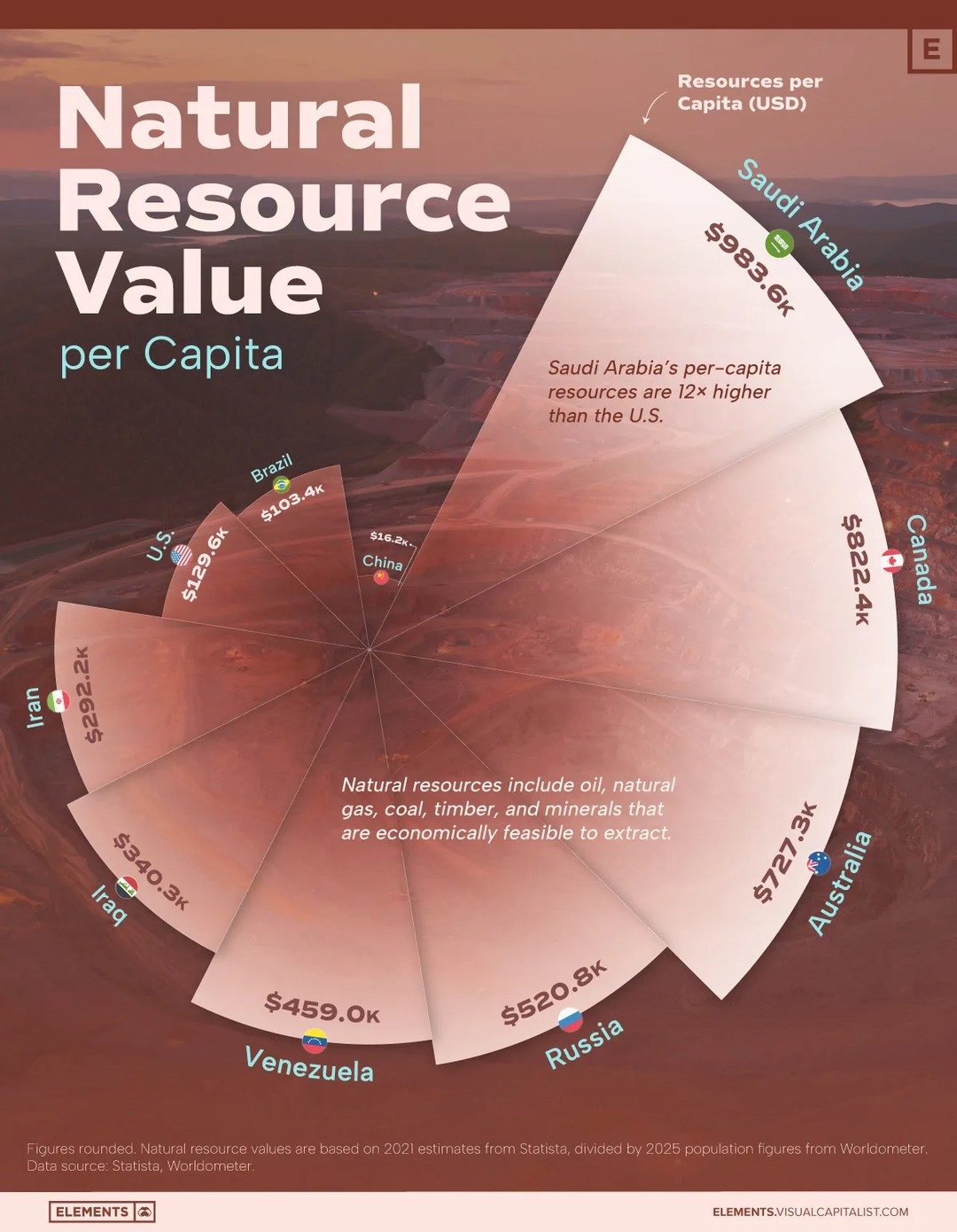
Natural Resource Value Per Capita
When discussing global resource wealth, the total reserves often grab the headlines. However, the true picture of a country's resource richness becomes more nuanced when considering the value of these resources on a per-capita basis. This perspective reveals how the distribution of natural resources varies significantly among countries, with some nations boasting extraordinarily high values of resources per person.
Context / Why This Matters
Understanding natural resource wealth per capita is crucial for several reasons. It offers insights into a country's economic potential, its capacity for development, and the implications for global commodity markets. Countries with high per-capita resource values often have significant economic advantages, while those with lower values may face challenges in sustaining economic growth.
Main Discussion
Top Resource-Rich Countries
According to a recent analysis, Saudi Arabia leads the world with nearly $1 million in natural resources per person. This high value is largely due to the country's vast oil reserves, which constitute a significant portion of its natural resource wealth.
Saudi Arabia
Saudi Arabia’s dominance in natural resource wealth per capita is unparalleled. With a value of nearly $1 million per person, it stands head and shoulders above other nations. This wealth is primarily driven by the country's extensive oil reserves, which are among the largest in the world. Saudi Arabia's strategic position in the global energy market further amplifies its resource value.
Brazil and Venezuela
Brazil and Venezuela also hold substantial natural resource values, with Brazil at $103.4k per capita and Venezuela at $520.8k. Both countries benefit from diverse natural resources, including oil, natural gas, and significant mineral reserves. Brazil's resource wealth is bolstered by its vast forests, which contribute to its timber industry, while Venezuela's resource value is heavily influenced by its oil and mineral deposits.
U.S. and China
The U.S. and China, despite their massive total reserves, rank much lower on a per-capita basis. The U.S. has a resource value of $129.6k per capita, while China stands at a surprisingly low $16.2k. This discrepancy highlights the impact of population size. Both countries have large total reserves, but their high populations dilute the per-capita value significantly. China, in particular, has the world’s largest population, which reduces its per-capita resource value despite having substantial coal, oil, and other mineral reserves.
Factors Influencing Per-Capita Resource Value
Several factors contribute to the variations in per-capita resource value among countries:
Population Size
The most significant factor influencing per-capita resource value is population size. Countries with smaller populations generally have higher per-capita values, as the same amount of resources is divided among fewer people. For instance, Saudi Arabia’s relatively small population (compared to China and the U.S.) allows for a higher per-capita resource value.
Resource Diversity
The diversity of natural resources also plays a crucial role. Countries with a wide range of economically feasible resources, such as oil, natural gas, coal, timber, and minerals, tend to have higher per-capita values. For example, countries like Russia and Australia benefit from diverse resource portfolios, including vast mineral reserves, timber, and significant oil and gas deposits.
Economic Feasibility
The economic feasibility of extracting and utilizing natural resources is another critical factor. Resources that are economically feasible to extract and process contribute more significantly to a country's resource value. For instance, Saudi Arabia's oil reserves are not only vast but also highly economical to extract, enhancing the country's per-capita resource value.
Global Economic Implications
The per-capita resource value has significant global economic implications:
Economic Growth and Development
Countries with high per-capita resource values often have greater economic growth potential. These resources can be leveraged for industrial development, infrastructure projects, and technological advancements, driving economic progress. For instance, Saudi Arabia’s oil wealth has been a cornerstone of its economic development, funding large-scale infrastructure and social programs.
Global Commodity Markets
The distribution of natural resources per capita also influences global commodity markets. Countries with high per-capita values may have more significant control over global supply chains, impacting prices and market dynamics. For example, Saudi Arabia’s dominance in the oil market allows it to exert considerable influence over global oil prices.
Geopolitical Influence
Resource-rich countries often wield significant geopolitical influence. The control over valuable natural resources can enhance a country's diplomatic leverage and strategic importance. For instance, Saudi Arabia’s oil wealth has made it a key player in global politics, particularly in the Middle East.
Practical Tips
For countries looking to leverage their natural resource wealth, several practical steps can be beneficial:
Sustainable Management
Sustainable management of natural resources is crucial for long-term economic benefits. Countries should focus on extracting and utilizing resources in a manner that minimizes environmental impact and ensures the longevity of their reserves. For instance, resource-rich countries should invest in renewable energy and conservation efforts to sustain their resource base.
Diversifying the Economy
Diversifying the economy away from over-reliance on natural resources can provide long-term stability. Countries should focus on developing other sectors, such as technology, manufacturing, and services, to create a balanced and resilient economy. For example, Saudi Arabia's Vision 2030 aims to diversify its economy, reducing dependence on oil and promoting innovation and entrepreneurship.
Infrastructure Development
Investing in infrastructure development can enhance the economic benefits of natural resource wealth. Infrastructure projects, such as roads, railways, and ports, can improve resource extraction, processing, and transportation, thereby maximizing economic returns.
Strategic Partnerships
Forging strategic partnerships and alliances can help leverage natural resource wealth more effectively. Collaborating with other countries and international organizations can facilitate technology transfer, investment, and market access, enhancing a country’s economic potential. For example, countries with abundant resources can partner with technological hubs to advance their industrial capabilities and economic growth.
Important Takeaways
Understanding natural resource wealth on a per-capita basis provides valuable insights into a country's economic potential and global influence:
- Population Size Matters: Countries with smaller populations generally have higher per-capita resource values, as the same amount of resources is divided among fewer people.
- Resource Diversity: Countries with a diverse range of economically feasible resources tend to have higher per-capita values.
- Global Impact: Per-capita resource value significantly influences global commodity markets, geopolitical dynamics, and economic growth trajectories.
Conclusion
The value of natural resources per capita offers a more nuanced perspective on a country's resource wealth, highlighting the importance of factors like population size, resource diversity, and economic feasibility. By understanding these dynamics, countries can better leverage their natural resources to drive economic growth, development, and geopolitical influence.
Watch the Reel
Questions readers ask
What does natural resource value per capita mean?
Natural resource value per capita refers to the total value of a country's natural resources divided by its population. This metric provides a more personalized view of a nation's resource wealth, revealing how much each person would theoretically own if the resources were distributed evenly.
Why is natural resource value per capita important for understanding global wealth?
Natural resource value per capita is important because it shows the distribution of wealth across different countries. This distribution is a crucial factor in understanding economic potential and development capabilities. Countries with high natural resource values per person may have more opportunities and resources to accelerate development.
Which countries consistently rank high in natural resource value per capita?
Countries such as Saudi Arabia, Brazil, and Venezuela often rank high in natural resource value per capita. These nations have significant reserves of oil, minerals, and other natural resources, which contribute to their high per-capita values. This makes them key players in the global commodity market.
How does China's natural resource value per capita compare to other countries?
China has substantial natural resources, but its high population means that its natural resource value per capita is relatively lower compared to countries with smaller populations, such as Saudi Arabia or Venezuela. However, China's vast reserves and resource management policies still influence global commodity markets.
What are the implications of having a high natural resource value per capita for a country's economic development?
A high natural resource value per capita can provide significant economic advantages. These countries may have more resources to invest in infrastructure, technology, and social services, potentially leading to higher standards of living. However, effective management and sustainability of these resources are crucial to ensure long-term benefits.
How might the world's natural resource per capita landscape change by 2025?
By 2025, changes in world population and natural resource extraction could significantly alter the landscape of natural resource value per capita. Technological advancements, shifts in global demand, and changes in geopolitics might influence which countries lead in this metric. Monitoring these factors will be essential for understanding future economic dynamics.
How does the world population factor into natural resource value per capita calculations?
The world population plays a critical role in natural resource value per capita. Countries with smaller populations often have higher per-capita values, as the same amount of resources are spread across fewer people. Conversely, large populations can dilute the per-capita value, even if the total resource reserves are substantial.
Related deep dives
Similar reads based on topic and creator.


Recent articles
Fresh deep dives from the latest Reels we unpacked.




Comments
Be the first to comment.