Natural Resource Value by Country
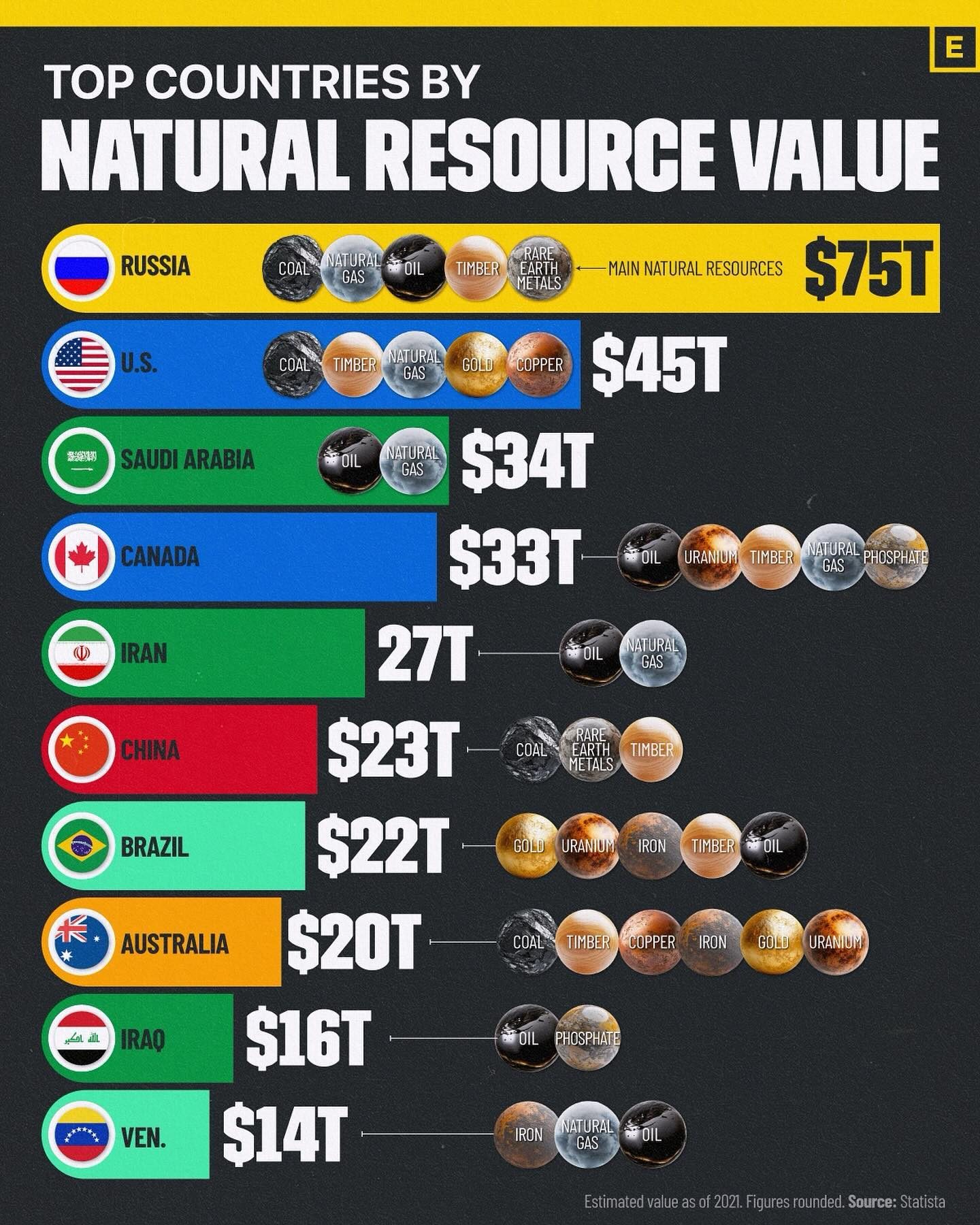
Natural resources play a crucial role in a country's economy and global standing. This infographic provides a glimpse into the top 10 countries with the highest natural resource value. Topping the list is Russia, followed by the United States, Saudi Arabia, and others. Understanding the distribution and value of these resources offers insights into global economic dynamics and strategic advantages.
The Top Countries
Russia leads the pack with a staggering $75 trillion in natural resources. This vast wealth is primarily driven by its abundant reserves of coal, natural gas, oil, and rare earth metals. These resources not only fuel Russia's domestic economy but also make it a significant player on the global stage. The country's rich deposits of rare earth metals, in particular, are highly coveted for their use in advanced technologies.
Following closely is the United States, with an estimated $45 trillion in natural resources. The U.S. boasts a diverse range of resources, including coal, timber, and natural gas. This diversity is a key strength, allowing the country to maintain a robust and resilient economy. The presence of substantial timber resources also highlights the importance of sustainable forestry practices in maintaining economic stability.
Saudi Arabia, known for its vast oil reserves, comes in third with $34 trillion. Oil and natural gas are the backbone of Saudi Arabia's economy, driving both domestic growth and international influence. The country's strategic investments in infrastructure and technology further enhance its position as a global energy powerhouse.
Canada, with $33 trillion, ranks fourth. The country is rich in oil, uranium, timber, and natural phosphate. These resources support a wide range of industries, from energy production to agriculture. Canada's commitment to sustainable resource management is also noteworthy, as it seeks to balance economic growth with environmental responsibility.
Iran, with $27 trillion, is next on the list. The country's economy is heavily reliant on oil and natural gas, which account for a significant portion of its natural resource value. Iran's strategic location and vast energy reserves make it a key player in global energy markets.
China, valued at $23 trillion, is rich in coal, rare earth metals, and timber. China's vast coal reserves are particularly important, as they fuel the country's industrial sector. The country's dominance in rare earth metals is also a critical factor in its global economic strategy, as these metals are essential for modern technologies.
Brazil, with $22 trillion, is endowed with gold, uranium, iron, timber, and oil. These resources support a diverse range of industries, from mining to energy production. Brazil's rich timber reserves also highlight the importance of sustainable forestry practices in maintaining the country's economic stability.
Australia, valued at $20 trillion, is known for its coal, timber, copper, iron, gold, and uranium. The country's abundant mineral resources make it a key player in global mining and energy markets. Australia's strategic investments in renewable energy also position it as a leader in sustainable resource management.
Iraq, with $16 trillion, is heavily reliant on oil and phosphate. The country's vast oil reserves are a critical factor in its economic development, driving both domestic growth and international trade. Iraq's strategic investments in infrastructure and technology further enhance its position as a global energy player.
Venezuela rounds out the top 10 with $14 trillion, primarily driven by its vast reserves of iron, natural gas, and oil. The country's rich oil reserves are a key factor in its economic development, supporting both domestic growth and international trade. Venezuela's strategic investments in energy infrastructure further enhance its position as a global energy player.
Context / Importance
Natural resources are the foundation of many countries' economies. They fuel industrialization, support agriculture, and drive technological advancements. Understanding the distribution and value of these resources is crucial for policymakers, investors, and businesses alike. It provides insights into global economic dynamics, strategic advantages, and potential areas for investment and development.
The value of natural resources is not static; it fluctuates with market conditions, technological advancements, and geopolitical factors. For instance, the demand for rare earth metals has surged due to their use in modern technologies, making countries with abundant reserves more valuable. Similarly, advancements in renewable energy technologies are changing the dynamics of the energy market, with countries rich in resources like uranium and timber becoming increasingly important.
Main Discussion
The Role of Oil and Gas
Oil and natural gas are two of the most valuable natural resources globally. They are essential for energy production, transportation, and industrial processes. Countries with abundant reserves of these resources, such as Saudi Arabia, Russia, and the United States, have significant economic and political influence.
Oil, in particular, is a strategic resource that drives global economies. It fuels transportation, heats homes, and powers industries. The demand for oil is expected to continue growing, driven by industrialization and urbanization in developing countries. However, the transition to renewable energy sources is also reshaping the energy landscape, with countries investing heavily in solar, wind, and other clean energy technologies.
The Significance of Rare Earth Metals
Rare earth metals are a group of 17 chemically similar elements that are crucial for modern technologies. They are used in everything from smartphones and electric vehicles to wind turbines and military equipment. China's dominance in rare earth metals gives it a strategic advantage in global markets, as these metals are essential for advanced technologies.
The demand for rare earth metals is expected to continue rising, driven by the growing adoption of green technologies and electronic devices. Countries with abundant reserves of these metals, such as Russia and China, are investing heavily in their production and processing. However, environmental concerns and geopolitical tensions are also shaping the global rare earth metals market, with countries seeking to diversify their supply chains and reduce dependence on a single source.
The Value of Coal and Timber
Coal and timber are two of the most abundant and versatile natural resources. They are used in a wide range of industries, from energy production to construction and manufacturing. Countries with vast reserves of coal, such as Russia, China, and the United States, have significant economic and political influence.
Coal is a critical source of energy, particularly in developing countries. It fuels power plants, heats homes, and powers industries. However, its use is also a major contributor to greenhouse gas emissions, raising concerns about climate change. Countries are increasingly investing in clean coal technologies and renewable energy sources to reduce their carbon footprint.
Timber, on the other hand, is a renewable resource that supports a wide range of industries, from construction and furniture making to paper production. Countries with abundant timber reserves, such as Canada, Brazil, and Australia, are investing in sustainable forestry practices to maintain their economic stability while protecting the environment.
Practical Tips for Investors and Businesses
Investing in natural resources can be highly lucrative, but it also comes with risks. Here are some practical tips for investors and businesses:
Diversify Your Portfolio
Natural resource investments can be volatile, with prices fluctuating due to market conditions and geopolitical factors. Diversifying your portfolio can help mitigate these risks. Invest in a mix of oil, gas, minerals, and timber to spread your risk and maximize potential returns.
Stay Informed
The natural resource market is dynamic, with new technologies and geopolitical shifts constantly reshaping the landscape. Stay informed about market trends, technological advancements, and geopolitical developments to make informed investment decisions.
Focus on Sustainability
Sustainable resource management is increasingly important, as countries and investors seek to balance economic growth with environmental responsibility. Invest in companies that prioritize sustainable practices and technologies, such as renewable energy, clean coal, and sustainable forestry.
Consider Long-term Growth
Natural resource investments often require a long-term perspective. Fluctuations in market prices and geopolitical risks can be challenging, so it’s essential to have a vision for long-term growth and sustainability.
Important Takeaways
The distribution and value of natural resources play a critical role in shaping global economies and geopolitics. Understanding the natural resource wealth of countries like Russia, the United States, Saudi Arabia, and others provides valuable insights into their economic and strategic strengths.
Resource Diversity Matters
Countries with diverse natural resources, such as the United States and Canada, are better positioned to adapt to changing market conditions and technological advancements. A diverse resource base provides resilience and flexibility, allowing countries to navigate economic and geopolitical challenges more effectively.
Strategic Investments
Investing in natural resources requires a strategic approach. Diversifying portfolios, staying informed, and prioritizing sustainability are key principles for successful investments. Long-term vision and adaptability are also crucial, as the natural resource market is dynamic and subject to various risks and opportunities.
Global Interdependence
The natural resource market is highly interconnected, with trends and events in one region influencing markets and economies globally. Geopolitical tensions, technological advancements, and environmental concerns are all factors that shape the global natural resource landscape. Understanding these interdependencies is essential for making informed investment decisions.
Conclusion
The natural resource value of countries like Russia, the United States, Saudi Arabia, and others highlights the importance of these resources in driving economic growth and geopolitical influence. From the strategic value of oil and gas to the critical role of rare earth metals and timber, natural resources are at the heart of modern economies. Investors, businesses, and policymakers must stay informed, diversify their portfolios, and prioritize sustainability to navigate the complexities of the natural resource market. By understanding the distribution and value of natural resources, we can gain insights into global economic dynamics and strategic advantages, paving the way for informed and responsible investment decisions.
Watch the Reel
Questions readers ask
What are the top 3 countries by natural resource value in 2021?
The top 3 countries are Russia, the United States, and Saudi Arabia. Russia leads with $75 trillion in natural resources, followed by the United States and Saudi Arabia. These countries are rich in various resources such as oil, gas, and minerals.
Which types of natural resources contribute to Russia's high ranking?
Russia's high ranking is primarily due to its vast reserves of coal, natural gas, oil, and rare earth metals. These resources are crucial for both domestic use and global exports, contributing significantly to Russia's economy and international influence.
How do oil and gas resources factor into the global rankings?
Oil and gas resources are pivotal in the global rankings. Countries with substantial reserves, like Saudi Arabia and the United States, benefit from the high demand and economic value of these resources. They contribute significantly to a nation's wealth and global standing.
Which countries are notable for their rare earth metal reserves?
Russia is one of the notable countries with significant rare earth metal reserves. These metals are essential for various technological applications, making them highly valuable in the global market.
Why is understanding the distribution of natural resources important?
Understanding the distribution of natural resources is crucial because it provides insights into global economic dynamics and strategic advantages. Countries with abundant resources often have stronger economies and more influence in international affairs.
Related deep dives
Similar reads based on topic and creator.

Recent articles
Fresh deep dives from the latest Reels we unpacked.




Comments
Be the first to comment.