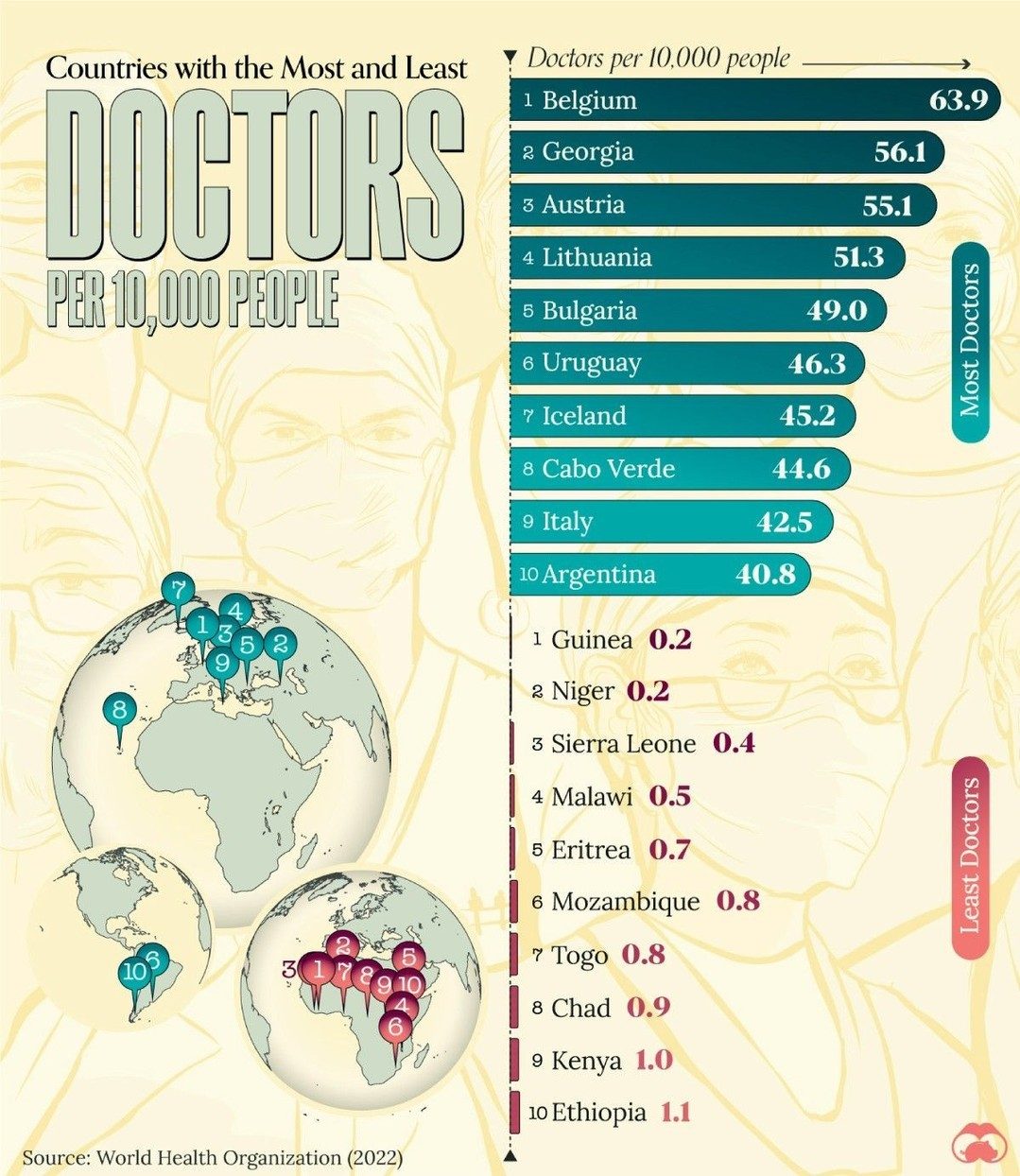
Doctors per Capita by Country
The distribution of doctors per capita varies significantly around the world, reflecting disparities in healthcare access and investment. This analysis highlights the countries with the highest and lowest doctor densities, offering insights into global healthcare landscapes.
Context / Why this matters
Understanding the distribution of doctors per capita is crucial for assessing healthcare access and planning. High doctor density often correlates with better healthcare outcomes, while low density can indicate underserved populations. This data helps identify areas needing improved healthcare infrastructure and workforce development.
Main discussion
Countries with the highest doctor density
The top countries with the most doctors per 10,000 people are:
- Belgium: Leading the list with 63.9 doctors per 10,000 people, Belgium has one of the highest doctor densities in the world. This high density reflects a strong healthcare system with extensive investment in medical education and infrastructure.
- Georgia: Following closely with a significant number of doctors, Georgia demonstrates a robust healthcare workforce.
- Austria, Lithuania, and Bulgaria: These countries also rank high in doctor density, indicating well-developed healthcare systems with ample medical personnel.
- Uruguay, Iceland, and Cabo Verde: These nations, though geographically diverse, share a notable doctor density, with Cabo Verde standing out as the highest in Africa.
These countries' high doctor densities likely contribute to better healthcare access and outcomes for their populations.
Countries with the lowest doctor density
The countries with the lowest doctor densities are primarily in Africa:
- Guinea: With a mere 0.2 doctors per 10,000 people, Guinea faces significant challenges in healthcare access and delivery. The low doctor density underscores the urgent need for healthcare infrastructural development.
- Niger, Sierra Leone, and Malawi: These countries also struggle with very low doctor densities, highlighting the critical need for investment in medical education and healthcare systems.
- Eritrea, Mozambique, Togo, Chad, Kenya, and Ethiopia: These nations round out the list of countries with the lowest doctor densities, indicating widespread healthcare access issues across the continent.
The low doctor densities in these countries can be attributed to various factors, including limited medical education opportunities, economic constraints, and ongoing conflicts or political instability.
Cabo Verde: An African Exception
Cabo Verde, a small nation of 10 islands off the coast of Africa, stands out with a notable 44.6 doctors per 10,000 people. This figure is significantly higher than other African countries on the list, reflecting Cabo Verde's investments in healthcare and medical education.
Practical tips
For countries aiming to improve their doctor density, several practical steps can be taken:
- Invest in Medical Education: Increasing the number of medical schools and scholarships can help train more doctors and attract healthcare professionals.
- Attract and Retain Talent: Offering competitive salaries, better working conditions, and career development opportunities can help retain medical professionals.
- Leverage Technology: Telemedicine and other digital health solutions can extend healthcare access to underserved areas, complementing the work of available doctors.
Important takeaways
- Global Disparities: The significant variation in doctor densities highlights global disparities in healthcare access and investment.
- Africa's Challenges: Most countries with the lowest doctor densities are in Africa, underscoring the continent's healthcare challenges.
- Investment and Development: Improving doctor densities requires investment in medical education, infrastructure, and technology.
- Cabo Verde's Progress: Cabo Verde demonstrates that even small, resource-limited countries can make significant strides in healthcare development.
Conclusion
The distribution of doctors per capita offers valuable insights into global healthcare landscapes. While some countries excel in providing ample medical personnel, others face significant challenges. Addressing these disparities requires targeted investments, education, and innovative solutions to ensure better healthcare access for all.
Watch the Reel
Questions readers ask
Which country has the highest number of doctors per capita?
According to recent data, Cabo Verde, a small island nation off the coast of West Africa, has the highest number of doctors per capita. This high doctor density is particularly notable given the country's size and resources, making it a standout in global healthcare access.
What factors contribute to a country having a high or low doctor density?
Several factors can influence a country's doctor density, including healthcare investment, medical training programs, and population size. High doctor density often correlates with better healthcare outcomes, while low density can indicate underserved populations or a need for improved healthcare infrastructure and workforce development.
Which countries have the lowest doctor density?
Countries with the lowest doctor density often face significant challenges in healthcare access. Nations such as Niger, Senegal and Seychelles have some of the lowest doctor population ratios. These disparities can highlight areas needing improved healthcare infrastructure and workforce development.
How does the distribution of doctors per capita vary around the world?
The distribution of doctors per capita varies greatly around the world, with some countries having a high concentration of doctors while others have a notably low ratio. This variation reflects disparities in healthcare access, investment, and infrastructure, offering insights into global healthcare landscapes.
Why is it important to analyze the global doctor density?
Analyzing global doctor density is important for assessing healthcare access and planning. High doctor density often correlates with better healthcare outcomes, and low density can indicate underserved populations. This data helps identify areas needing improved healthcare infrastructure and workforce development, and can be a particularly useful tool for health organizations and policymakers.
What can be inferred from the 2022 Health Organization report about healthcare access worldwide?
The 2022 Health Organization report provides valuable insights into global healthcare access by highlighting the countries with the highest and lowest doctor densities. This information can help international bodies and policymakers to understand and address healthcare disparities, fostering better resource allocation and improving healthcare delivery in underserved regions.
How do small nations fare in terms of doctor population ratio?
Small nations often exhibit unique trends in doctor population ratios. Some small countries, like Cabo Verde, have surprisingly high doctor densities, while others face significant challenges. This variability highlights the importance of considering both population size and healthcare investment when assessing global healthcare access.
Recent articles
Fresh deep dives from the latest Reels we unpacked.




Comments
Be the first to comment.