Endangered Languages: A Global Perspective
Over 88 million people speak languages that are at risk of extinction. These languages represent 43% of the world's 7,168 living languages. The majority of these endangered languages are spoken in Indigenous communities, making cultural and knowledge loss a serious concern. Understanding the global landscape of endangered languages and the regions most affected can help raise awareness and spark initiatives to preserve these vital forms of human expression.
Why This Matters
Endangered languages are more than just a means of communication; they are repositories of unique cultural knowledge, traditions, and worldviews. When a language dies, a piece of human heritage is lost forever. Indigenous communities often rely on their languages to maintain their cultural identity, environmental knowledge, and social cohesion. The loss of these languages can lead to the erosion of traditional practices, the disappearance of unique cultural practices, and the degradation of ecological knowledge.
The Global Distribution of Endangered Languages
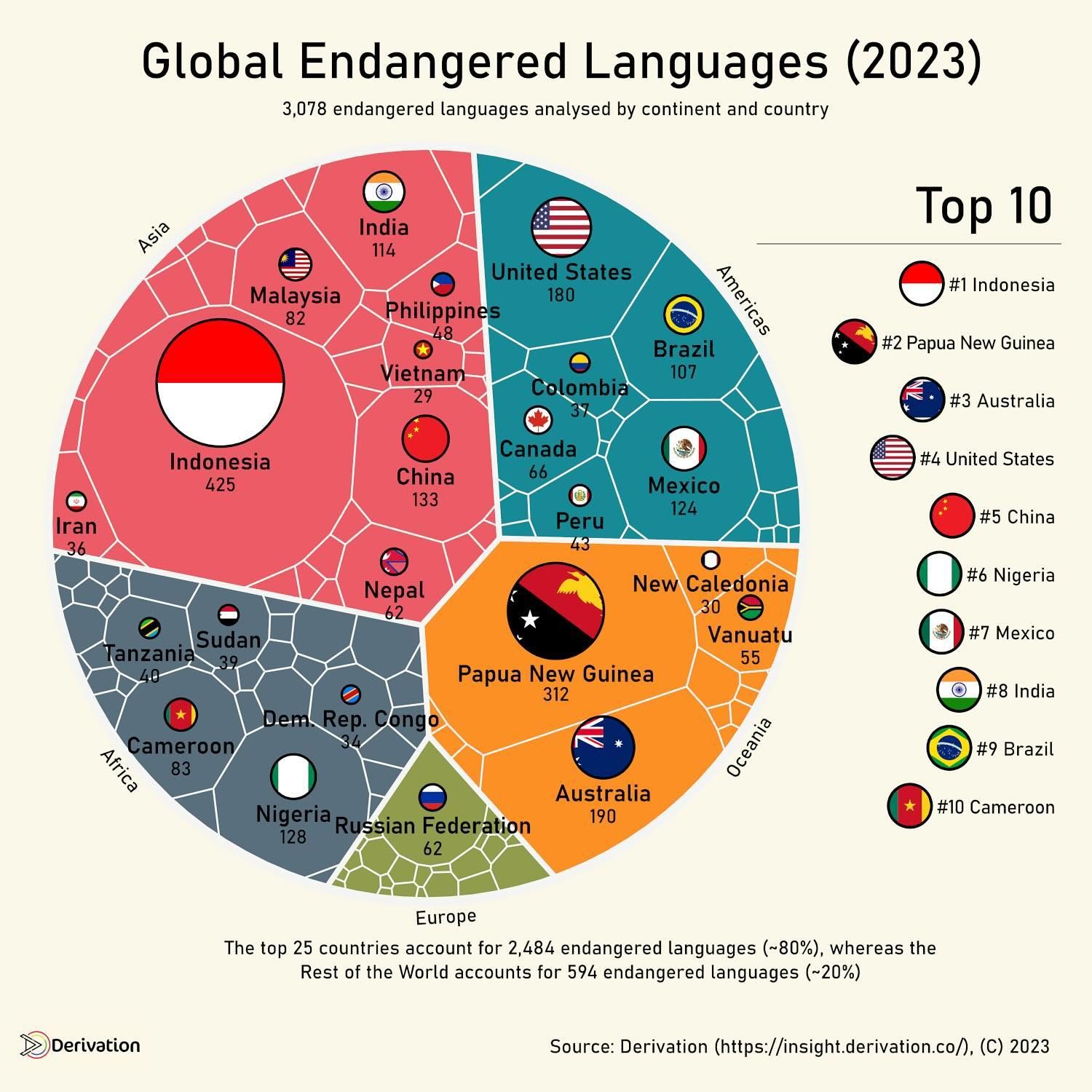
The data visualization highlights the distribution of endangered languages across different continents and countries. By analyzing 3,078 endangered languages, it becomes clear that the top 25 countries account for approximately 80% of all endangered languages worldwide. This concentration underscores the critical need for targeted efforts in these regions.
Regions with the Highest Concentration of Endangered Languages
Asia
Asia is home to a significant number of endangered languages. Countries like Indonesia, Papua New Guinea, and India are among the top hotspots. Indonesia, for instance, has the highest number of endangered languages, with 425 languages at risk. This is likely due to its vast archipelago, which has given rise to a diverse array of linguistic and cultural groups. Papua New Guinea and India follow closely, each with a rich linguistic heritage that is under threat.
Oceania
Oceania, particularly countries like Papua New Guinea, Australia, and Vanuatu, also has a high concentration of endangered languages. Papua New Guinea, which has the second-highest number of endangered languages, is a linguistic hotspot with over 800 languages, many of which are endangered. Its diverse geography and cultural makeup contribute to this linguistic diversity.
Americas
In the Americas, the United States, Colombia, Brazil, and Mexico stand out as countries with a significant number of endangered languages. The United States, for example, has a rich history of Indigenous languages, many of which are now at risk due to historical and cultural pressures. Mexico, with its extensive Indigenous population, is also a critical region for language preservation efforts.
Countries with the Highest Number of Endangered Languages
- Indonesia: With 425 endangered languages, Indonesia tops the list. The country's vast and diverse population, coupled with rapid modernization, poses significant threats to its linguistic diversity.
- Papua New Guinea: This Pacific nation has the second-highest number of endangered languages, with over 800 languages spoken. Its unique cultural and geographical diversity is both a blessing and a challenge for language preservation.
- Australia: Australia's rich Indigenous heritage is reflected in its numerous endangered languages. The country has a long history of cultural and linguistic diversity, much of which is now at risk.
- United States: The United States is home to many Indigenous languages, many of which are at risk of extinction. Efforts to revitalize these languages are critical to preserving the cultural heritage of Native American communities.
- China: China's vast population and diverse regions contribute to its significant number of endangered languages. The country's rapid modernization and urbanization pose challenges to linguistic diversity.
- Nigeria: Nigeria, with its diverse ethnic and linguistic landscape, has a substantial number of endangered languages. The country's rich cultural heritage is under threat from various socio-economic factors.
- Mexico: Mexico's Indigenous communities have a rich linguistic heritage, much of which is now at risk. The country's history of colonization and modernization has led to the decline of many Indigenous languages.
- India: India's linguistic diversity is unparalleled, with numerous languages and dialects spoken across the country. However, many of these languages are at risk due to socio-economic pressures and cultural shifts.
- Brazil: Brazil's Indigenous communities face significant challenges in preserving their languages. The country's vast Amazon region is home to many endangered languages, each with unique cultural and environmental knowledge.
- Cameroon: Cameroon's linguistic diversity is a result of its rich cultural heritage and geographical location. The country's numerous Indigenous languages are under threat from various socio-economic factors.
Practical Tips for Language Preservation
Preserving endangered languages requires a multi-faceted approach that involves communities, governments, and international organizations. Here are some practical steps that can be taken:
Community Involvement
Communities play a crucial role in language preservation. Encouraging the use of endangered languages in daily life, establishing language schools, and promoting cultural festivals can help revitalize these languages. Community-led initiatives often have the most significant impact, as they are tailored to the specific needs and contexts of the Indigenous groups.
Government Support
Governments can support language preservation through policies that promote linguistic diversity. This includes funding for language programs, creating legal protections for endangered languages, and supporting community-led initiatives. Governments can also play a role in raising awareness about the importance of linguistic diversity and the risks posed by language extinction.
Educational Programs
Educational programs that focus on endangered languages can help preserve these languages for future generations. This includes teaching endangered languages in schools, developing language learning materials, and training language teachers. Educational programs can also play a role in documenting and archiving endangered languages, ensuring that they are preserved for future generations.
Technological Innovations
Technology can be a powerful tool for language preservation. Digital platforms, mobile apps, and online resources can make language learning more accessible and engaging. For example, language learning apps can provide interactive lessons, while online communities can connect speakers of endangered languages from around the world.
Cultural Exchange
Cultural exchange programs can help promote linguistic diversity by fostering mutual understanding and appreciation for different languages and cultures. These programs can include language immersion experiences, cultural festivals, and international exchanges. By promoting cultural exchange, we can raise awareness about the importance of linguistic diversity and the risks posed by language extinction.
Important Takeaways
- Critical Numbers: With 3,078 endangered languages analyzed, it is clear that language preservation is a global priority. The top 25 countries account for approximately 80% of all endangered languages, highlighting the urgent need for targeted efforts in these regions.
- Indigenous Communities: The majority of endangered languages are spoken in Indigenous communities, making cultural and knowledge loss a serious concern. Efforts to preserve these languages must involve and support Indigenous communities.
- Diverse Solutions: Preserving endangered languages requires a multi-faceted approach that involves communities, governments, and international organizations. Community involvement, government support, educational programs, technological innovations, and cultural exchange can all play a role in language preservation.
Conclusion
The global landscape of endangered languages is a complex and pressing issue. By understanding the distribution of these languages and the regions most affected, we can take steps to preserve this vital aspect of human heritage. Efforts to revitalize and preserve endangered languages are crucial for maintaining cultural diversity, promoting social cohesion, and preserving the unique knowledge and traditions of Indigenous communities. Through community involvement, government support, educational programs, technological innovations, and cultural exchange, we can work towards a future where linguistic diversity is valued and celebrated.
Watch the Reel
Questions readers ask
What are the primary causes of language endangerment worldwide?
Language endangerment is primarily caused by globalization, cultural assimilation, lack of intergenerational transmission, and the dominance of major languages. These factors contribute to the decline of lesser-known languages, particularly in regions like Asia, Indonesia, and Papua New Guinea.
Which countries house the largest number of endangered languages?
Asia, Indonesia, Papua New Guinea, and India are among the top countries with the highest number of endangered languages. These regions are hotspots for language diversity and cultural heritage, making them critical areas for preservation efforts.
How many languages are at risk of extinction globally?
Currently, approximately 43% of the world's 7,168 living languages are at risk of extinction. This means that over 88 million people speak languages that are threatened, highlighting the urgent need for global language preservation initiatives.
What role do Indigenous communities play in language preservation?
Indigenous communities are often the custodians of endangered languages. These communities hold unique cultural knowledge, traditions, and worldviews that are deeply intertwined with their languages. Supporting these communities is vital for preserving this heritage.
What are some hotspots for language extinction, and why are they important?
Hotspots for language extinction include Asia, Indonesia, Papua New Guinea, and India. These regions are important because they host a significant number of the world's endangered languages, making them critical for efforts aimed at preserving not only linguistic diversity but also the cultural and environmental knowledge embedded in these languages.
Why is it important to preserve endangered languages?
Preserving endangered languages is crucial because they are repositories of unique cultural knowledge, traditions, and worldviews. When a language dies, a piece of human heritage is lost forever, affecting not just the speakers but the collective human experience.
Related deep dives
Similar reads based on topic and creator.




Recent articles
Fresh deep dives from the latest Reels we unpacked.




Comments
Be the first to comment.