Mining Export Dependence: A Global Perspective
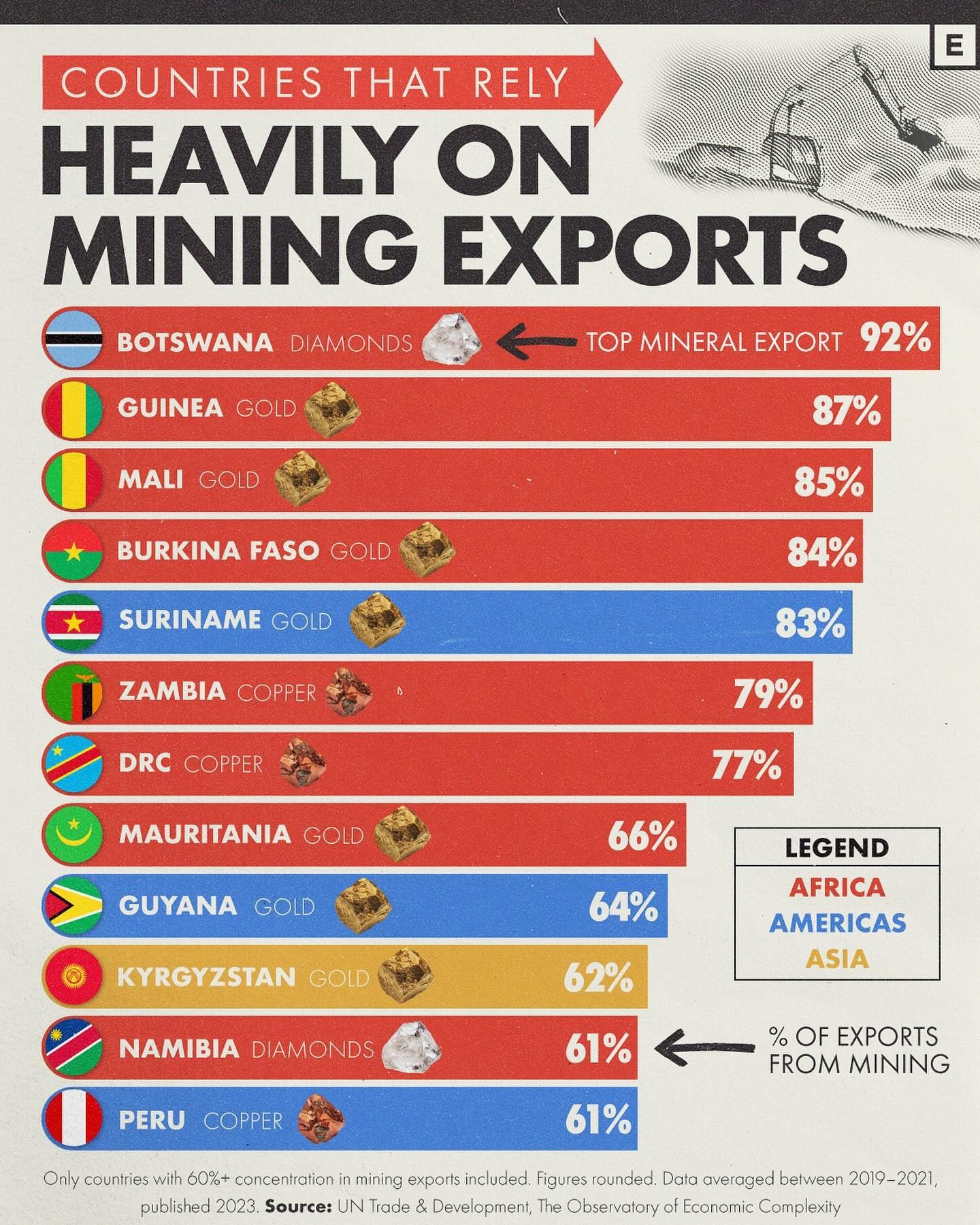
Mining export dependence is a critical factor in the economies of many countries worldwide. This reliance on mineral resources for export revenue shapes economic policies, influences development strategies, and impacts global trade dynamics. Around 90% of Botswana’s exports, for instance, are concentrated in mining, making it the most mineral resource-dependent country globally. This high level of dependence is not unique to Botswana; seven out of the top ten countries whose exports are predominantly mining-based are African.
Context / Why this matters
Understanding which countries rely heavily on mining exports is crucial for grasping the broader economic and geopolitical landscape. Mining exports often drive significant portions of a country's GDP, influencing everything from infrastructure development to social welfare programs. This reliance can be both a boon and a challenge, offering substantial revenue but also creating vulnerabilities to market fluctuations and global demand shifts.
Main discussion
Mineral Resources and Economic Dependence
The countries that heavily rely on mining exports span multiple continents, including Africa, the Americas, and Asia. These nations include Botswana, Guinea, Mali, Burkina Faso, Suriname, Zambia, DRC, Mauritania, Guyana, Kyrgyzstan, Namibia, and Peru. Each of these countries has a significant portion of its export revenue tied to specific minerals.
Africa's Mining Powerhouses
Africa is home to several of the world's most mining-dependent economies. Botswana, for example, relies on diamonds for 92% of its exports. This extreme dependence underscores the critical role of the diamond industry in the country's economic stability. Guinea and Mali, on the other hand, are heavily reliant on gold exports, with 87% and 85% of their exports, respectively, coming from this precious metal. Other African nations, such as Burkina Faso, Suriname, Zambia, and DRC, also have significant mining export dependencies, primarily focused on gold and copper.
Beyond Africa: Mining in the Americas and Asia
While Africa dominates the list, other regions also have countries with substantial mining export dependencies. Suriname and Guyana, both in South America, rely heavily on gold exports. Suriname's 79% and Guyana's 77% export reliance on gold highlights the economic importance of this resource in these countries. Peru, another significant player in the Americas, derives 61% of its exports from copper. This reliance on copper is a testament to the mineral's critical role in the global economy, particularly in industrial and technological applications.
In Asia, Kyrgyzstan's 62% dependence on gold exports illustrates the region's involvement in the global mining industry. Similarly, Namibia, with 61% of its exports coming from diamonds, highlights the country's critical reliance on this precious stone.
The Role of Diamonds, Gold, and Copper
Diamonds, gold, and copper are among the most valuable minerals driving these economies. Diamonds, known for their rarity and value, are a significant export for countries like Botswana and Namibia. Gold, equally valuable, is crucial for Guinea, Mali, Burkina Faso, Suriname, Mauritania, Guyana, and Kyrgyzstan. Copper, essential for industrial applications, is vital for Zambia, DRC, and Peru.
These minerals not only drive export revenues but also shape the economic policies and development strategies of these countries. The mining industry often attracts foreign investment, creates employment opportunities, and drives infrastructure development. However, reliance on these resources also exposes countries to the volatility of global commodity markets, requiring robust economic diversification strategies.
Practical tips
Diversifying Economies
To mitigate the risks associated with mining export dependence, countries can focus on economic diversification. This involves investing in other sectors such as agriculture, manufacturing, and services. Diversifying the economy can help reduce reliance on a single resource, making the country more resilient to global market fluctuations.
Strengthening Infrastructure
Investing in infrastructure can also help countries maximize the benefits of their mineral resources. Improved transportation networks, for example, can facilitate the efficient movement of goods to ports and markets. Additionally, developing local processing capabilities can add value to raw minerals, increasing export revenues.
Promoting Sustainable Mining Practices
Sustainable mining practices are crucial for the long-term viability of the mining industry. This includes implementing environmental regulations to mitigate the environmental impact of mining activities. Countries can also benefit from promoting social responsibility in the mining sector, ensuring that local communities benefit from mining operations.
Building Strategic Partnerships
Building strategic partnerships with other countries and international organizations can help mining-dependent countries navigate the complexities of global trade. These partnerships can provide access to technology, markets, and investments, supporting sustainable economic growth.
Important takeaways
The economic landscape of many countries is significantly shaped by their reliance on mining exports. From diamonds to gold and copper, these resources drive export revenues and influence economic policies. While this dependence can bring substantial benefits, it also poses challenges, particularly in the form of market volatility and global demand fluctuations. Economic diversification, sustainable mining practices, and strategic partnerships are key to mitigating these risks and promoting sustainable economic growth.
Conclusion
Mining export dependence is a complex issue with far-reaching implications for global trade and economic development. Understanding which countries rely heavily on these exports and the specific minerals driving their economies provides valuable insights into the global economic landscape. By focusing on economic diversification, strengthening infrastructure, promoting sustainable mining practices, and building strategic partnerships, countries can navigate the challenges of mining export dependence and achieve sustainable economic growth.
Watch the Reel
Questions readers ask
Which country is the most dependent on mining exports?
Botswana is the most dependent on mining exports, with approximately 90% of its exports coming from mining. This high level of dependence significantly influences the country's economy and its role in global trade dynamics.
What are the primary minerals exported by Guinea and Mali?
Guinea is renowned for its bauxite exports, which is a key component in the production of aluminum. Mali, on the other hand, is a significant exporter of gold, contributing substantially to its export revenue.
How does the reliance on mining exports affect global trade dynamics?
Countries that rely heavily on mining exports are particularly vulnerable to global market fluctuations. This dependence can lead to economic instability during periods of low commodity prices, affecting not only the exporting countries but also the global trade dynamics.
Which other African countries, besides Botswana, Guinea, and Mali, are heavily reliant on mining exports?
Other African countries that significantly rely on mining exports include Burkina Faso, which is known for its gold exports; Suriname, with its bauxite and gold; Zambia, a major copper exporter; and the Democratic Republic of Congo, which exports a variety of minerals, including cobalt and copper.
What are the economic risks associated with a high dependence on mining exports?
High dependence on mining exports can lead to economic instability due to price volatility in global markets. Countries relying heavily on mining may experience economic booms during high commodity prices and severe downturns during market slumps, impacting their overall economic health and development strategies.
How does the mining industry in Africa influence the continent's trade relationships?
The mining industry in Africa significantly influences the continent's trade relationships by driving a large portion of export revenue. Countries like Botswana and Zambia, which rely heavily on mining exports, often form strategic trade alliances and partnerships with countries that require their mineral resources, shaping Africa's role in global trade.
What measures can countries take to reduce their reliance on mining exports?
Countries can diversify their economies by investing in other sectors such as manufacturing, agriculture, and technology. Additionally, they can implement policies that promote sustainable mining practices and develop infrastructure to support other industries, thereby reducing their vulnerability to market fluctuations in the mining sector.
Recent articles
Fresh deep dives from the latest Reels we unpacked.




Comments
Be the first to comment.