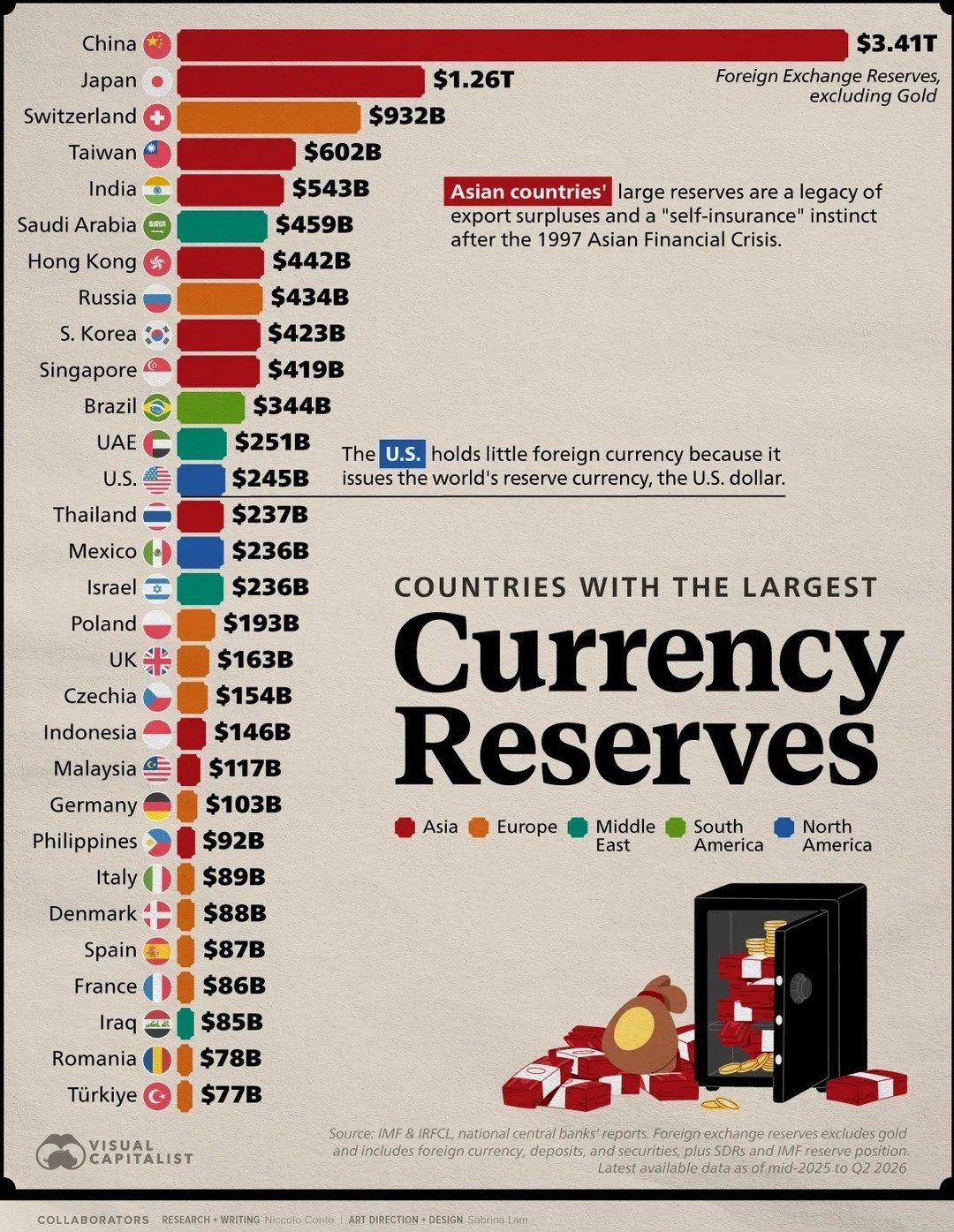
Foreign Currency Reserves
Foreign currency reserves play a pivotal role in global finance, serving as a critical economic indicator and a tool for central banks to manage monetary policy. These reserves, held by central banks and monetary authorities, are comprised of foreign currency, deposits, and securities, as well as Special Drawing Rights (SDRs) and the IMF reserve position.
Why This Matters
High levels of foreign currency reserves can provide a safety net during economic uncertainty, support exchange rate stability, and facilitate international trade. The distribution of these reserves among countries offers insights into global economic dynamics and the strategies employed by different nations to maintain financial stability.
Main Discussion
Regional Dominance in Asia
Asia stands out as a dominant region in terms of foreign currency reserves. Seven of the ten countries with the largest reserves are located in Asia. Leading the pack is China, which holds an impressive $3.41 trillion in reserves. This amount is nearly three times the reserves held by Japan, the second-largest holder in the region with $1.26 trillion. The substantial reserves in Asia reflect decades of export-led growth, where countries have accumulated significant foreign exchange earnings.
China's reserves are particularly noteworthy. As the world's second-largest economy, China’s reserves are crucial for stabilizing its currency, the renminbi, and for influencing global markets. The country's export-oriented economy has historically generated substantial foreign exchange earnings, which are then used to build up these reserves.
Europe's Significant Holders
In Europe, notable countries with large reserves include Switzerland and Russia. Switzerland holds $932 billion, making it one of the leading reserve holders globally. The country’s reserves are critical for maintaining the stability of the Swiss franc, which is often seen as a safe-haven currency due to Switzerland's political and economic stability.
Russia, with $423 billion in reserves, also plays a significant role in global finance. Russia’s reserves have been particularly important for managing the impact of economic sanctions and maintaining financial stability amidst geopolitical tensions.
Middle East and South America
The Middle East is home to significant reserve holders, such as Saudi Arabia and the United Arab Emirates (UAE). Saudi Arabia holds $442 billion, while the UAE has $245 billion. These reserves are largely derived from oil revenues and are crucial for these countries to manage economic volatility and support development projects.
South America, although not typically associated with high reserves, has a few key players. Brazil, for instance, holds $251 billion, which is significant for a region often impacted by economic fluctuations.
The United States: A Unique Case
The United States, despite having the world’s largest economy, ranks only 13th in terms of foreign currency reserves. The U.S. holds $236 billion in reserves. This ranking is somewhat misleading, as the U.S. dollar serves as the world’s primary reserve currency. Due to the dollar's global acceptance, the U.S. does not need to hold as many reserves as other countries. The greenback’s status as a reserve currency provides the U.S. with significant financial flexibility and makes it a global economic powerhouse.
Key Reserve Holders
Several other countries have substantial reserves, each with unique economic contexts and strategic reasons for maintaining these reserves. Here is a detailed look at some of the key reserve holders:
Hong Kong
Hong Kong holds $434 billion in reserves. The city’s reserves are essential for maintaining its status as a global financial hub and for managing the volatility of the Hong Kong dollar, which is pegged to the U.S. dollar. Hong Kong's reserves also support its role as a key intermediary for global financial transactions.
India and Taiwan
India and Taiwan are significant reserve holders in Asia, with $459 billion and $543 billion, respectively. Both countries use their reserves to manage economic stability and to support their export-oriented economies. India’s reserves have been particularly important for managing the impact of global economic fluctuations and for funding development projects.
Singapore
Singapore holds $344 billion in reserves. The city-state’s reserves are crucial for maintaining the stability of its currency and for supporting its role as a global financial center. Singapore’s reserves are also used to fund its sovereign wealth fund, the Government of Singapore Investment Corporation (GIC), which invests globally to generate returns for future generations.
The Role of IMF Data
The data on foreign currency reserves is primarily sourced from the International Monetary Fund (IMF) and other international financial institutions. This data provides a comprehensive view of global reserves and is used by economists and policymakers to assess economic health and financial stability. The IMF’s reports are critical for understanding the dynamics of global finance and for making informed decisions on monetary policy.
Importance of Reserves in Global Stability
Foreign currency reserves are not just a measure of a country's wealth but also a critical tool for managing economic stability. High reserves can provide a buffer against financial crises, support currency stability, and facilitate international trade. For countries with export-oriented economies, these reserves are particularly important as they help manage the volatility of foreign exchange earnings.
Practical Tips
For individuals and businesses, understanding foreign currency reserves can provide insights into global economic trends and potential risks. Here are a few practical tips:
- Monitor Reserve Levels: Keep an eye on the foreign currency reserves of countries you do business with. Significant fluctuations can impact trade and financial stability.
- Diversify Investments: Given the importance of foreign reserves, consider diversifying your investments across different currencies and regions to mitigate risks.
- Stay Informed: Follow international financial news and reports from organizations like the IMF to stay updated on global financial trends and potential impacts on your investments.
Important Takeaways
Foreign currency reserves are a cornerstone of global finance, providing a measure of economic stability and financial resilience. The distribution of these reserves across regions reflects the unique economic strategies and challenges faced by different countries. Understanding the dynamics of foreign currency reserves can help individuals and businesses make informed decisions in an increasingly interconnected global economy.
Conclusion
Foreign currency reserves are a critical component of global finance, reflecting the economic health and stability of nations. From Asia's dominant hold on reserves to the unique position of the U.S. as the world's primary reserve currency holder, the distribution of these reserves offers valuable insights into global economic dynamics. By staying informed about foreign currency reserves, individuals and businesses can better navigate the complexities of the global financial landscape.
Watch the Reel
Questions readers ask
What are foreign currency reserves and why are they important?
Foreign currency reserves are assets held by a country's central bank or monetary authority in foreign currencies. They are important because they provide a safety net during economic uncertainty, support exchange rate stability, and facilitate international trade. High levels of these reserves can also influence global markets and indicate a country's economic strength.
Which country has the largest currency reserves in the world?
As of recent data, China holds the largest currency reserves. China's substantial reserves are a result of strategic economic policies and play a significant role in maintaining the country's economic stability and global influence.
How do countries like Japan and Switzerland manage their foreign exchange reserves?
Countries like Japan and Switzerland manage their foreign exchange reserves through strategic policies aimed at stabilizing their economies. This involves holding significant amounts of foreign currencies, deposits, securities, and other assets. These reserves are used to intervene in foreign exchange markets, manage exchange rates, and ensure economic stability during times of uncertainty.
What are Special Drawing Rights (SDRs) and how do they contribute to global currency reserves?
Special Drawing Rights (SDRs) are an international type of monetary reserve currency created by the IMF to supplement its member countries' official reserves. They contribute to global currency reserves by providing an additional layer of liquidity and stability, enabling countries to access foreign exchange in times of need. SDRs are especially useful for countries facing balance of payments issues or economic crises.
How do middle eastern countries utilize their currency reserves?
Middle Eastern countries, known for their significant oil revenues, often utilize their currency reserves to stabilize their economies, diversify their economic portfolios, and maintain financial stability. These reserves are crucial for managing fluctuations in oil prices and ensuring economic resilience. Additionally, they may invest in global markets to generate returns and support long-term economic growth.
What role do the United States' currency reserves play in the global economy?
The United States holds a substantial amount of currency reserves, which play a significant role in the global economy. These reserves help stabilize the U.S. dollar, which is the world's primary reserve currency. This status allows the U.S. to influence global markets, facilitate international trade, and provide liquidity to the global financial system.
How do Asian countries, aside from China and Japan, leverage their currency reserves?
Asian countries, such as South Korea and Taiwan, leverage their currency reserves to maintain economic stability and support growth. These reserves are used to intervene in foreign exchange markets, manage exchange rates, and stabilize their economies during financial crises. Additionally, they invest in global markets to generate returns and diversify their economic portfolios, ensuring long-term financial health.
Recent articles
Fresh deep dives from the latest Reels we unpacked.




Comments
Be the first to comment.