Military Troop Deployment Statistics
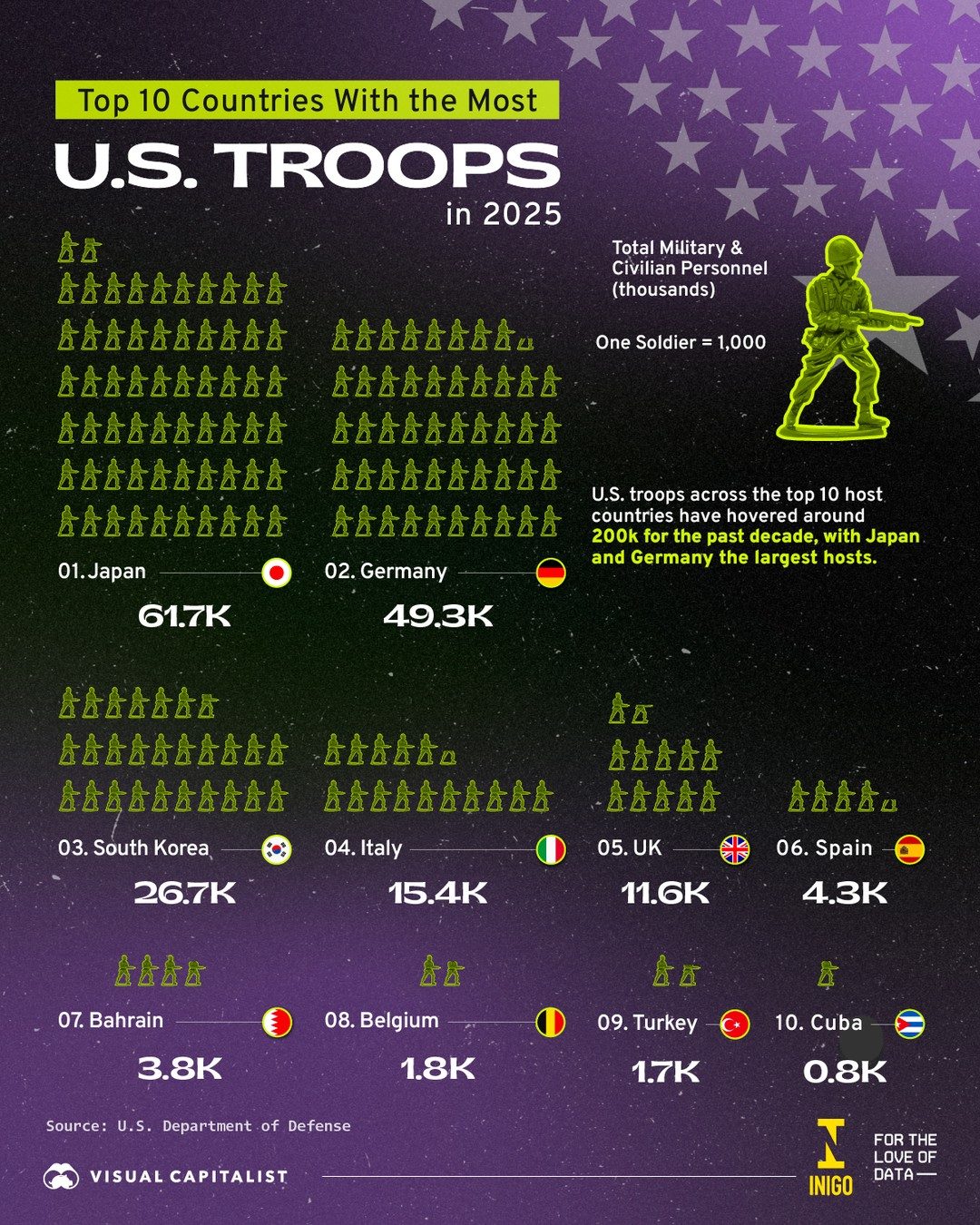
The global presence of U.S. military forces is substantial, with a significant concentration of troops stationed in a select few strategic countries. This deployment reflects the United States' geopolitical priorities and defense strategies. An infographic, created in partnership with Inigo Insurance, provides a visual overview of where U.S. troops are based and how this distribution has evolved over time.
Context / Why This Matters
Understanding the distribution of U.S. military personnel around the world is crucial for grasping the broader geopolitical landscape and the strategic priorities of the United States. The presence of troops in specific regions can have significant implications for international relations, security, and economic interests. By examining the top host countries and the number of troops stationed in each, we gain insights into the U.S.'s strategic focus and how it has remained relatively stable over the past decade.
Main Discussion
The Top 10 Host Countries
The United States maintains a robust military presence in several key countries. According to the infographic, the top 10 countries with the most U.S. troops in 2025 are:
- Japan - 61,700
- Germany - 49,300
- South Korea - 26,700
- Italy - 15,400
- United Kingdom - 8,400
- Spain - 3,800
- Bahrain
- Belgium
- Turkey
- Cuba
These countries form the backbone of the U.S.'s global military footprint, with Japan and Germany hosting the largest number of troops. Germany, which hosts 49,300 troops, is a crucial ally in Europe, reflecting the U.S.'s commitment to NATO and European security. The significant presence in Japan, with 61,700 troops, underscores the strategic importance of the Asia-Pacific region, particularly in light of tensions with North Korea and the ongoing regional dynamics.
Strategic Significance
The deployment of troops in these countries is not arbitrary. Each location serves a specific strategic purpose. For example, the presence of U.S. troops in South Korea is a direct response to the threat posed by North Korea. The troops in Italy and the UK support NATO operations and provide a forward-deployed presence in Europe. Spain and Turkey are key allies in the Mediterranean and Middle East, respectively, while Bahrain serves as a crucial base for operations in the Persian Gulf. These deployments reflect the U.S.'s commitment to maintaining stability and security in critical regions.
Stability Over Time
One of the most notable aspects of the infographic is the stability of troop numbers over the past decade. The total number of U.S. troops across the top 10 host countries has hovered around 200,000. This consistency indicates a deliberate and long-term strategic approach to military deployment. The relatively stable numbers suggest that the U.S. military has achieved a balance between maintaining a robust global presence and managing resources efficiently.
Practical Tips
Analyzing Troop Deployments
For those interested in understanding global military strategies, analyzing troop deployments can provide valuable insights. Here are some practical tips for analyzing these statistics:
- Geopolitical Context: Always consider the geopolitical context of each deployment. Why are troops stationed in a particular country? What regional threats or alliances are at play?
- Historical Trends: Look at historical data to understand how troop numbers have changed over time. This can help identify long-term trends and shifts in strategy.
- Regional Dynamics: Examine the regional dynamics and how they influence troop deployment. For example, the presence of troops in Japan and South Korea is closely tied to the ongoing tensions with North Korea.
- Alliance and Partnerships: Understand the role of alliances and partnerships. The U.S. often stations troops in countries that are key allies or strategic partners, such as Germany and the UK.
Using Visual Aids
Visual aids, such as the infographic from Visual Capitalist, can be incredibly useful for grasping complex data. Here’s how you can make the most of them:
- Visual Representations: Use visual representations, like maps and charts, to understand the distribution of troops. These can quickly convey the scale and scope of deployments.
- Comparative Analysis: Compare troop numbers across different regions and countries. This can help identify patterns and priorities.
- Interactive Tools: If available, use interactive tools that allow you to explore the data in more detail. These can provide deeper insights and customizable views.
Important Takeaways
- Strategic Focus: The top 10 host countries for U.S. troops highlight the strategic focus areas, including Europe, the Asia-Pacific, and the Middle East.
- Stability and Consistency: The stability in troop numbers over the past decade indicates a consistent and deliberate strategic approach by the U.S. military.
- Geopolitical Significance: The presence of troops in specific countries reflects broader geopolitical priorities and security concerns.
Conclusion
The global deployment of U.S. troops is a complex and multifaceted issue that reflects the United States' strategic priorities and geopolitical concerns. By examining the top 10 host countries and the number of troops stationed in each, we gain valuable insights into the U.S.'s military strategy and its commitment to maintaining global security. Understanding this data can help inform discussions about international relations, security, and the strategic priorities of the United States.
Watch the Reel
Questions readers ask
Which countries will host the most U.S. troops in 2025?
The top countries hosting the most U.S. troops in 2025 include Japan and Germany, along with several other nations that are strategically important for U.S. defense priorities. The exact list can vary based on geopolitical developments, but these countries consistently rank high due to their significance in global security.
Why are Japan and Germany significant locations for U.S. troops?
Japan and Germany are key locations for U.S. troops due to their strategic geopolitical positions. Japan is crucial for maintaining stability in the Asia-Pacific region, while Germany plays a vital role in European security and NATO operations. These countries provide a strong military foothold in critical regions.
How does the distribution of U.S. troops reflect global military strategy?
The distribution of U.S. troops reflects a strategic balance aimed at protecting U.S. interests and allies worldwide. By concentrating forces in specific regions, the U.S. can respond quickly to potential threats, support key allies, and ensure stability in volatile areas. This deployment also supports global defense strategies and international relations.
What factors influence the number of U.S. troops stationed in each country?
The number of U.S. troops stationed in each country is influenced by several factors, including regional security threats, the need to support alliances, and the availability of military infrastructure. Additionally, the U.S. considers the political and economic stability of the host country, as well as the overall global defense strategy.
How has the global presence of U.S. military forces changed over time?
The global presence of U.S. military forces has evolved in response to changing geopolitical dynamics. Over the years, the U.S. has adjusted the number and location of its troops to address emerging threats, support new allies, and adapt to shifts in global power. This flexibility is essential for maintaining an effective and responsive military footprint around the world.
What role do U.S. military bases play in global security?
U.S. military bases around the world serve as critical hubs for global security operations. They provide logistical support, enable rapid deployment of forces, and facilitate collaboration with allied nations. These bases are essential for maintaining a strong global military presence and ensuring the U.S. can respond effectively to crises and threats.
What are the implications of the U.S. military presence in host countries?
The U.S. military presence in host countries can have significant implications for both the host nation and the U.S. These implications include enhanced security cooperation, economic benefits through military spending, and potential political tensions. Additionally, the presence of U.S. troops can influence regional dynamics and contribute to geopolitical stability or instability, depending on the context.
Related deep dives
Similar reads based on topic and creator.


Recent articles
Fresh deep dives from the latest Reels we unpacked.




Comments
Be the first to comment.