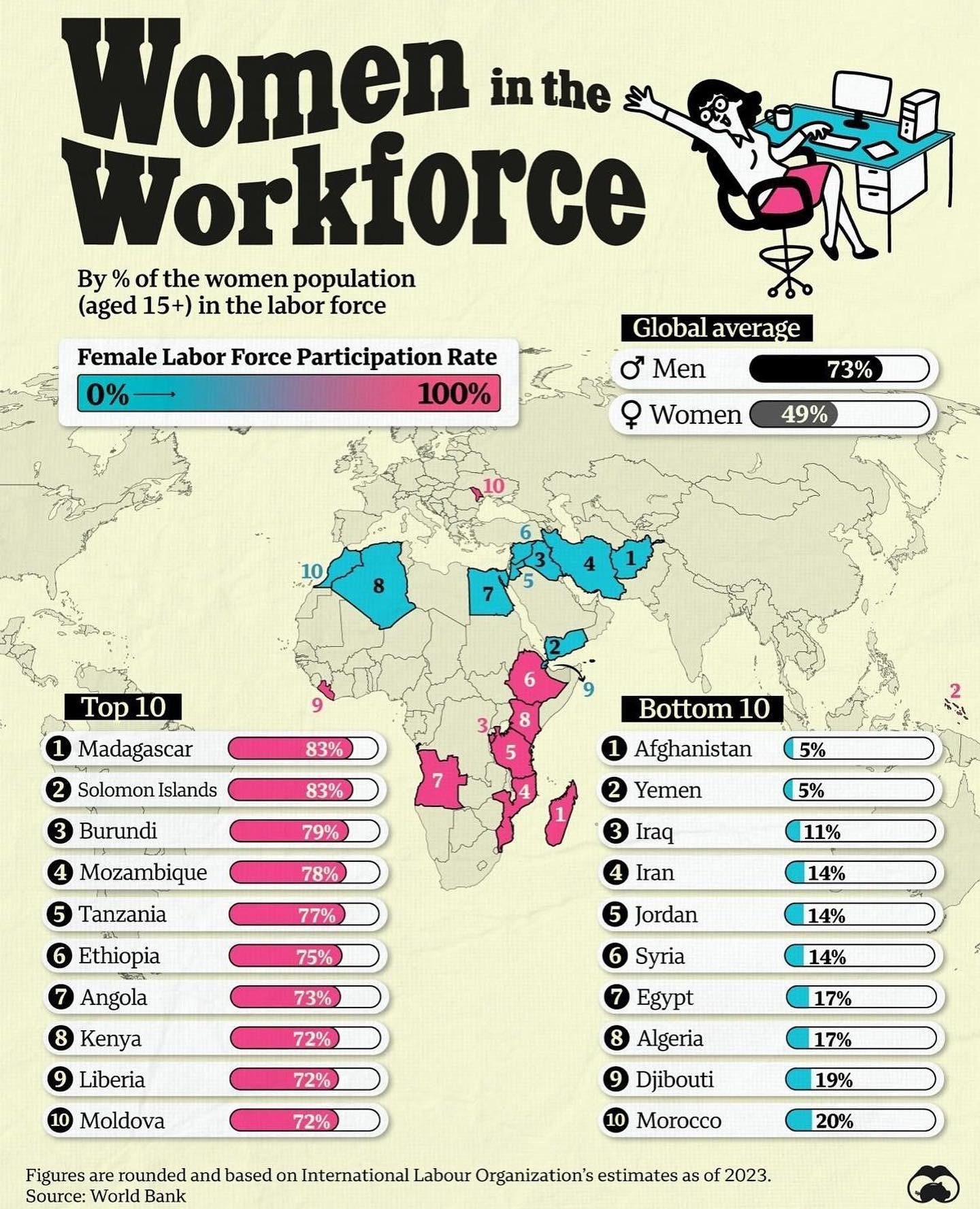
Understanding the global landscape of women in the workforce is crucial for appreciating the diverse economic contributions and challenges faced by women around the world. The female labor force participation rate varies significantly from one country to another, reflecting cultural, economic, and social factors. This article delves into the top and bottom 10 countries ranked by their female labor force participation rates, providing insights into the global trends and specific regional dynamics.
Top 10 Countries with the Highest Female Labor Force Participation
Leading Examples
Madagascar and the Solomon Islands stand out as leaders, with over 80% of women aged 15 and above actively engaged in the labor force. These countries showcase high levels of female participation, indicating robust economic involvement and opportunities for women. Liberia closely follows with an 83% participation rate, making it another notable leader in the region.
Sub-Saharan Africa
Several African nations, including Tanzania, Ethiopia, and Kenya, rank high in female labor force participation. Tanzania boasts a 77% rate, highlighting strong female involvement in the economy. Ethiopia and Kenya, with 75% and 72% respectively, also demonstrate significant contributions from women.
Eastern Europe and Beyond
Moldova, with a 72% participation rate, is another standout. This country's high figures suggest a strong emphasis on gender equality in the workforce. The presence of countries like Moldova and Angola (73%) in the top ranks reflects diverse global trends, as these countries are not typically associated with the highest female labor force participation rates.
Bottom 10 Countries with the Lowest Female Labor Force Participation
Struggles in the Middle East
Afghanistan and Yemen stand at the bottom of the list, with a dismal 5% female labor force participation rate. This stark contrast to the top-ranking countries underscores significant challenges and barriers for women in these regions. Economic instability and cultural norms are likely significant contributors to these low rates.
Regional Challenges
Countries like Iraq, Iran, and Algeria, with participation rates of 11%, 14%, and 14% respectively, face considerable challenges in integrating women into the labor force. Syria, Egypt, and Djibouti, with rates of 14%, 17%, and 19% respectively, also demonstrate significant barriers to female labor force participation.
Global Trends and Comparisons
Gender Disparities
The global average for female labor force participation stands at 49%, which is significantly lower than the male participation rate. This disparity highlights ongoing challenges related to gender equality in the workforce. The breakdown of male vs. female participation rates serves as a critical benchmark for understanding these differences.
Economic and Social Factors
Several factors contribute to the varying participation rates, including cultural norms, economic policies, and educational opportunities. Countries with higher educational attainment and progressive gender policies tend to have higher female labor force participation rates.
Regional Variations
The African continent, in particular, showcases diverse trends. Sub-Saharan Africa, with countries like Madagascar, Liberia, and Tanzania at the top, contrasts sharply with regions like the Middle East, where economic and social barriers impede female participation.
Practical Tips for Enhancing Female Labor Force Participation
Policy Interventions
Governments can implement policies that support gender equality, such as equal pay laws, maternity leave, and childcare support. These measures can significantly boost female labor force participation by addressing key barriers.
Educational Opportunities
Investing in education for girls and women is crucial. Access to quality education and vocational training can equip women with the skills needed to enter and thrive in the workforce.
Cultural Shifts
Promoting gender equality at a societal level is essential. This involves challenging cultural norms and stereotypes that limit women's roles in the economy. Public awareness campaigns and community engagement can play a vital role in driving these changes.
Important Takeaways
Understanding the global landscape of female labor force participation is essential for addressing gender disparities and promoting economic equality. From the high participation rates in Madagascar and the Solomon Islands to the low rates in Afghanistan and Yemen, the data highlights the diverse challenges and successes in different regions.
Conclusion
The female labor force participation rate is a critical indicator of a country's economic and social health. By examining the top and bottom 10 countries, we gain insights into the factors driving these rates and the necessary steps for improvement. Enhancing female labor force participation requires a multifaceted approach, involving policy interventions, educational opportunities, and cultural shifts. As we continue to strive for gender equality, these insights provide a roadmap for creating more inclusive and equitable economies.
Watch the Reel
Questions readers ask
Which countries have the highest female labor force participation rates?
The countries with the highest female labor force participation rates include Madagascar and the Solomon Islands, both exceeding 80%. Other notable countries with high rates include Liberia and Moldova, each boasting rates over 70%.
Why do some countries have higher female labor force participation rates?
Higher rates of female labor force participation in countries like Madagascar and Liberia can be attributed to various factors, including economic needs, cultural norms, and available job opportunities. These factors create an environment where women actively engage in the workforce.
How does the Solomon Islands achieve such a high female labor force participation rate?
The Solomon Islands has a high female labor force participation rate due to a combination of strong cultural support for women in the workforce and significant economic opportunities in sectors traditionally dominated by women.
What can other countries learn from those with high female labor force participation rates?
Countries with high female labor force participation rates can offer insights into effective policies and cultural norms that support women's economic involvement. By studying the global trends in these countries, others can learn to implement strategies that encourage and facilitate greater female participation in the labor force.
Are there any surprising countries on the list?
Yes, some countries on the list, such as Madagascar and the Solomon Islands, may surprise readers due to their high female labor force participation rates. These countries demonstrate that diverse cultural and economic factors can lead to significant female economic involvement, challenging common stereotypes about women in the workforce.
How does Afghanistan compare in terms of female labor force participation?
Afghanistan, unfortunately, has one of the lowest female labor force participation rates globally. This is indicative of the significant challenges and barriers that women face in entering and staying in the workforce, reflecting deep-seated societal and economic issues.
Recent articles
Fresh deep dives from the latest Reels we unpacked.




Comments
Be the first to comment.