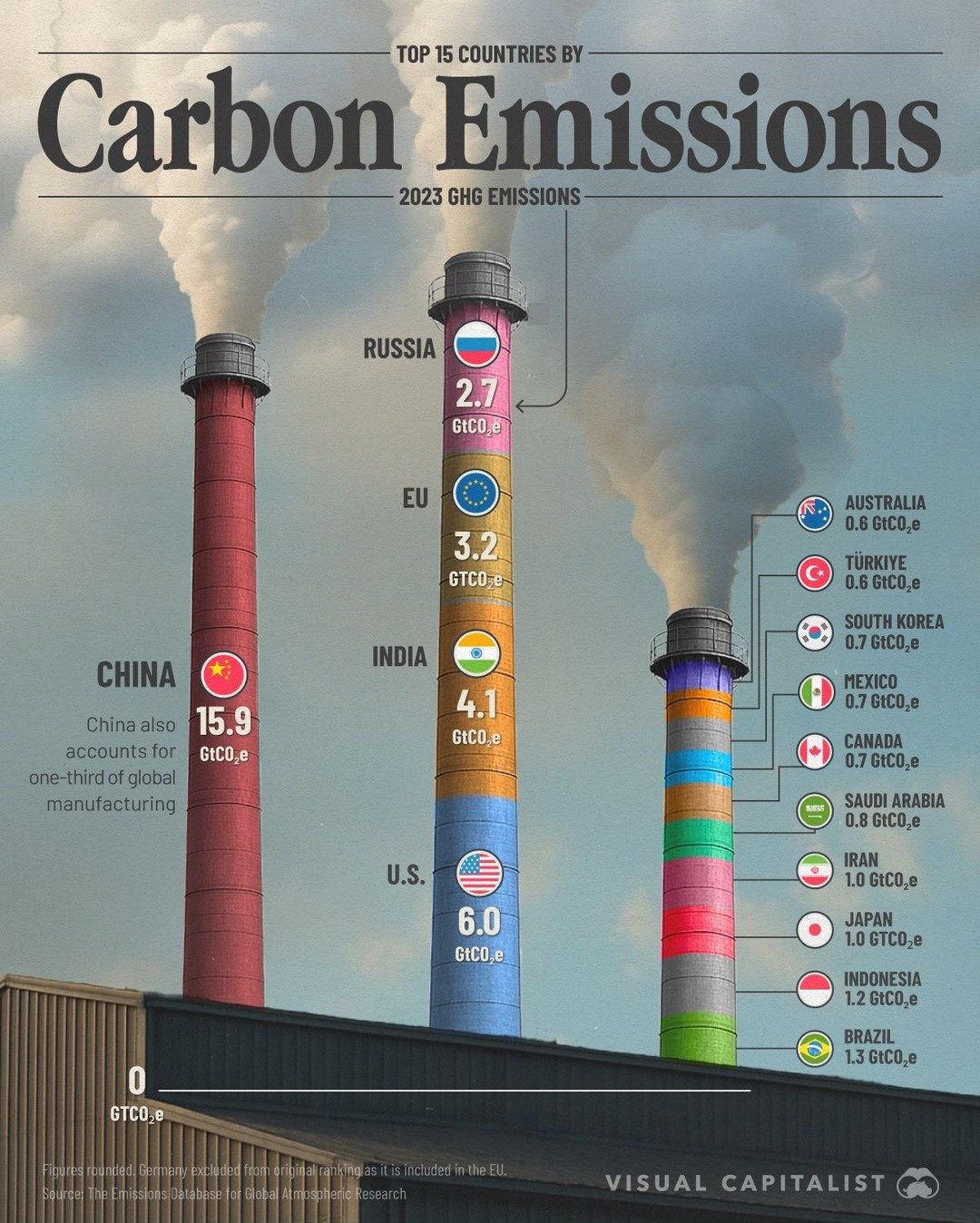
Carbon emissions are a hot topic of debate in the fight against climate change. Let’s look at the top 15 countries by carbon emissions and explore the significance of these numbers.
Countries worldwide emit varying amounts of greenhouse gases, which contribute to the overall carbon footprint and climate change. The global carbon emissions data for 2023, sourced from the Emissions Database for Global Atmospheric Research (EDGAR), provides a clear ranking of the top contributors. This information is crucial for understanding the global effort to mitigate climate change and highlighting the need for sustainable practices.
The Top 15 Countries by Carbon Emissions
China Leads the Way
China tops the list with an astonishing 15.9 gigatonnes of CO₂ equivalent (GtCO₂e) emissions. This figure represents more than 30% of global carbon emissions. China's significant industrial output, particularly in manufacturing, accounts for a substantial portion of its emissions. The country's rapid industrialization and economic growth have led to a surge in emissions, making it a focal point for global climate discussions. China's dominance in the emissions ranking underscores the importance of their environmental policies and commitments to reducing emissions in the coming decades.
Other Major Contributors
United States
The United States comes in second with 6.0 GtCO₂e. As one of the world's largest economies, the U.S. has a significant industrial and transportation sector, contributing to its high emissions. The country's efforts towards renewable energy and emission reduction policies will play a crucial role in global climate mitigation.
India
India ranks third with 4.1 GtCO₂e. India’s rapid economic growth and increasing industrialization have led to a rise in emissions. However, the country is also investing heavily in renewable energy sources, aiming to balance its growth with environmental sustainability.
Russia
Russia emits 2.7 GtCO₂e, making it the fourth-largest emitter. Russia's economy is heavily reliant on fossil fuels, particularly oil and natural gas exports. The country's vast reserves and energy-intensive industries contribute significantly to its emissions.
Saudi Arabia
Saudi Arabia, with 0.8 GtCO₂e, is another significant emitter. The country's economy is heavily dependent on oil production and export. Saudi Arabia's high per capita emissions highlight the challenges of balancing economic growth with environmental sustainability.
Additional Top Contributors
The list continues with countries like Australia (0.6 GtCO₂e), South Korea (0.7 GtCO₂e), Türkiye (0.7 GtCO₂e), Canada (0.6 GtCO₂e), Mexico (0.7 GtCO₂e), Iran, Brazil (1.3 GtCO₂e), and Indonesia (1.2 GtCO₂e).
Each of these countries has unique economic and industrial landscapes that contribute to their carbon emissions. Understanding the specific factors driving these emissions is essential for developing tailored strategies to reduce them.
Per Capita Emissions: A More Nuanced View
High Per Capita Emissions
While China leads in total emissions, countries like Saudi Arabia, Australia, and Canada have some of the highest per capita emissions globally. These nations have smaller populations but high levels of industrialization and fossil fuel reliance. Their high per capita emissions underscore the importance of per capita metrics, as they provide a more nuanced view of emissions that account for population size.
Implications for Climate Policy
High per capita emissions often correlate with higher standards of living and more energy-intensive lifestyles. This implies that addressing per capita emissions is crucial for countries looking to balance economic development with environmental sustainability. Policies aimed at reducing emissions should consider both total and per capita emissions to ensure a comprehensive approach.
Why This Matters
Understanding the top emitters and the factors driving their emissions is key to developing effective global climate policies. The data from EDGAR provides a snapshot of the current state of carbon emissions, highlighting the urgent need for action. By identifying the primary contributors, policymakers can target specific sectors and implement measures to reduce emissions effectively.
Practical Tips for Reducing Carbon Emissions
Reducing carbon emissions is a collective effort that requires action from governments, industries, and individuals. Here are some practical tips for reducing carbon emissions:
For Governments
- Invest in Renewable Energy: Governments should prioritize investments in renewable energy sources like solar, wind, and hydroelectric power. These investments can reduce dependence on fossil fuels and lower emissions.
- Promote Energy Efficiency: Implement policies that encourage energy-efficient practices in industries, transportation, and residential sectors.
- Carbon Pricing: Implement carbon taxes or cap-and-trade systems to incentivize emissions reductions and encourage the adoption of cleaner technologies.
For Industries
- Adopt Clean Technologies: Invest in cleaner technologies and processes that reduce emissions. This includes using renewable energy sources, improving energy efficiency, and adopting sustainable practices.
- Supply Chain Sustainability: Ensure that your supply chain is sustainable by working with suppliers who prioritize environmental standards.
- Innovation and Research: Invest in research and development to find innovative solutions for reducing emissions.
For Individuals
- Conserve Energy: Use energy-efficient appliances and practices, such as turning off lights and unplugging electronics when not in use.
- Reduce, Reuse, Recycle: Minimize waste by reducing consumption, reusing items, and recycling materials.
- Transportation Choices: Choose public transportation, carpool, bike, or walk whenever possible. Consider electric or hybrid vehicles if you need to drive.
Important Takeaways
- China's Dominance: China's high emissions, driven by industrialization, underscore the importance of its role in global climate efforts.
- Per Capita Emissions: High per capita emissions in countries like Saudi Arabia and Australia highlight the need for tailored policies that address specific economic and industrial landscapes.
- Global Effort: Reducing carbon emissions requires a collective effort from governments, industries, and individuals. Policies and practices that promote renewable energy, energy efficiency, and sustainable practices are essential for achieving significant reductions.
Conclusion
The top 15 countries by carbon emissions provide a clear picture of the global contributors to climate change. Understanding these data points is crucial for developing effective strategies to mitigate emissions and promote sustainable practices. By focusing on both total and per capita emissions, we can target specific sectors and implement measures that address the unique challenges each country faces.
Global collaboration and commitment to reducing carbon emissions are essential for combating climate change. As we move forward, it is vital to continue monitoring emissions data, implementing innovative solutions, and fostering a collective effort towards a sustainable future.
Watch the Reel
Questions readers ask
Which country emitted the most carbon in 2023?
China led the world in carbon emissions in 2023, releasing 15.9 gigatonnes of CO₂ equivalent (GtCO₂e). This significant amount highlights the urgency for sustainable practices in China and the global community.
How are the top 15 countries determined for carbon emissions?
The top 15 countries are determined based on data from the Emissions Database for Global Atmospheric Research (EDGAR). This database tracks and ranks countries by their greenhouse gas emissions, providing a clear picture of the global carbon emissions landscape.
What role do the USA, India, and Russia play in global carbon emissions?
The USA, India, and Russia rank among the top carbon emitting countries. The USA emitted 5.1 GtCO₂e, India 4.2 GtCO₂e in 2023, and Russia 2.7 GtCO₂e. These countries have a significant impact on global carbon emissions and are key players in climate change mitigation efforts.
Why is it important to track global carbon emissions data?
Tracking global carbon emissions is crucial for understanding the extent of climate change. It helps identify the major contributors to greenhouse gases, allowing for targeted efforts in climate change mitigation and the promotion of sustainable practices.
What are some of the key countries in the top 15 carbon emissions list besides China, the USA, India, and Russia?
Besides China, the USA, India, and Russia, countries like Saudi Arabia and Brazil are also listed in the top 15. Saudi Arabia emitted 1.7 GtCO₂e, and Brazil emitted 1.2 GtCO₂e in 2023. This data underscores the importance of focusing on high-emitting countries.
How can individuals contribute to reducing carbon emissions?
Individuals can contribute by adopting greener practices such as reducing energy use, transitioning to renewable energy sources, and minimizing waste. Supporting policies and initiatives that prioritize sustainability can also help reduce carbon emissions at a larger scale.
What is the significance of Saudi Arabia's position in the 2023 carbon emissions rankings?
Saudi Arabia's position in the top 15 carbon emitting countries highlights the significant role of the energy sector in global emissions. With 1.7 GtCO₂e emissions, Saudi Arabia's ranking emphasizes the need for sustainable practices in the energy industry and broader climate change mitigation efforts.
Related deep dives
Similar reads based on topic and creator.


Recent articles
Fresh deep dives from the latest Reels we unpacked.




Comments
Be the first to comment.