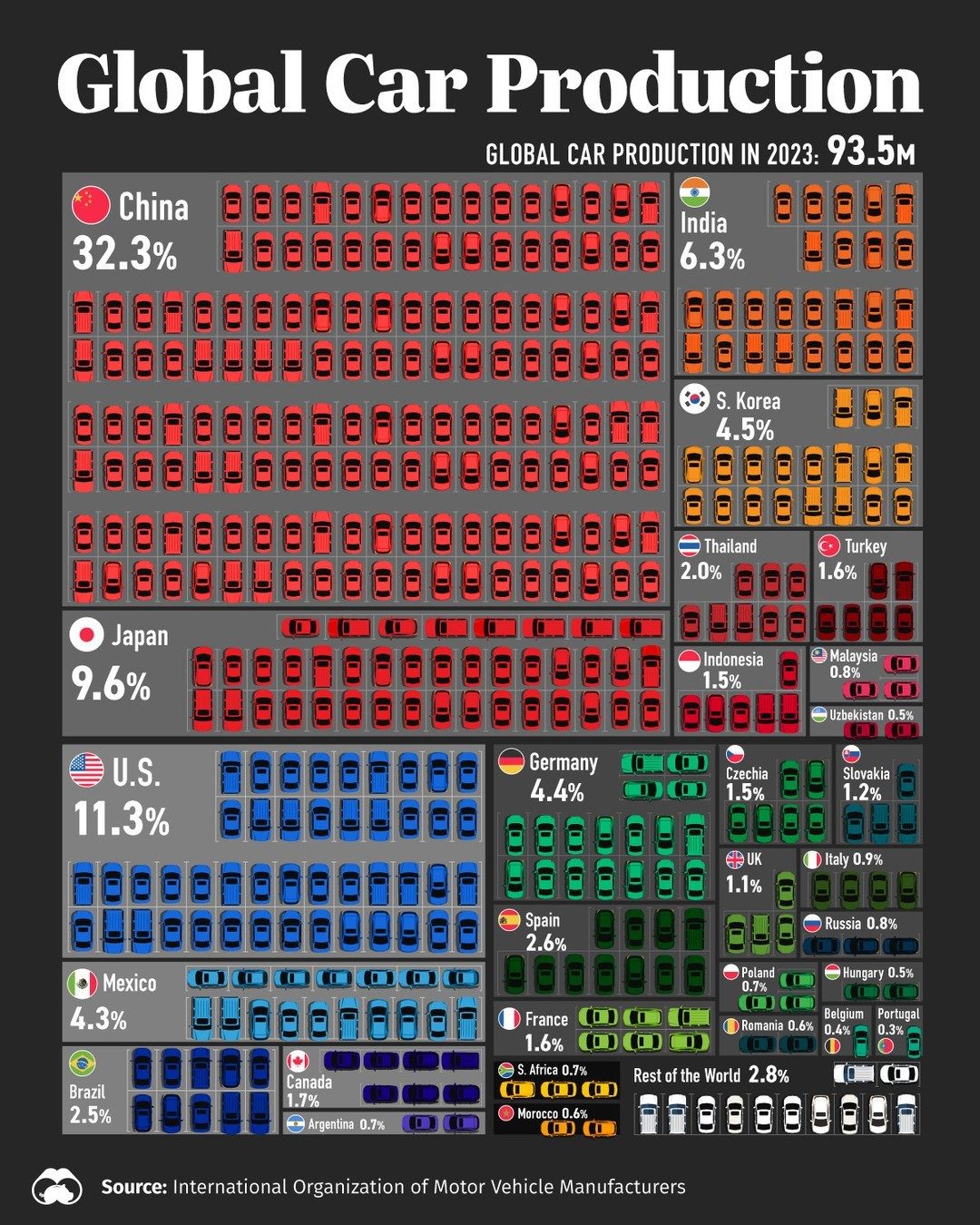
Global Car Production in 2023
In 2023, global car production reached an impressive 93.5 million units, with China leading the pack by producing nearly a third of the world's cars. The United States followed with 11.3% of global production, while Japan, renowned for brands like Toyota and Honda, contributed 9.6%. This breakdown reveals not only the dominance of these countries in automotive manufacturing but also highlights the diverse landscape of global car production.
Context / Why This Matters
The automotive industry is a cornerstone of global manufacturing, influencing economic growth, employment, and technological innovation. Understanding the distribution of car production across different countries offers insights into global trade dynamics, industrial capabilities, and strategic partnerships.
Main Discussion
Dominant Players: China, The United States, and Japan
China continues to be the titan of global car production, accounting for 32.3% of the world's total output. This dominance can be attributed to the country's vast manufacturing infrastructure, supportive government policies, and robust domestic market. China's success in the automotive sector has also attracted significant foreign investment, further bolstering its production capabilities.
The United States maintains a strong presence in global car production, with 11.3% of the total output. The U.S. is home to major automotive giants such as Ford, General Motors, and Tesla. Its production capacity is underpinned by a history of innovation, strong supply chains, and a competitive labor force. The U.S. market is also a significant driver of global automotive trends, influencing everything from design to technology.
Japan is another powerhouse in the automotive sector, contributing 9.6% to global production. Japan's automotive industry is renowned for its efficiency, quality, and innovation. Brands like Toyota, Honda, and Nissan have set global standards for reliability and fuel efficiency, making Japanese cars popular worldwide. Japan's success in the automotive sector is bolstered by its advanced manufacturing technologies and skilled workforce.
Emerging and Established Players
Mexico, Brazil, and Germany are among the other notable players in global car production. Mexico produced 4.3% of the world's cars, benefiting from its strategic location and numerous free trade agreements. Brazil, with 2.5%, and Germany, with 4.4%, also play significant roles in global production. These countries are home to major automotive plants and have established supply chains that support global demand.
South Korea produced 4.5% of the world's cars, driven by the success of brands like Hyundai and Kia. These companies have gained global recognition for their competitive pricing, innovative features, and high-quality standards. South Korea's automotive industry has seen substantial growth, driven by increasing exports and a strong domestic market.
Regional Contributors
The European landscape of car production is diverse, with countries like Germany, Italy, and Czechia making significant contributions. Germany's 4.4% share is driven by brands like Volkswagen, BMW, and Mercedes-Benz, which are globally recognized for their engineering excellence and luxury offerings. Italy, with 0.9%, is known for its iconic brands like Ferrari and Lamborghini, which cater to niche markets. Czechia, with 1.2%, has become a key player in the European automotive sector, hosting production facilities for major global brands.
Countries like Canada (1.7%) and Turkey (1.6%) also contribute to global car production. Canada's automotive industry benefits from its proximity to the U.S. and strong trade relationships, while Turkey's strategic location and growing industrial capabilities make it an important player in the region.
Poland, Romania, and Belgium also have notable contributions, with 0.7%, 0.4%, and 0.3% respectively. These countries are part of the broader European automotive ecosystem, hosting production facilities for various global brands. Their involvement in the supply chain and manufacturing processes supports the overall European automotive industry.
Southeast Asian Contributors
Thailand and Indonesia are significant contributors to global car production in Southeast Asia. Thailand, with 1.5%, benefits from its supportive government policies and strategic location, making it a hub for automotive manufacturing in the region. Indonesia, with 0.8%, is known for its growing automotive sector, driven by increasing domestic demand and investment in manufacturing capabilities.
Russia, although producing a smaller percentage (0.5%), is another notable player in the global automotive landscape. The country's production capabilities are supported by a strong domestic market and strategic partnerships with global automotive brands.
The Role of International Organizations
The International Organization of Motor Vehicle Manufacturers (OICA) plays a crucial role in compiling and standardizing data on global car production. This organization provides essential insights into production trends, technological advancements, and market dynamics. By tracking and analyzing data from various countries, the OICA offers a comprehensive view of the global automotive industry, helping stakeholders make informed decisions and develop strategic plans.
Practical Tips
For those interested in the automotive industry, staying informed about global production trends is crucial. Here are some practical tips to help you navigate the complex landscape:
Stay Updated with Industry Reports
Regularly review industry reports and publications from organizations like the OICA. These reports provide valuable insights into production trends, technological advancements, and market shifts.
Analyze Production Data
Understanding the production data from different countries can help you identify emerging markets and strategic opportunities. Look at the percentage contributions of each country and analyze the factors driving their production capabilities.
Monitor Policy Changes
Government policies, trade agreements, and regulations significantly impact the automotive industry. Stay informed about policy changes in key production countries to anticipate market shifts and potential disruptions.
Explore Technological Advancements
The automotive sector is rapidly evolving with advancements in electric vehicles (EVs), autonomous driving, and connected cars. Keep an eye on technological trends and innovations that are shaping the future of automotive manufacturing.
Important Takeaways
- China leads global car production with 32.3% of the total output.
- The United States and Japan are significant contributors, with 11.3% and 9.6% respectively.
- Mexico, Brazil, and Germany are other key players in global production.
- South Korea, Italy, and Czechia contribute significantly to global car production.
- Russia, Thailand, and Indonesia are notable in their respective regions.
- The International Organization of Motor Vehicle Manufacturers (OICA) provides essential data and insights into global car production.
Conclusion
Global car production in 2023 highlights the dominance of China, the United States, and Japan, while also showcasing the diverse contributions of other countries. Understanding the production landscape offers valuable insights into the automotive industry's dynamics, trends, and future prospects. By staying informed and analyzing key data points, stakeholders can make strategic decisions and capitalize on emerging opportunities in the global automotive market.
Watch the Reel
Questions readers ask
Which country is the world's largest car producer in 2023?
The United States is the world's largest car producer in 2023, producing 11.3% of the global total.
What is the total number of cars produced globally in 2023?
In 2023, global car production reached 93.5 million units, reflecting a significant output from various countries around the world.
What makes China a significant player in global car production?
China's vast output is a key factor in its dominance in the global car production. In 2023, China produced nearly a third of the world's cars, making it a significant player in the automotive industry.
How does Japan's car production compare to other top-producing countries?
Japan's car production in 2023 was 9.6% of global production, making it a significant contributor to the world’s car production. Japan is renowned for its efficiency in car manufacturing.
What is the importance of understanding global car production trends?
Understanding global car production trends is crucial for gaining insights into global trade dynamics, industrial capabilities, and economic influences. It also helps in recognizing the impact of the automotive industry on employment and technological innovation.
What is Mexico's role in global car production in 2023?
Mexico is a significant player in global car production, contributing to the international car output in 2023. Mexico's production is notable, but the exact percentage of global production is not mentioned in the article.
What are some of the leading car-producing countries in 2023 besides China, the United States, and Japan?
In addition to China, the United States, and Japan, other leading car-producing countries in 2023 include Germany, South Korea, and India. These countries contribute significantly to the global motor vehicle production and reflect the diverse landscape of international car output.
Related deep dives
Similar reads based on topic and creator.


Recent articles
Fresh deep dives from the latest Reels we unpacked.




Comments
Be the first to comment.