The Largest Banks in the World by Assets
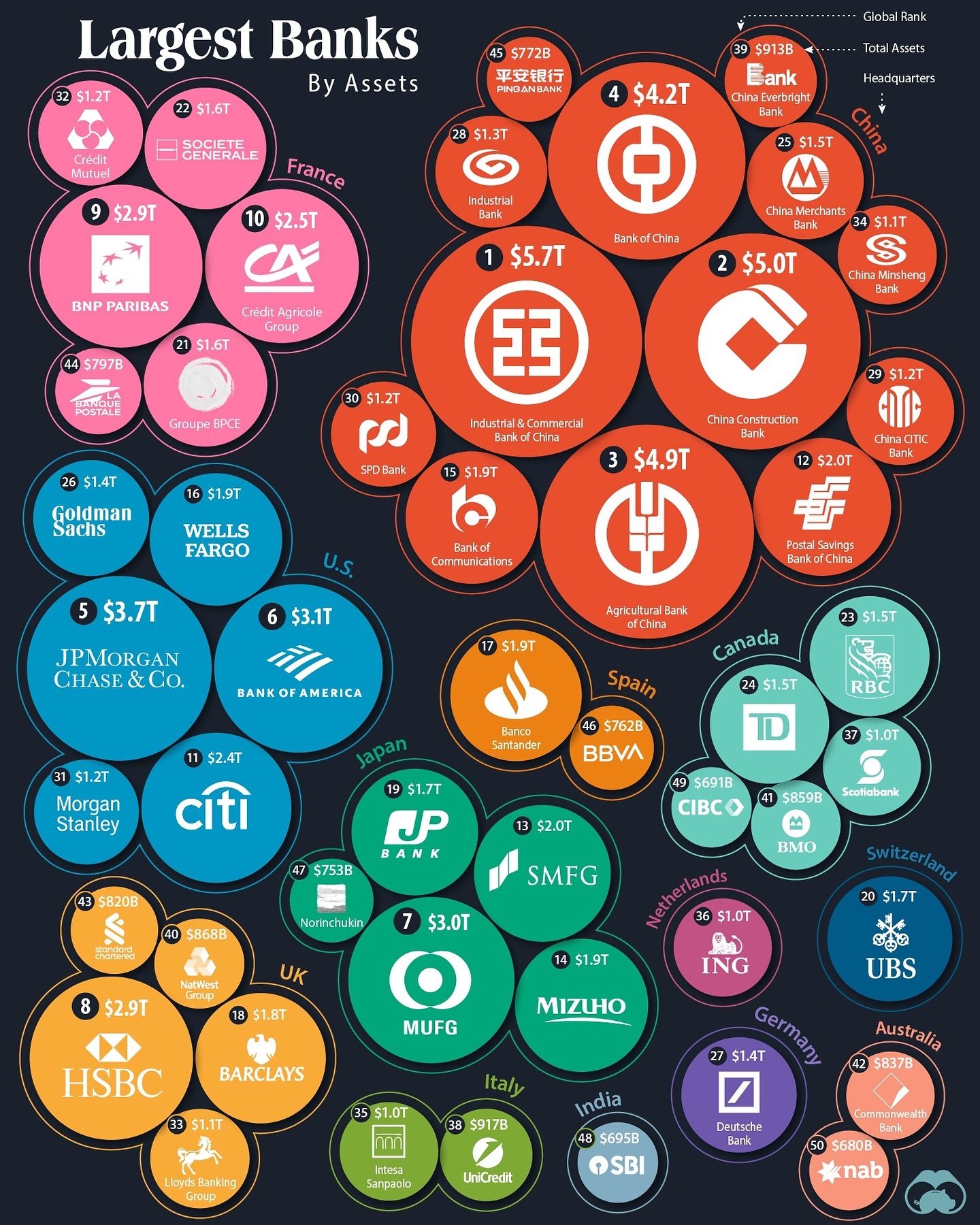
The global financial landscape is dominated by a handful of banks with enormous asset holdings. According to S&P, the four largest Chinese banks expanded their assets by 4.1% in 2022, bringing their combined total to a staggering $19.8 trillion. This figure represents over a third of the assets held by the largest banks worldwide, highlighting the significant influence of Chinese banks on the global financial stage.
Following closely is the American market, where six U.S. banks collectively hold $13.7 trillion in assets. This comparison underscores the immense scale of the financial institutions at play and their critical roles in shaping global economics.
The Geographic Distribution of Financial Power
The distribution of the world's largest banks by assets showcases a diverse geographic landscape, with significant contributions from various regions, including China, the United States, Europe, and Asia.
China: The Financial Powerhouse
China's dominance in the global banking sector is evident, with several of its banks ranking among the largest in the world. The Industrial and Commercial Bank of China (ICBC) leads the pack with assets totaling $5.0 trillion. Other prominent Chinese banks include Agricultural Bank of China and China Construction Bank, each with substantial asset values. These institutions play a pivotal role in China's economic growth and stability, contributing significantly to the country's financial prowess on the global stage.
United States: A Close Second
The United States is home to some of the world's most influential financial institutions. JPMorgan Chase & Co., with $3.7 trillion in assets, is one of the leading banks globally. Other major U.S. banks include Bank of America, Citigroup, Wells Fargo, and Morgan Stanley, each with assets ranging from $1.2 trillion to $3.1 trillion. These banks are integral to the U.S. economy, driving financial innovation and supporting economic growth.
Europe: A Mix of Traditional and Modern
European banks, including BNP Paribas, Société Générale, and Credit Agricole, hold significant global influence. While European banks are not as dominant as their Chinese and American counterparts, they still have a substantial presence in the global financial landscape. Notable mentions include BNP Paribas and Société Générale, each with assets of approximately $1.6 trillion.
Asia and Beyond
Asia's financial landscape is diverse, with contributions from Japan, India, and other countries. Japan's MUFG (Mitsubishi UFJ Financial Group) and Mizuho Financial Group are among the largest banks globally, with assets of $3.8 trillion and $3.0 trillion, respectively. In India, State Bank of India is a significant player, reflecting the growing importance of the Indian economy. Other notable mentions include Norinchukin Bank, Postal Savings Bank of China, and China Construction Bank.
Why This Matters
Understanding the distribution of the world's largest banks by assets is crucial for several reasons. These financial institutions are pivotal in shaping global economic policies, influencing international trade, and driving financial innovation. Their size and influence can affect everything from interest rates to investment opportunities, making them key players in the global economy.
Economic Stability and Growth
The sheer size of these banks means they have a significant impact on economic stability and growth. Their asset management practices, lending policies, and financial strategies can either stabilize or destabilize economies. For instance, during economic downturns, these banks can provide liquidity to markets, helping to mitigate the impact of financial crises.
Global Influence
The largest banks in the world hold significant sway over global financial policies and regulations. Their decisions can influence international trade agreements, foreign direct investment, and cross-border financial flows. Understanding their market positions provides insights into the broader economic trends and geopolitical dynamics.
Investment Opportunities
For investors, knowing the asset distribution of the world's largest banks can offer valuable insights. These banks often have diverse investment portfolios, ranging from equities and bonds to real estate and commodities. Their investment strategies can serve as benchmarks for other financial institutions and individual investors, highlighting potential opportunities and risks.
Practical Tips for Understanding Bank Asset Values
For those interested in the financial sector, understanding the asset values of the world's largest banks can be both informative and practical. Here are some tips to help you navigate this complex landscape:
Stay Informed
Keeping up with the latest financial news and reports is essential. Regularly reviewing reports from organizations like S&P Global Market Intelligence can provide valuable insights into the financial health and asset values of the world's largest banks.
Analyze Trends
Analyzing trends in bank asset values can help identify potential investment opportunities and risks. For example, a steady increase in assets might indicate a bank's strong financial performance, while a decline could signal potential issues.
Diversify Your Portfolio
Diversification is key to mitigating risk. Investing in banks across different regions and countries can help balance your portfolio, reducing the impact of any single bank's performance.
Seek Expert Advice
Consulting with financial advisors or investment professionals can provide valuable guidance. They can offer personalized advice based on your financial goals and risk tolerance, helping you make informed investment decisions.
Important Takeaways
The Significance of Chinese Banks
Chinese banks, particularly the Industrial and Commercial Bank of China, dominate the global financial landscape. Their asset growth and influence underscore the rising importance of the Chinese economy.
The Role of American Banks
American banks, with their substantial asset values, play a critical role in the global financial system. Their financial strategies and asset management practices can shape economic policies and investment opportunities on a global scale.
The Diversity of European and Asian Banks
European and Asian banks, while not as dominant as their Chinese and American counterparts, still hold significant global influence. Their diverse financial strategies and asset management practices contribute to the global financial landscape.
Conclusion
The world's largest banks by assets are pivotal players in the global financial system. Their asset values, financial strategies, and market positions shape economic policies, influence international trade, and drive financial innovation. Understanding their distribution and influence can provide valuable insights for investors, policymakers, and financial professionals alike. By staying informed, analyzing trends, and seeking expert advice, you can navigate this complex landscape with confidence.
Watch the Reel
Questions readers ask
Which countries have the most significant influence on the global financial landscape based on bank assets?
China and the United States have the most significant influence. China's banks hold over a third of the world's largest assets, while U.S. institutions hold a substantial $13.7 trillion, highlighting their critical roles in shaping global economics.
Which Chinese bank has the largest asset holdings?
The Industrial and Commercial Bank of China (ICBC) is the largest bank in China by assets. This reflects the significant influence of Chinese financial institutions in the global landscape.
What is the total asset value of the largest U.S. banks?
The six largest U.S. banks collectively hold $13.7 trillion in assets. This underscores the immense scale of these financial institutions and their pivotal role in the global economy.
Who are the top banks in the U.S. by assets in 2023?
The top banks in the U.S. by assets in 2023 include giants like JPMorgan Chase. Other prominent names include Bank of America, Citigroup, and Wells Fargo, each contributing to the substantial asset holdings of U.S. institutions.
How have the assets of the largest Chinese banks grown in recent years?
The four largest Chinese banks expanded their assets by 4.1% in 2022, bringing their combined total to $19.8 trillion. This growth highlights the expanding influence of Chinese financial institutions on the global stage.
What is the combined asset value of the world's largest banks?
The world's largest banks by total assets combined hold around $60 trillion. This figure underscores the immense financial power and influence these institutions wield in the global economy.
Recent articles
Fresh deep dives from the latest Reels we unpacked.




Comments
Be the first to comment.