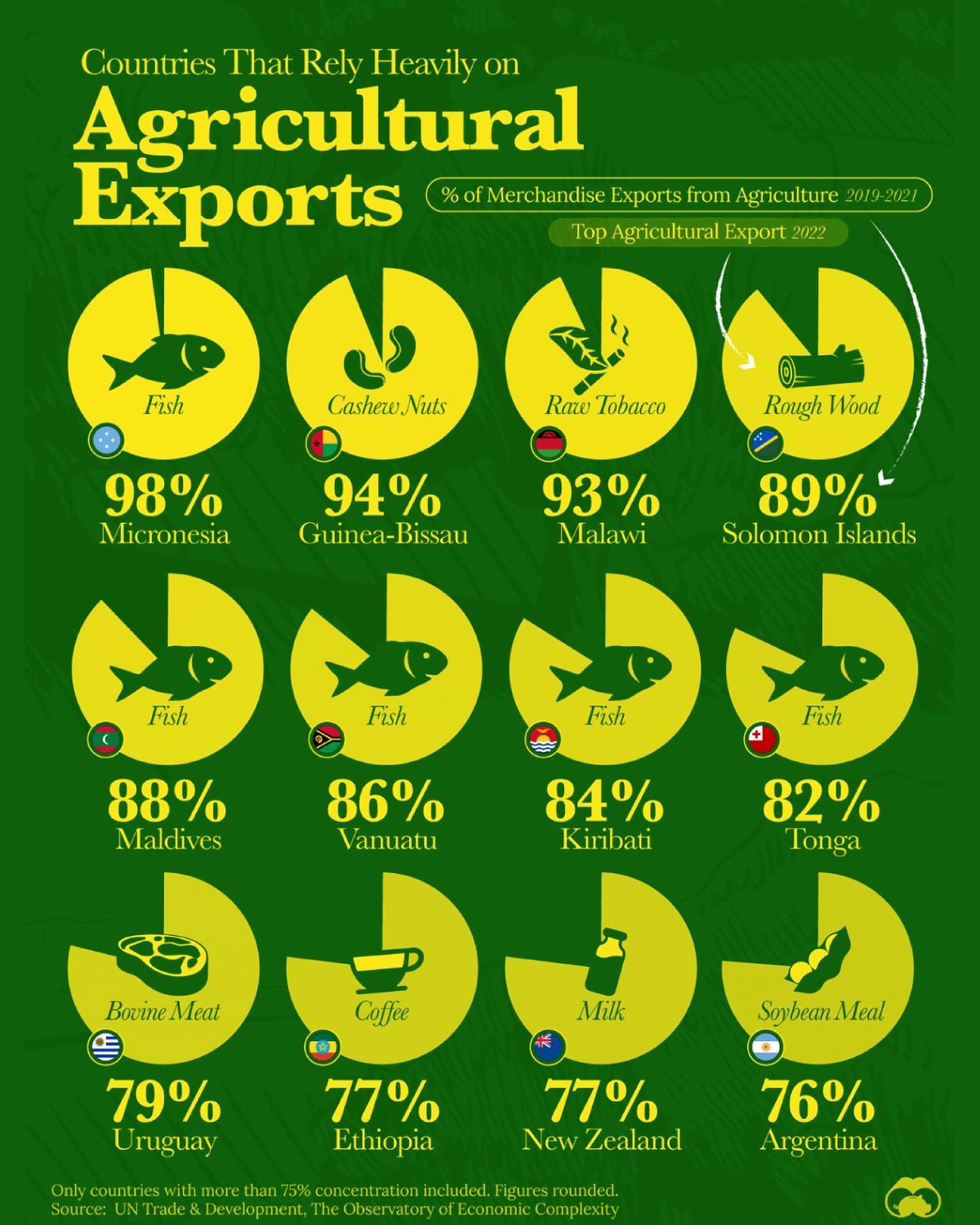
Agricultural Exports by Country
Agriculture is a cornerstone of many nations' economies, and for some, it is the primary driver of export revenue. This reliance on agricultural exports, while beneficial, also poses significant risks, particularly for small island nations. These countries often depend heavily on a limited range of primary commodities, making them vulnerable to economic shocks from price fluctuations. Here, we delve into the agricultural export landscapes of countries where over 75% of their total merchandise exports come from agricultural products.
Context / Why This Matters
Understanding the dependency on agricultural exports is crucial for grasping the economic vulnerabilities and strengths of these nations. Small island nations, in particular, often rely on a narrow range of commodities, such as fish, which can expose their economies to significant risks. Economic shocks, whether from natural disasters, global market changes, or policy shifts, can have drastic impacts on these countries. This analysis highlights the importance of diversification in export economies and the need for robust economic planning to mitigate risks.
Main Discussion
Small Island Nations and Their Reliance on Fish
Half of the top agriculturally dependent countries are small island nations, primarily exporting fish. These nations include Micronesia, the Maldives, Kiribati, and Solomon Islands. For instance, Micronesia relies on fish exports for 98% of its merchandise exports, making it one of the most agriculturally dependent countries in the world. Similarly, the Maldives and Kiribati rely on fish for 88% and 84% of their exports, respectively. These figures underscore the critical role that the fishing industry plays in the economies of these island nations.
The Case of Micronesia
Micronesia's economy is almost entirely dependent on fish exports. This heavy reliance can be both a blessing and a curse. On one hand, it provides a significant portion of the country's revenue. On the other hand, it makes the economy extremely vulnerable to market fluctuations and environmental changes. For example, a decline in fish populations due to overfishing or climate change could have severe economic repercussions. Diversifying the export base could help mitigate these risks.
The Maldives and Kiribati
The Maldives and Kiribati are other small island nations that heavily rely on fish exports. These countries, like Micronesia, face similar economic vulnerabilities. The Maldives, for instance, relies on fish for 88% of its merchandise exports. This high dependency makes the country susceptible to fluctuations in global fish prices and changes in fishing regulations. Similarly, Kiribati's 84% reliance on fish exports highlights the need for economic diversification to ensure long-term stability.
Other Agricultural Export Leaders
While small island nations are notable for their heavy reliance on fish, other countries have diverse agricultural exports. Guinea-Bissau, for example, relies on cashew nuts for 86% of its merchandise exports. This dependency, while significant, is less vulnerable to market fluctuations compared to fish exports, as cashew nuts have a more stable global market.
Uruguay and Its Bovine Meat Exports
Uruguay, a South American country, relies on bovine meat for 79% of its merchandise exports. This high concentration in the meat sector highlights the importance of the livestock industry to Uruguay's economy. However, it also underscores the need for diversification to protect against potential shocks in the meat market.
Coffee and Coffee Exports
Ethiopia is another country that relies heavily on a single agricultural product—coffee. Coffee accounts for 77% of Ethiopia's merchandise exports, making it a critical component of the country's economy. The global demand for coffee is generally stable, but Ethiopia still faces risks from price fluctuations and climate change, which can affect coffee production.
Argentina and Soybean Meal
Argentina relies on soybean meal for 76% of its merchandise exports. Soybean meal is a key component in animal feed, and its export plays a significant role in Argentina's economy. Like other countries with high agricultural dependencies, Argentina needs to consider diversifying its export base to reduce economic risks.
The Role of Rough Wood and Cashew Nuts
Countries like Solomon Islands heavily rely on rough wood for 89% of their merchandise exports. Rough wood is a valuable commodity that contributes significantly to the economy. Similarly, Guinea-Bissau relies on cashew nuts for 86% of its merchandise exports. These products, while valuable, present risks similar to those faced by fish-exporting nations.
Practical Tips
For countries heavily reliant on agricultural exports, diversification is key to mitigating economic risks. Here are some practical tips for managing and reducing dependency:
Diversify the Export Base
Countries should aim to diversify their export base to reduce reliance on a single commodity. This can be achieved by investing in other agricultural sectors, developing industrial and service sectors, and fostering innovation.
Strengthen Infrastructure
Investing in infrastructure, such as roads, ports, and processing facilities, can enhance the efficiency of agricultural exports and reduce post-harvest losses. Improved infrastructure can also attract foreign investment and create job opportunities.
Promote Sustainable Practices
Implementing sustainable agricultural practices can ensure long-term productivity and reduce environmental degradation. This includes sustainable fishing practices, reforestation, and soil conservation.
Encourage Value Addition
Countries should focus on adding value to their agricultural exports through processing and manufacturing. For example, instead of exporting raw casing nuts, Guinea-Bissau could process them into value-added products like cashew nut butter or confections.
Foster International Partnerships
Building strong international partnerships and trade agreements can help stabilize export markets and provide access to new markets. This can also attract foreign investment and technology transfer, contributing to economic growth.
Important Takeaways
The high dependency on agricultural exports, particularly in small island nations, presents significant economic risks. Diversification, sustainable practices, and value addition are crucial strategies for reducing these risks. Countries like Micronesia, the Maldives, and Kiribati, which rely heavily on fish exports, need to explore other export opportunities to ensure long-term economic stability.
Conclusion
Agricultural exports play a pivotal role in the economies of many countries, but high dependency on a single commodity can lead to economic vulnerabilities. For small island nations and other agriculturally dependent countries, diversifying export bases, promoting sustainable practices, and fostering international partnerships are essential strategies. By doing so, these countries can build resilient economies that are better prepared to face global market fluctuations and environmental challenges.
Watch the Reel
Questions readers ask
Which countries are the top fish exporting countries among small island nations?
Among small island nations, Micronesia, the Maldives, and Kiribati are significant fish exporters. These countries rely heavily on fish exports to generate revenue. To improve their economic stability, diversification of their exports is crucial.
What are the primary agricultural commodities exported by Guinea-Bissau?
Guinea-Bissau primarily exports cashew nuts and other agricultural commodities. These exports are vital to the nation's economy, making up a significant portion of its total merchandise exports. However, this reliance on a few commodities presents economic risks that the country must navigate.
Why is export diversification important for countries like the Solomon Islands and Uruguay?
For countries like the Solomon Islands and Uruguay, export diversification is important because it helps to mitigate the risks associated with relying on a single or few commodities. By diversifying, these nations can reduce their vulnerability to global market changes and price fluctuations, ensuring more stable economic growth.
What role do agricultural exports play in the economies of countries like Micronesia and Maldives?
In countries like Micronesia and the Maldives, agricultural exports, particularly fish, form the backbone of their economies. These exports are crucial for generating foreign exchange and revenue. However, this dependence also makes these nations susceptible to fluctuations in global markets and natural disasters.
What are the main challenges faced by countries that heavily rely on agricultural commodities exports?
Countries heavily reliant on agricultural commodities exports often face challenges such as price volatility, market access barriers, and vulnerability to natural disasters. These factors can significantly impact their economic stability, making it essential for these nations to explore ways to diversify their export portfolios and reduce dependence on a single commodity.
Which small island nations heavily rely on fish exports for their economic stability?
Small island nations such as Micronesia, the Maldives, and Kiribati heavily rely on fish exports for their economic stability. Fish makes up a majority of their export revenue, which makes these nations vulnerable to global market changes, natural disasters, and policy shifts. Diversification of their export sectors is essential for mitigating these risks.
Recent articles
Fresh deep dives from the latest Reels we unpacked.




Comments
Be the first to comment.