Global Import Statistics
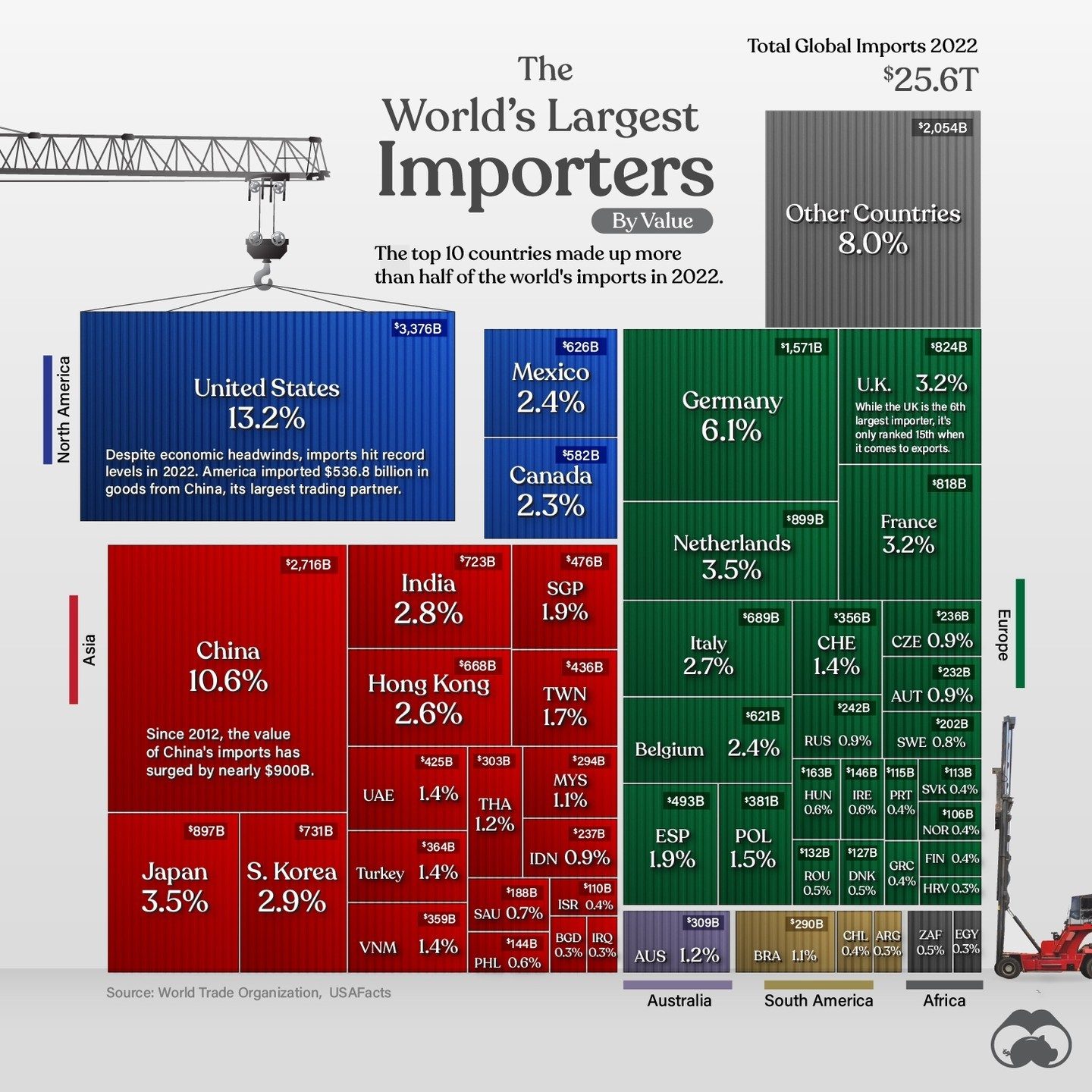
In 2022, global imports reached a staggering $25.6 trillion, matching the U.S. GDP. This figure underscores the significance of global trade as a driving force for economic growth. By enhancing consumer choices and reducing the cost of goods, international trade plays a pivotal role in economic development.
Context / Why This Matters
Global trade influences the economic landscape in numerous ways. For consumers, it broadens the variety of available products and can lead to lower prices due to increased competition. For businesses, global trade is essential for sourcing high-quality inputs and improving competitiveness in local and international markets.
Main Discussion
The Global Import Landscape
The 2022 data highlights the United States as the largest importer, accounting for 13.2% of global imports. China follows closely with 10.6%, while Germany, the Netherlands, and France are also significant contributors.
United States
The United States remains the dominant player in global imports, highlighting its robust economy and consumer demand. The country imports a wide array of goods, from raw materials to finished products, which fuels its industrial and consumer sectors.
China
China's significant share of global imports reflects its status as a global manufacturing hub. The country's extensive imports of raw materials and intermediate goods support its vast industrial production and export-driven economy.
Europe
Germany, the Netherlands, and France are among the top European importers. These countries rely heavily on international trade to obtain necessary resources and to maintain their competitive edge in global markets.
The Role of Smaller Importers
Although countries like the United States, China, and Germany dominate the import landscape, smaller economies also play a crucial role. Countries such as Mexico, Canada, and India contribute to global trade dynamics by importing goods to support their own industries and meet domestic demand.
Mexico
Mexico's import activity is closely tied to its trade agreements, particularly with the United States. The country imports a variety of goods to support its manufacturing sector, which is a significant contributor to its economic growth.
The Importance of Trade Agreements
Trade agreements are critical for enhancing global trade flows. They reduce tariffs, eliminate trade barriers, and foster economic cooperation among nations. International trade agreements have played a pivotal role in increasing global imports and promoting economic development.
Multilateral Agreements
The World Trade Organization (WTO) facilitates multilateral trade agreements, which reduce tariffs and promote fair trade practices. These agreements encourage global trade and contribute to the overall growth in imports and exports.
Bilateral Agreements
Bilateral trade agreements between countries can further enhance trade relations. These agreements are tailored to address specific trade issues and foster economic cooperation between nations, ultimately increasing trade volumes.
The Impact of Global Trade on Economic Growth
Global trade has a profound impact on economic growth. It allows nations to specialize in industries where they have a comparative advantage, leading to increased productivity and economic efficiency. By accessing a wider range of goods and services, consumers benefit from cost savings and a broader selection.
Consumer Choice and Competition
Global trade expands consumer choices by offering a variety of products at competitive prices. This increased availability of goods fosters competition among suppliers, leading to better quality and lower costs for consumers.
Economic Competitiveness
For businesses, global trade provides access to better-quality inputs and technologies, enhancing their competitiveness in the global market. This access to high-quality materials and technologies supports innovation and productivity growth.
Economic Stability
Global trade also contributes to economic stability by promoting economic diversification. By importing a variety of goods, countries can mitigate the risks associated with over-reliance on a single product or industry, thereby enhancing economic resilience.
Practical Tips
For businesses and consumers alike, understanding the dynamics of global trade can lead to better decision-making and strategic planning. Here are some practical tips:
Leveraging Trade Data
Utilize trade data to identify opportunities and make informed decisions. Accessing data from sources like the World Trade Organization can help businesses understand global trade trends and adapt their strategies accordingly.
Optimizing Supply Chains
Companies should optimize their supply chains to take advantage of global trade opportunities. By diversifying suppliers and sourcing inputs from various countries, businesses can reduce costs and enhance efficiency.
Staying Informed
Keeping up with trade agreements and policy changes is essential for making informed decisions. Staying informed about new agreements and trade policies can help businesses capitalize on emerging opportunities and mitigate risks.
Enhancing Competitiveness
Improve competitiveness by leveraging global trade to access better-quality inputs and technologies. Investing in innovation and technology can help businesses stay ahead in a competitive global market.
Supporting Economic Development
For policymakers, promoting global trade can foster economic development. By supporting trade agreements and removing trade barriers, governments can encourage economic growth and development.
Important Takeaways
- Global imports reached $25.6 trillion in 2022, with the United States and China as the leading importers.
- Global trade enhances consumer choices, lowers costs, and improves the quality of inputs for businesses.
- Trade agreements play a critical role in promoting global trade and economic growth.
- Understanding and leveraging global trade data can help businesses make informed decisions and enhance competitiveness.
- Promoting global trade fosters economic development and stability.
Conclusion
Global trade is a vital engine of economic growth, benefiting both consumers and businesses. By expanding consumer choices, reducing costs, and improving the quality of inputs, global trade drives economic development and prosperity. Understanding the dynamics of global trade and utilizing trade data can help businesses make informed decisions, optimize supply chains, and enhance competitiveness. Promoting global trade through agreements and policies is essential for fostering economic growth and stability.
Watch the Reel
Questions readers ask
What were the total global imports in 2022?
Global imports in 2022 amounted to $25.6 trillion. This figure is comparable to the GDP of the United States and highlights the substantial role international trade plays in global economic activity.
Who were the top importers in 2022?
The United States and China led the list of top importers in 2022. These countries, along with others in the top 50, significantly influence global trade dynamics and economic trends.
How does global trade impact consumer choices?
Global trade extends the range of products available to consumers, often at reduced prices. This is due to increased competition and the ability of businesses to source materials and goods more efficiently.
Why is global trade crucial for businesses?
For businesses, global trade is vital for obtaining quality inputs and maintaining competitiveness. It allows companies to access a broader market and improve their product offerings, both locally and internationally.
What is the significance of the top 50 importers?
The top 50 importers hold a pivotal role in the global economy. Their import values reflect their influence on international trade and economic growth, making them key players in the global market.
What trends can be observed from the 2022 global import data?
The 2022 global import data reveals the strong interdependence of economies and the importance of international trade. The data underscores the need for countries to maintain and expand their trade relationships to drive economic development.
Recent articles
Fresh deep dives from the latest Reels we unpacked.




Comments
Be the first to comment.