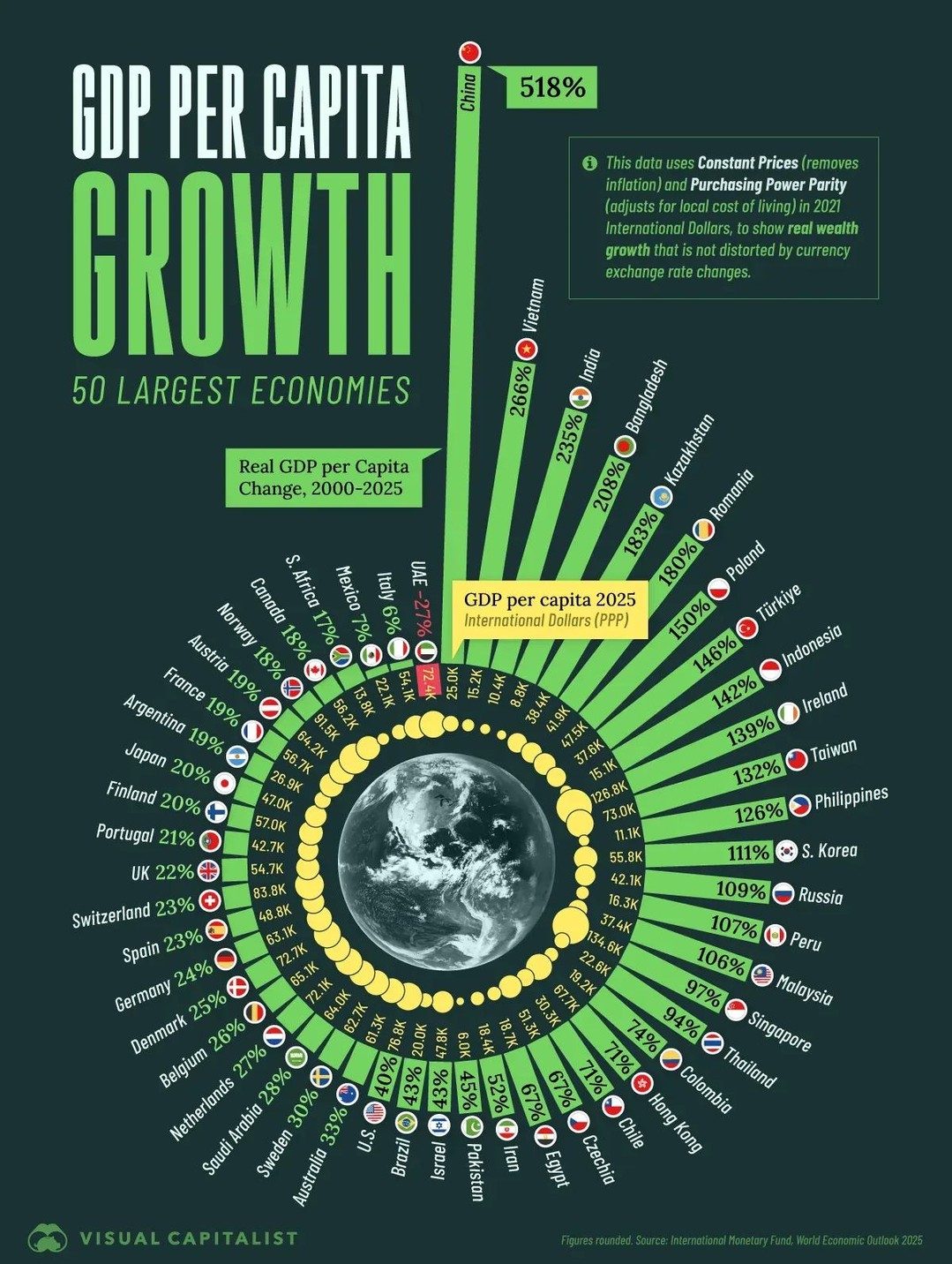
Economic Growth Comparison from 2000 to 2025
Real GDP per capita growth serves as a critical gauge for measuring economic prosperity and growth in a country. It reflects the average income within a population, adjusted for inflation and currency fluctuations. Over the past two and a half decades, there have been stark differences in the growth trajectories of various economies. These differences are shaped by various factors ranging from global economic policies, economic reforms, development strategies, technology adoption, and even geopolitical dynamics.
Context / Why This Matters
Understanding real GDP per capita growth is essential for grasping the economic landscape today and predicting future trends. Knowing which countries have experienced the most significant growth can provide insights into successful economic strategies and highlight regions poised for continued advancement. By analyzing these trends, governments, investors, and businesses can make data-driven decisions and strategize for future economic growth.
Economic Growth Across Regions
Asian Economies Leading the Way
Asian economies have dominated the real GDP per capita growth since 2000. Countries like China, Vietnam, and several others have demonstrated remarkable growth, reflecting rapid industrialization, technological advancements, and strategic economic policies. China, for instance, has seen an unprecedented +518% growth in real GDP per capita, positioning itself as a leader in global economic growth.
Eastern European Economies Making Strides
Several Eastern European countries, including Romania and Poland, have also seen significant growth, with increases of +180% and +150% respectively. These high growth rates reflect rapid catch-up growth as these economies transition towards developed economy living standards. The growth in these countries is a testament to the success of economic reforms, integration into global markets, and effective policy implementation.
Key Growth Data for the Top 50 Economies
The top 50 economies by real GDP per capita growth since 2000 reveal a diverse array of growth rates and economic strategies. Notable mentions include:
- Taiwan (+146%): Known for its robust electronics industry and strategic location in the global supply chain.
- S. Korea (+139%): A leader in technology and innovation, particularly in sectors like electronics and automotive.
- Japan (+106%): A mature economy with a strong focus on technology and innovation.
- Malaysia (+94%): Benefiting from strategic economic policies and a diverse economic landscape.
- Thailand (+79%): Driven by sectors like tourism, automotive, and agriculture.
These countries exhibit varied economic strengths and strategies, contributing to their growth trajectories.
Middle Eastern and Latin American Growth
Countries like the UAE and Chile have also shown significant growth, with increases of 183% and 132%, respectively. These countries have leveraged their strategic geographical locations and robust policy frameworks to achieve these remarkable growth rates. For instance, the UAE has transformed itself into a global hub for business and finance, while Chile has capitalized on its strong mining sector and strategic economic reforms.
Factors Driving Economic Growth
Technological Advancements
Many of the top-performing economies have seen significant growth due to advancements in technology. Countries with a strong emphasis on innovation and research and development have been able to capitalize on technological advancements to improve productivity and efficiency. Examples include:
- South Korea: Known for its advanced semiconductor industry and global tech leadership.
- S. Korea: Leveraging technological innovation to drive economic growth.
Economic Reforms and Policy Implementation
Countries with effective economic policies and reforms have demonstrated robust growth. For instance, Eastern European countries have benefited from economic reforms that have helped them transition towards market-based economies. Countries like Poland and Romania have implemented policies that have attracted foreign investment, improved infrastructure, and enhanced economic efficiency.
Industrialization and Diversification
Many of the top-performing economies have diversified their industrial bases, reducing reliance on a single sector. This diversification has helped to stabilize economic growth and reduce vulnerability to economic shocks. Examples include:
- China: Transitioning from a manufacturing powerhouse to a more diversified economy with strong service and technology sectors.
- Thailand: Diversifying from traditional industries like agriculture to modern ones like automotive and technology.
Practical Tips for Businesses and Investors
For businesses and investors looking to capitalize on these growth trends, several practical tips can provide a strategic advantage:
- Invest in Emerging Markets: Focus on countries with robust growth potential, such as those highlighted in the top 50 economies.
- Leverage Technology: Invest in countries and sectors that are at the forefront of technological advancements.
- Stay Informed: Keep abreast of economic policies and reforms in different regions to identify investment opportunities.
- Diversify Portfolios: Allocate investments across various countries and sectors to mitigate risks and maximize returns.
Important Takeaways
The analysis of real GDP per capita growth since 2000 provides valuable insights into the global economic landscape. Key takeaways include:
- Asian Dominance: Asian economies have consistently led in real GDP per capita growth, driven by strategic economic policies and technological advancements.
- Eastern European Progress: Countries like Romania and Poland have shown significant growth, reflecting successful economic reforms and catch-up strategies.
- Diverse Growth Patterns: Different regions and countries have leveraged unique strengths to achieve growth, such as technological advancements, economic reforms, and industrial diversification.
Conclusion
Real GDP per capita growth remains a crucial measure of economic prosperity and growth. Understanding the growth trajectories of various economies from 2000 to 2025 provides valuable insights for businesses, investors, and policymakers. By leveraging the insights from top-performing economies, stakeholders can make informed decisions and capitalize on emerging opportunities in the global economic landscape.
Watch the Reel
Questions readers ask
Which countries in Asia have shown the most significant GDP growth since 2000?
China and Vietnam have been standout performers in Asia, with remarkable increases in real GDP per capita growth since 2000. These countries have significantly contributed to the continent's leadership in global economic growth over the past 25 years.
How have Eastern European countries like Poland and Romania grown economically?
Poland and Romania have exhibited strong economic growth, driven by economic reforms and integration into global markets. Their strategic policies have enabled them to achieve notable increases in real GDP per capita since 2000.
What is the significance of real GDP per capita growth?
Real GDP per capita growth is a vital metric for assessing a country's economic prosperity and growth. It provides insights into the average income levels within a population, adjusted for inflation and currency fluctuations, making it a more accurate indicator of economic progress.
What factors influence the GDP per capita growth of a country?
Several factors influence GDP per capita growth, including global economic policies, economic reforms, development strategies, technology adoption, and geopolitical dynamics. These elements shape the growth trajectories of various economies over time.
Which regions have been leading global economic growth from 2000 to 2025?
Asia, particularly with countries like China and Vietnam, has been the leading region in global economic growth over the past 25 years. Additionally, several Eastern European countries, such as Poland and Romania, have shown notable growth due to their effective economic reforms and market integration.
What is the projected scenario for the largest economies in 2025?
The largest economies in 2025 are expected to reflect the growth trends observed over the past two and a half decades. Countries that have implemented successful economic reforms and adopted advanced development strategies are likely to maintain or improve their positions in the global economic landscape.
How does technology adoption affect real GDP per capita growth?
Technology adoption plays a crucial role in enhancing real GDP per capita growth. Countries that embrace and integrate advanced technologies into their economic systems can experience more efficient production processes, increased productivity, and higher average income levels.
Recent articles
Fresh deep dives from the latest Reels we unpacked.




Comments
Be the first to comment.