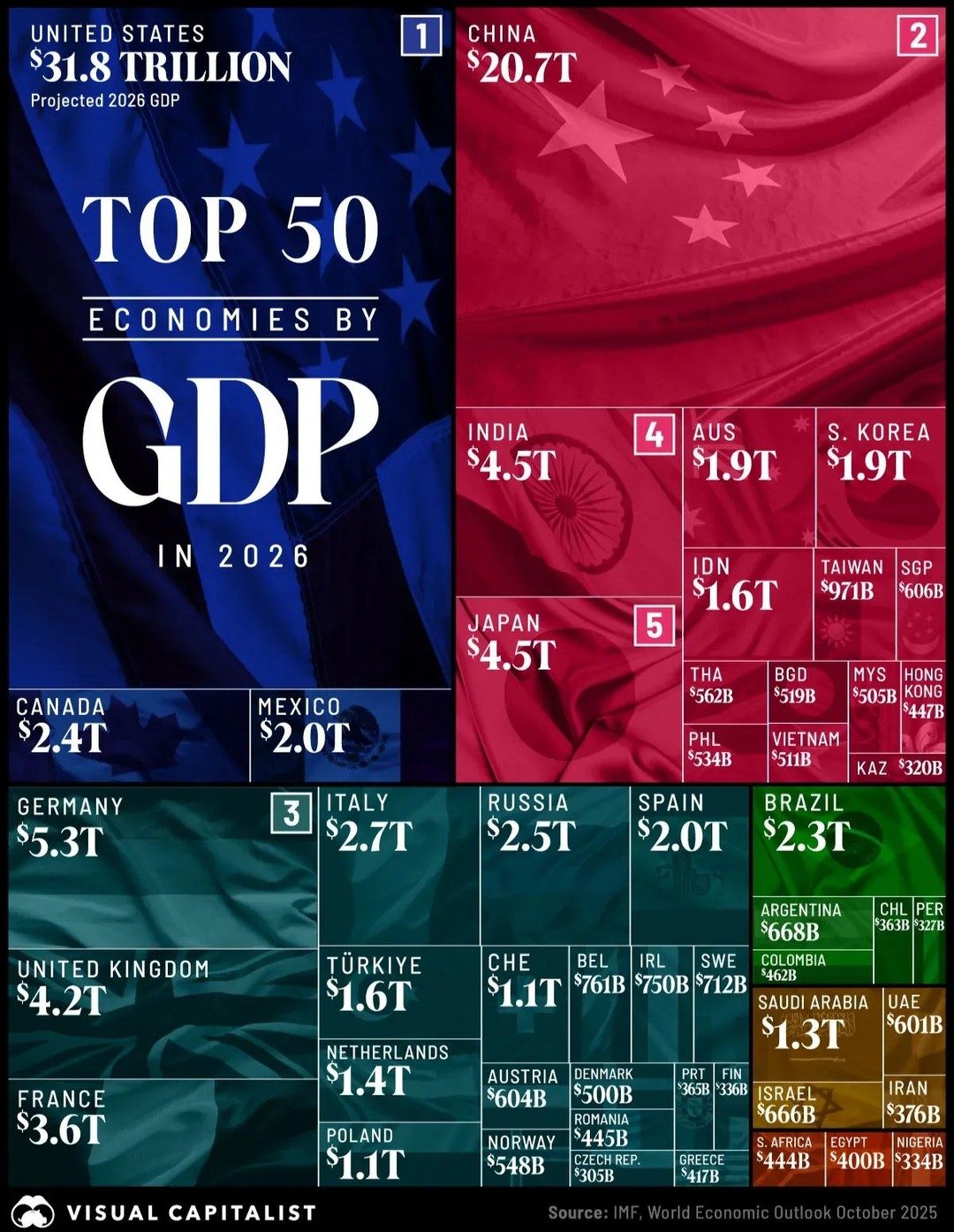
Global GDP Comparison: Ranking the World's Largest Economies in 2026
The global economy is set to reach $123.6 trillion by 2026, with the United States leading at $31.8 trillion in GDP. This projection highlights the significant economic influence of a few major players as the world navigates shifting growth dynamics and higher interest rates. By examining the top 50 economies, we can understand the distribution of global economic power and the key players shaping the future.
Context: The Global Economic Landscape
The global economy is projected to grow substantially by 2026, and this growth is not evenly distributed. The top five economies—including the United States, China, and several European countries—are expected to account for more than 55% of the global output. This concentration underscores the enduring dominance of certain nations in the global economic landscape.
Main Discussion
The United States and China: Economic Powerhouses
The United States remains the world's largest economy, with a projected GDP of $31.8 trillion in 2026. This figure alone is indicative of the U.S.'s robust economic infrastructure and its significant role in global trade and innovation. China follows closely, with a projected GDP of $20.7 trillion. China's rapid economic growth in recent decades has positioned it as a major player in the global economy, rivaling the United States in terms of economic influence.
Key European Economies
Several European nations are also among the top economies in 2026. Germany is projected to have a GDP of $5.3 trillion, making it one of the largest economies in Europe and the world. Italy and Japan, both with projected GDPs of $4.5 trillion, are also significant economic powers. The United Kingdom, with a projected GDP of $4.2 trillion, and France, with $3.6 trillion, further highlight the economic strength of European countries.
Emerging Economies and Their Impact
Emerging economies like Brazil, Russia, and Saudi Arabia are also making notable contributions to the global GDP. Brazil is projected to have a GDP of $320 billion, while Russia is expected to reach $2.5 trillion. Saudi Arabia, with a projected GDP of $1.3 trillion, is a key player in the global energy market, which significantly contributes to its economic power.
The Role of Smaller Economies
While the focus is often on the largest economies, smaller countries also have a significant role in the global economic landscape. For example, Norway, with a projected GDP of $548 billion, and the United Arab Emirates, with $601 billion, show that even mid-sized economies can have a substantial impact. Countries like Turkey, with a projected GDP of $1.6 trillion, and Poland, with $1.1 trillion, are also key contributors to the global economy.
Shifting Economic Dynamics
The global economic landscape is continually evolving, influenced by factors such as higher interest rates, technological advancements, and geopolitical shifts. As countries adjust to these changes, the economic power dynamics will likely continue to shift. For instance, the rise of digital economies and the growing importance of innovation and technology are reshaping the economic landscape, with countries that invest heavily in these areas likely to see significant growth.
Practical Tips for Understanding Global GDP Rankings
Navigating the complex world of global economics can be daunting, but understanding the key factors influencing GDP rankings is a good starting point. Here are some practical tips to help you make sense of global GDP data:
-
Understand the Methodology: Always consider the methodology used in GDP projections. The International Monetary Fund (IMF) provides comprehensive data, but different organizations may use varying methods, which can affect the results.
-
Look Beyond GDP: While GDP is a crucial metric, it's not the only indicator of economic health. Consider factors like per capita income, economic growth rates, and poverty levels for a more nuanced understanding.
-
Track Economic Trends: Economic conditions are dynamic. Regularly tracking economic trends and projections can provide a clearer picture of a country's economic trajectory.
-
Consider Inflation Rates: Inflation can significantly impact the value of GDP. Countries with higher inflation rates may have a lower real GDP compared to those with stable inflation.
-
Evaluate Economic Policies: Government policies play a crucial role in shaping an economy. Understanding fiscal and monetary policies can offer insights into why certain economies are thriving or struggling.
Important Takeaways
The projected GDP rankings for 2026 reveal a few key insights:
- The U.S. and China are expected to maintain their positions as the world’s largest economies, underscoring their dominant roles in global trade and finance.
- European economies, particularly Germany, Italy, and Japan, will continue to be significant contributors to the global GDP.
- Emerging economies like Brazil, Russia, and Saudi Arabia are poised to grow, showcasing the expanding influence of developing nations.
- The concentration of economic power among the top five economies highlights the enduring influence of a few major players in the global economy.
Conclusion
As we look towards 2026, the global economy is poised for significant growth, with the top 50 economies driving much of this expansion. Understanding the projected GDP rankings provides valuable insights into the dynamics of global economic power and the key players shaping the future. By keeping track of these trends and understanding the factors influencing economic growth, we can gain a clearer picture of the world's economic landscape and the challenges and opportunities it presents.
Watch the Reel
Questions readers ask
Why is the 2026 GDP ranking important for understanding the global economy?
The 2026 GDP ranking provides insights into the shifting dynamics of the global market. It helps identify which economies are expected to have the most significant influence and how the distribution of global economic power might evolve. This information is crucial for businesses, investors, and policymakers planning for the future.
Which economies are projected to be the top five in 2026?
According to the projections, the top five economies in 2026 will be the United States, China, Germany, Italy, and Japan. Together, these nations are expected to account for over half of the global economic output, highlighting their substantial economic influence.
How much is the global economy projected to be worth by 2026?
The global economy is anticipated to reach approximately $123.6 trillion by 2026. This significant growth reflects the combined economic output of all nations, with a few major players contributing a substantial portion of this total.
What role do emerging markets play in the 2026 GDP ranking?
Emerging markets are expected to contribute to substantial growth in the 2026 GDP ranking. While the top spots are dominated by established economies, the growth of emerging markets will be a key factor in shaping the overall global economic landscape.
How does the IMF's GDP projection for 2026 influence economic planning?
The IMF's GDP projection for 2026 is a vital tool for economic planning. It provides a forward-looking perspective on which economies are expected to grow, helping governments and businesses make informed decisions about investments, trade policies, and economic strategies.
What is the projected GDP for the United States and China in 2026?
The United States is projected to have a GDP of $31.8 trillion in 2026, making it the largest economy. China is expected to follow closely, with a significant contribution to the global economic output, though exact figures may vary based on economic trends and policies.
How do the top five economies in 2026 compare to the rest of the world?
The top five economies—United States, China, Germany, Italy, and Japan—are expected to account for more than 55% of the global economic output in 2026. This concentration of economic power underscores the dominance of these nations in the global market and their influence on global economic trends.
Related deep dives
Similar reads based on topic and creator.


Recent articles
Fresh deep dives from the latest Reels we unpacked.




Comments
Be the first to comment.