Military Spending Comparison
Every year, countries around the world allocate significant portions of their budgets to defense. The scale and focus of these expenditures vary widely, influenced by factors such as geopolitical tensions, domestic security concerns, and economic capabilities. Let's dive into the intricacies of global military spending, focusing on the top spenders and the metrics that define their military budgets.
Why This Matters
Understanding military spending is crucial for several reasons. It provides insights into global power dynamics, highlights areas of potential conflict, and offers a glimpse into how nations prioritize their resources. Additionally, it sheds light on the economic impact of defense spending, both in terms of job creation and economic stimulus.
Key Metrics: Total Military Spend, Per Capita, and GDP Percentage
Total Military Spend
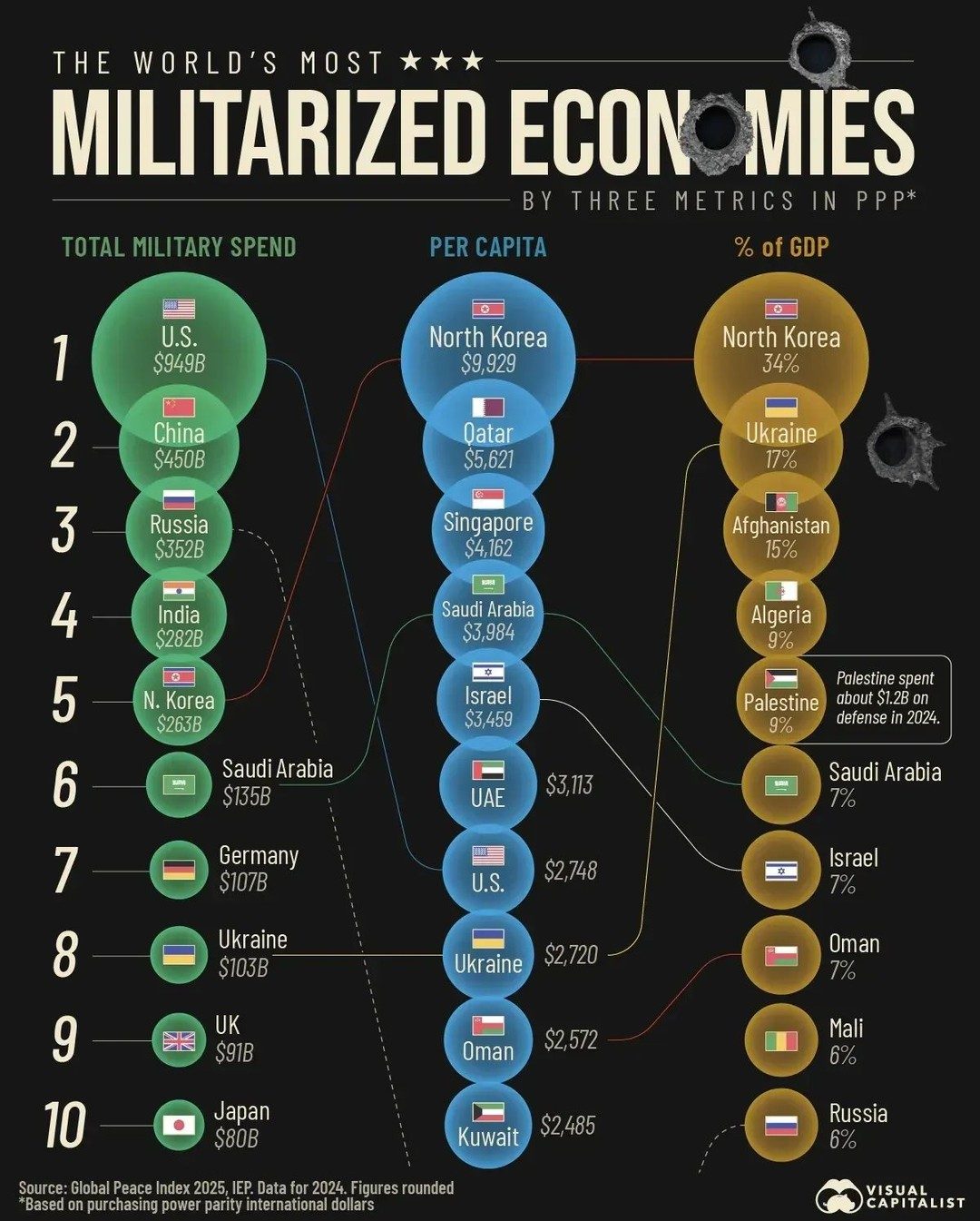
The total military spend is a straightforward metric that shows how much a country allocates to its defense budget. In 2024, the United States leads with a staggering $949 billion. This massive spending reflects the U.S.'s role as a global superpower and its extensive military operations worldwide. Following the U.S. are China with $450 billion, Russia with $352 billion, and India with $282 billion. These figures underscore the significant investments made by major powers to maintain their military capabilities.
Per Capita Military Spend
The per capita military spend, adjusted for purchasing power parity (PPP), reveals how much each citizen contributes to their country's defense budget. North Korea tops this list with $9,929 per person, followed by Qatar at $5,621, and Singapore at $4,162. This metric highlights the extreme focus on military readiness in these countries, often driven by regional security concerns and geopolitical tensions. For instance, Qatar's high spending can be attributed to its strategic location and history of regional conflicts, while Singapore's spending is driven by its need to maintain a strong defense despite its small land area.
Percentage of GDP Spent on Defense
The percentage of GDP allocated to defense provides a different perspective, showing how defense spending relates to a country's overall economic output. Afghanistan leads with 15% of its GDP spent on defense, followed by Palestine and Saudi Arabia with 9% each, and Israel with 7%. These percentages indicate the significant economic burden these countries bear for defense, often due to ongoing conflicts or geopolitical instability.
Contextualizing the Numbers: Regional Dynamics
East Asia and the Pacific
In East Asia and the Pacific, China and India are significant players. China's $450 billion defense budget is the second-highest globally, reflecting its growing military prowess and territorial ambitions. India's $282 billion spending is driven by its long-standing border disputes and strategic competition with China and Pakistan. Japan, with $80 billion, is also a notable spender, focusing on modernizing its defense capabilities in the face of regional threats.
Middle East
The Middle East is characterized by high per capita spending on defense. Qatar's $5,621 per capita spend and Saudi Arabia's $3,984 per capita spend are indicative of the region's tumultuous security environment. Israel's $3,459 per capita spend is similarly high, reflecting its constant state of readiness due to ongoing conflicts with neighboring states.
Europe
In Europe, Germany leads with a $107 billion defense budget, followed by the UK with $91 billion. These countries, members of NATO, allocate significant resources to maintain their military readiness and contribute to collective defense efforts. The percentage of GDP spent on defense is relatively lower, indicating a balance between defense and other economic priorities.
Practical Tips for Understanding Military Spending
When analyzing military spending, it's essential to consider the following:
- Contextualize the Numbers: Understand the geopolitical context and regional dynamics that influence a country's defense spending.
- Look Beyond the Headlines: Examine multiple metrics, including total spend, per capita spend, and percentage of GDP, to get a comprehensive view.
- Consider Economic Impact: Understand how defense spending affects a country’s economy, job market, and overall development.
- Track Trends Over Time: Military spending is not static. Analyze trends over several years to identify patterns and shifts in priorities.
Important Takeaways
-
Diverse Metrics: Each metric—total spend, per capita, and percentage of GDP—provides unique insights into a country's military priorities and capabilities.
-
Geopolitical Context: Regional tensions and strategic interests significantly influence military spending. For instance, North Korea's high per capita spending is driven by its isolated geopolitical situation, while Saudi Arabia's spending reflects its regional conflicts.
-
Economic Balance: Countries must balance military readiness with economic development. High defense spending can strain resources, but it also stimulates economic activity and job creation.
Conclusion
Military spending is a multifaceted issue that reflects a country's strategic priorities, economic capabilities, and geopolitical challenges. By examining the world's most militarized economies through the lenses of total spend, per capita, and percentage of GDP, we gain a deeper understanding of global defense dynamics. Whether it's the U.S. leading in total military spend or North Korea's exceptionally high per capita spending, each country's defense budget tells a story of its unique circumstances and strategic outlook.
Watch the Reel
Questions readers ask
Which countries are the top 5 military spenders in 2024?
The top 5 countries with the highest military spending in 2024 are the United States, China, Russia, and India. These countries lead in overall defense expenditures, reflecting their significant global influence and security concerns.
How does North Korea rank in military spending per capita?
North Korea ranks high in military spending per capita. This is indicative of the country's unique security priorities and its focus on maintaining a substantial military presence despite economic constraints.
What factors influence a country's military spending?
Several factors influence a country's military spending, including geopolitical tensions, domestic security concerns, and economic capabilities. These factors drive the scale and focus of defense expenditures across different countries.
Why is it important to track global military spending?
Tracking global military spending is important as it provides insights into global power dynamics and highlights areas of potential conflict. It also offers a glimpse into how nations prioritize their resources and the economic impact of defense spending, including job creation and economic stimulation.
Which countries lead in per capita military spending in 2024?
North Korea, Qatar, and Singapore are the leading countries in per capita military spending in 2024. Their high per capita spending reflects their unique security priorities and the significant portion of their budgets allocated to defense.
How does military spending vary among the top 5 spenders in 2024?
Military spending among the top 5 spenders in 2024, which include the United States, China, Russia, and India, varies based on their geopolitical strategies, economic capabilities, and domestic security needs. These countries allocate substantial portions of their budgets to defense, reflecting their global influence and strategic importance.
What insights can be gained from analyzing global military data in 2024?
Analyzing global military data in 2024 offers insights into how nations prioritize their resources, the economic impact of defense spending, and the areas of potential conflict. It highlights the geopolitical tensions and security concerns that drive military expenditures around the world.
Related deep dives
Similar reads based on topic and creator.


Recent articles
Fresh deep dives from the latest Reels we unpacked.




Comments
Be the first to comment.