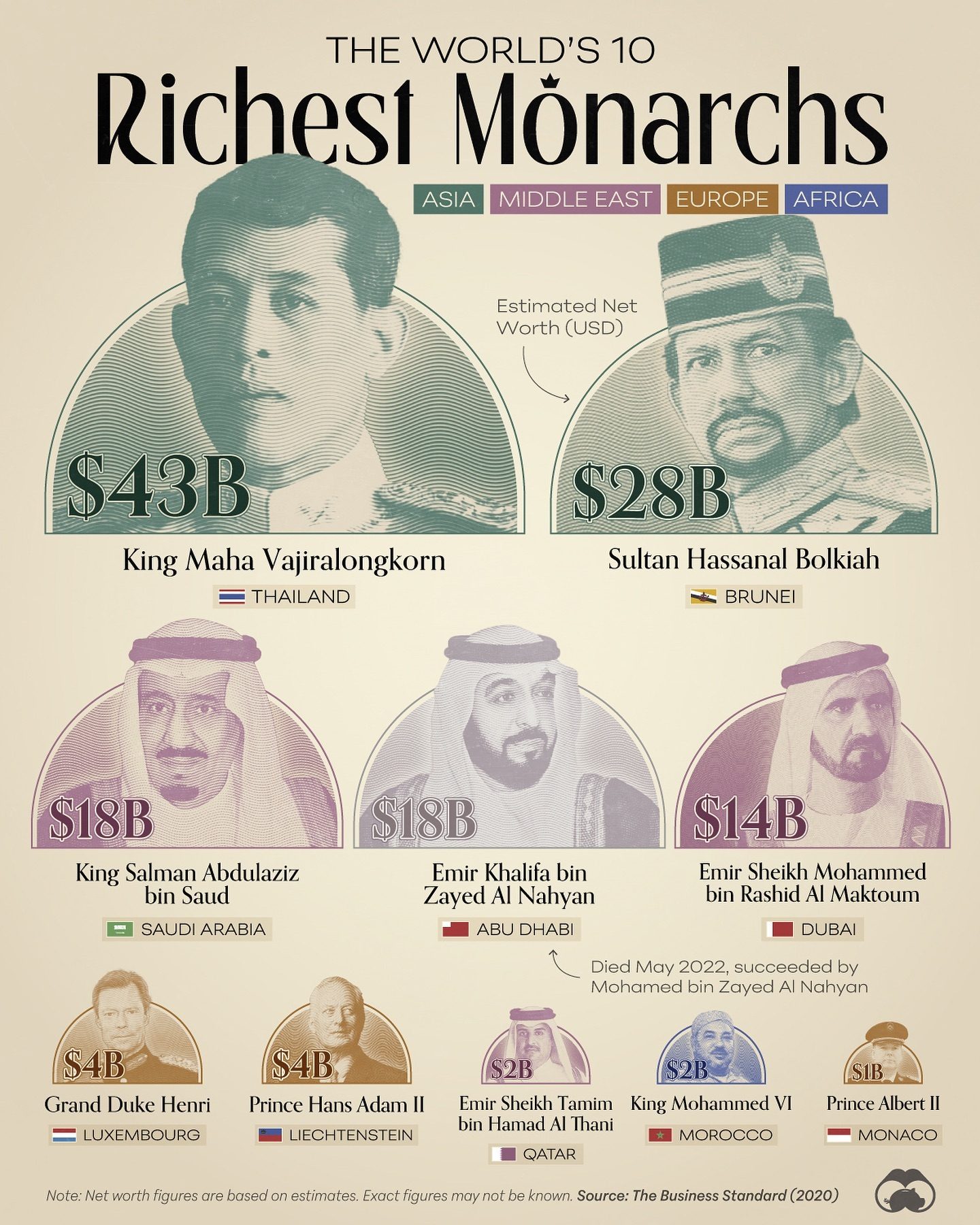
A lasting interest in wealth and power, the world's monarchs hold significant influence and assets. The richest monarchs, in particular, often draw attention due to their vast fortunes and the sources of their wealth. At the top of this list is King Maha Vajiralongkorn from Thailand, with an estimated net worth of $43 billion. Let's delve into the wealth of the world's top monarchs, exploring their sources of income and the broader context of their financial power.
Context / Why this matters
The wealth of monarchs is often tied to the economic health and resources of their countries. For instance, King Maha Vajiralongkorn's fortune is largely attributed to his stakes in real estate in Bangkok, as well as his ownership in Thailand's largest cement company and bank. This kind of wealth, derived from strategic investments and ownership, is a common theme among the world's richest monarchs. Understanding the sources of their wealth provides insights into the economic landscapes of their respective regions and the broader dynamics of global wealth distribution.
Main discussion
Asia's Wealthiest Monarchs
King Maha Vajiralongkorn of Thailand
King Maha Vajiralongkorn tops the list with an estimated net worth of $43 billion. His wealth is primarily sourced from strategic investments in real estate in Bangkok, as well as significant ownership stakes in Thailand's largest cement company and bank. These investments not only contribute to his personal fortune but also play a crucial role in Thailand's economic landscape. Thailand’s dependence on these sectors highlights the monarch's pivotal role in the country’s economy.
Sultan Hassanal Bolkiah of Brunei
Following King Maha Vajiralongkorn is Sultan Hassanal Bolkiah of Brunei, with an estimated net worth of $28 billion. Much of his wealth comes from the country’s substantial oil and gas reserves, which have made Brunei one of the wealthiest nations per capita. The Sultan's financial power is deeply intertwined with the nation’s oil and gas industry, reflecting the significant role of natural resources in global wealth dynamics.
Middle East Monarchs
King Salman Abdulaziz of Saudi Arabia
King Salman Abdulaziz of Saudi Arabia secures a spot with an estimated net worth of $18 billion. Saudi Arabia's wealth is largely derived from its vast oil reserves, making King Salman's financial power a direct reflection of the country's petroleum-based economy. The Saudi royal family's wealth has historically been tied to the nation's oil industry, which remains a cornerstone of its economic strategy.
Emir Khalifa bin Zayed Al Nahyan of Abu Dhabi
With an estimated net worth of $18 billion, Emir Khalifa bin Zayed Al Nahyan is another prominent figure. His wealth is driven by Abu Dhabi's significant oil and gas reserves, as well as investments in various sectors, including finance and real estate. The Emir's financial power is a testament to Abu Dhabi’s strategic investments and diversified economic portfolio.
European Monarchs
Emir Sheikh Mohammed bin Rashid Al Maktoum of Dubai
Emir Sheikh Mohammed bin Rashid Al Maktoum of Dubai has an estimated net worth of $14 billion. Dubai's rapid transformation into a global financial and tourism hub has significantly contributed to the Emir's wealth. The city’s strategic investments in real estate, finance, and tourism have positioned it as a major player in the global economy.
Europe's Other Millionaires
Grand Duke Henri of Luxembourg
With an estimated net worth of $4 billion, Grand Duke Henri of Luxembourg’s wealth is derived from the country’s financial sector, which is a major contributor to Luxembourg’s economic standing. The country's role as a key hub for European finance and investment is a significant factor in the Grand Duke's financial power.
Prince Albert II of Monaco
Prince Albert II of Monaco, with an estimated net worth of $1 billion, benefits from Monaco’s status as a tax haven and financial center. Monaco’s strategic investments and financial policies have helped build its reputation as a wealth hub and contributed to the Prince’s personal fortune. Monaco's economy, driven by tourism, finance, and real estate, is a critical source of the Prince's wealth.
Other Notable Monarchs
Emir Sheikh Tamim bin Hamad Al Thani of Qatar
Emir Sheikh Tamim bin Hamad Al Thani of Qatar has an estimated net worth of $2 billion. Qatar’s wealth is largely driven by its substantial natural gas reserves, making the Emir's fortune a direct reflection of the country’s natural resource wealth.
Prince Albert II of Monaco
Prince Albert II of Monaco, with an estimated net worth of $1 billion, benefits from Monaco’s status as a tax haven and financial center. Monaco’s strategic investments and financial policies have helped build its reputation as a wealth hub and contributed to the Prince’s personal fortune. Monaco's economy, driven by tourism, finance, and real estate, is a critical source of the Prince’s wealth.
Practical tips
While it's fascinating to explore the wealth of the world's monarchs, several practical tips can be drawn from these insights. Firstly, diversifying investments across various sectors, such as real estate, finance, and natural resources, can significantly enhance wealth accumulation. Secondly, strategic ownership and control over key industries can provide long-term financial stability and growth. Lastly, understanding the economic landscape of a region and leveraging its strengths can be a powerful strategy for building wealth.
Important takeaways
The wealth of the world's monarchs offers a glimpse into the broader dynamics of global wealth distribution. Key takeaways include the importance of diversified investments, strategic ownership, and leveraging regional economic strengths. While the wealth of these monarchs is often tied to their countries' economic performance, their personal fortunes also reflect broader global trends in wealth accumulation and management.
Conclusion
The world's richest monarchs, with their vast fortunes and strategic investments, provide valuable insights into global wealth dynamics. From King Maha Vajiralongkorn of Thailand to Prince Albert II of Monaco, these monarchs' wealth is a testament to the power of strategic investments and ownership. Understanding their financial strategies offers practical lessons in wealth management and economic diversification, highlighting the importance of leveraging regional strengths and strategic investments.
Watch the Reel
Questions readers ask
Who is the richest monarch in the world?
King Maha Vajiralongkorn of Thailand is currently the wealthiest monarch, with an estimated net worth of approximately $43 billion. His wealth is largely derived from strategic investments in real estate and significant holdings in major Thai corporations, including the country's largest cement company and bank.
What are the primary sources of wealth for the richest monarchs?
The primary sources of wealth for the richest monarchs often include strategic investments in key industries, ownership of national resources, and substantial holdings in major corporations. For example, many monarchs have significant stakes in real estate, finance, and natural resource sectors, which contribute to their vast fortunes.
How do monarchs such as Sultan Hassanal Bolkiah of Brunei accumulate their wealth?
Sultan Hassanal Bolkiah of Brunei accumulates his wealth through various means, including substantial oil and gas reserves, strategic investments, and significant control over the country’s economy. His wealth is closely tied to Brunei's natural resource wealth and his ownership of key assets within the country.
How do the wealth sources of monarchs impact their countries' economies?
The wealth sources of monarchs significantly impact their countries' economies. Monarchs often invest in key sectors such as real estate, finance, and natural resources, stimulating economic growth and development. For example, King Maha Vajiralongkorn’s investments in Thailand’s cement and banking industries have a broad economic influence on the country.
What are some common business strategies employed by the world’s wealthiest monarchs?
Common business strategies employed by the world’s wealthiest monarchs include owning and managing national resources, strategic real estate investments, and control over key industries. By leveraging their position and influence, these monarchs can build extensive portfolios that diversify their wealth and ensure long-term financial stability.
Why are investments in real estate and natural resources popular among monarchs?
Investments in real estate and natural resources are popular among monarchs because they offer long-term stability and high returns. These assets are often crucial to a country's economic infrastructure and can generate significant income through rent, royalties, and resource extraction. Additionally, owning such assets can provide monarchs with substantial influence over the economy.
How does the net worth of King Maha Vajiralongkorn compare to other wealthy monarchs?
King Maha Vajiralongkorn’s net worth of approximately $43 billion places him at the top among the world’s wealthiest monarchs. While other monarchs, such as Sultan Hassanal Bolkiah of Brunei, also have substantial fortunes, King Maha Vajiralongkorn's wealth stands out due to his extensive holdings in Thailand's major industries and strategic investments, making him one of the wealthiest individuals globally.
Related deep dives
Similar reads based on topic and creator.


Recent articles
Fresh deep dives from the latest Reels we unpacked.




Comments
Be the first to comment.