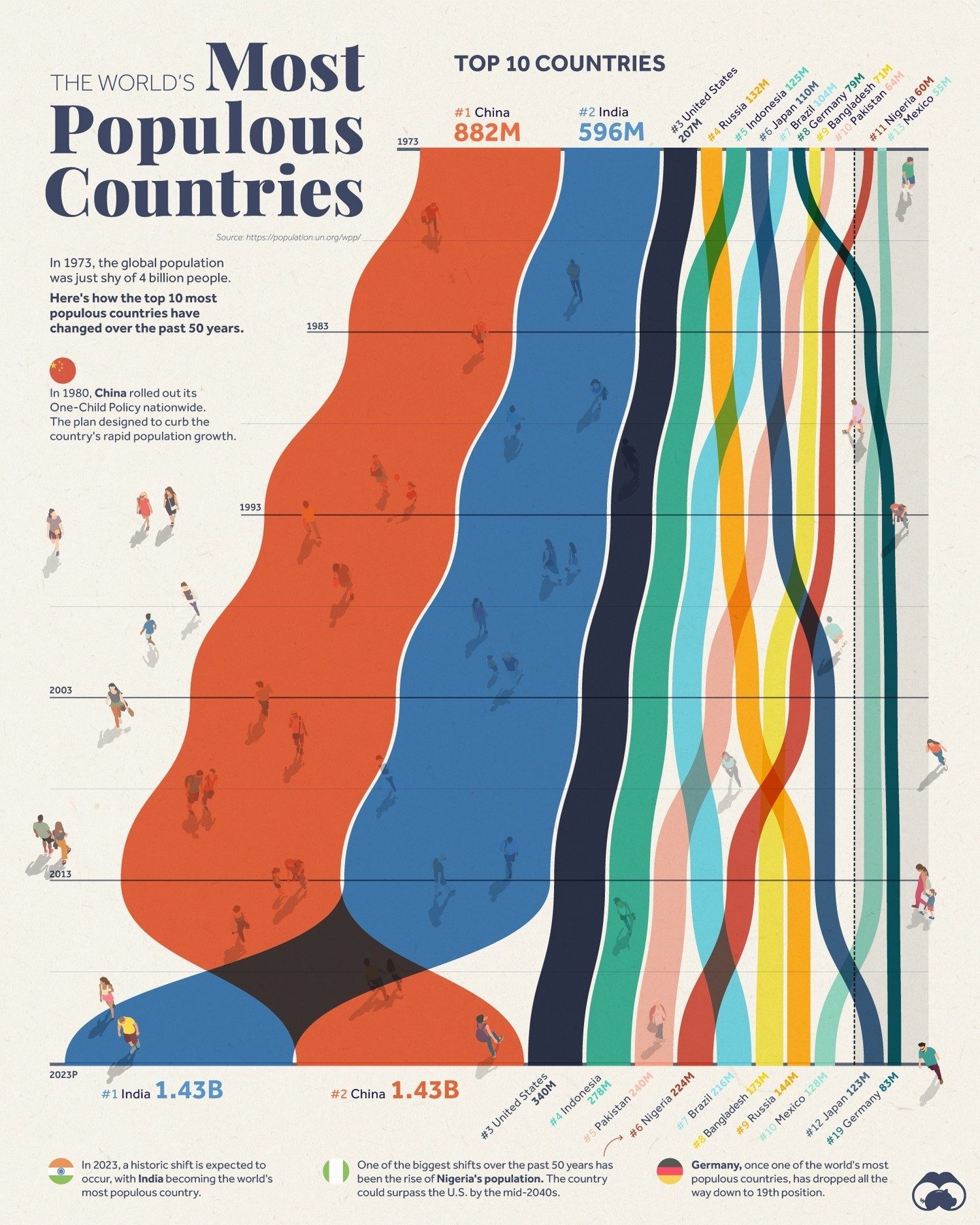
World Population Changes from 1973 to 2023
The global population has doubled since 1973, reaching eight billion people. This growth hasn't been evenly distributed, and the ranking of the world's most populous countries has shifted significantly over the past five decades. Using the latest data from the United Nations, we can explore which countries have the largest share of the world's population and how these figures have changed.
Why This Matters
Understanding population trends is crucial for various reasons. It helps governments plan for the future, allocate resources effectively, and address challenges such as housing, healthcare, and employment. For businesses, it provides insights into consumer markets and potential growth areas. On a global scale, population trends influence international relations, trade, and development strategies.
Population Trends Over the Decades
The 1970s: A Starting Point
In 1973, the global population was approximately 4 billion people. The top 10 most populous countries included China, India, the United States, Indonesia, Brazil, Russia, Japan, Nigeria, West Germany, and Poland. Notably, China and India were already the most populous nations, a trend that would continue and even amplify in the coming decades.
The 1980s: Policy Influences
The 1980s marked significant policy changes in several countries. China, for example, implemented its One-Child Policy in 1980 to control population growth. This policy had a profound impact, significantly slowing China's population growth rate. Meanwhile, other countries like Indonesia, Brazil, and Nigeria continued to see steady population increases.
The 1990s: Economic and Social Changes
By the 1990s, the global population had reached around 5.3 billion. Economic and social changes in countries like Brazil and Mexico led to shifts in their population rankings. Brazil, in particular, experienced economic growth and urbanization, which influenced its population trends. Pakistan and Bengaladesh's populations also grew rapidly, driven by high birth rates and improving healthcare.
The 2000s: A New Millennium
The turn of the millennium saw the global population surpass six billion. Countries like Nigeria and Bangladesh continued to climb the ranks, driven by high birth rates. The United States and Russia maintained their positions, while Germany's population began to plateau due to low birth rates.
The 2020s: A Changing Landscape
As of 2023, the global population is expected to reach eight billion. India is projected to surpass China as the world's most populous country, a shift largely influenced by China's family planning policies and India's high birth rates. Nigeria and Bangladesh also continue to grow rapidly, reflecting broader demographic trends in Africa and Asia.
Key Population Shifts
- China's One-Child Policy, implemented in 1980, played a significant role in controlling its population growth. However, the policy's long-term effects, including an aging population, are now being felt.
- India's population growth, driven by high birth rates, is expected to surpass China's in 2023, marking a significant shift in global demographics.
- Nigeria's population growth has been rapid, driven by high fertility rates and declining infant mortality. By 2023, Nigeria is projected to be the third most populous country worldwide, highlighting the demographic trends in sub-Saharan Africa.
- Bangladesh's population growth has also been significant, reflecting broader trends in South Asia. The country's high birth rates and improving healthcare have contributed to its growing population.
- Germany's population, once among the world's most populous, has dropped to 19th position due to low birth rates and an aging population.
Practical Tips for Understanding Population Data
When analyzing population data, consider the following tips:
- Look at birth and death rates, as well as migration patterns, to understand population changes.
- Consider the age structure of a population, as this can indicate future growth trends.
- Pay attention to policy changes, such as family planning initiatives, which can significantly impact population growth.
- Understand the economic and social context, as these factors can drive population changes.
Important Takeaways
- The global population has doubled since 1973, reaching eight billion people.
- China and India have consistently been the most populous countries, but India is expected to surpass China in 2023.
- Population growth has been driven by a mix of high birth rates, improving healthcare, and policy changes.
- Understanding population trends is crucial for effective planning and resource allocation.
Conclusion
The world's population has undergone significant changes over the past five decades, with shifts in rankings and growth rates. These trends reflect broader demographic, economic, and social changes. By understanding these shifts, we can better plan for the future, allocate resources, and address global challenges.
Watch the Reel
Questions readers ask
Which countries have consistently remained in the top 10 most populous since 1973?
Several countries have consistently ranked among the top 10 most populous since 1973. These include China, India, the United States, Indonesia, and Brazil. These nations have maintained their positions due to sustained population growth and large initial populations.
How has China's population growth impacted its global ranking?
As of the latest data, China remains one of the most populous countries, having experienced significant population growth over the decades. However, recent trends indicate that India may have surpassed China in population, reflecting a shift in global demographic trends.
What factors have influenced the changes in the top 10 most populous countries from 1973 to 2023?
Several factors have contributed to these changes, including economic growth, policy changes, and varying rates of fertility and mortality. For instance, improvements in healthcare and economic development have led to increased life expectancy and population growth in countries like India and Indonesia.
How has the world population size changed from 1973 to 2023?
The world population has more than doubled since 1973, reaching approximately eight billion people. This dramatic increase is due to a combination of declining mortality rates, improvements in healthcare, and varying fertility rates across different regions.
Why is it important to track global demographic trends?
Tracking global demographic trends is vital for governments and businesses alike. It helps in effective resource allocation, infrastructure planning, and addressing social challenges such as housing, healthcare, and employment. For businesses, understanding these trends can reveal potential growth areas and consumer markets.
Which region has seen the most significant population changes over the past five decades?
Asia, particularly countries like India and Indonesia, has seen the most significant population changes. These countries have experienced rapid growth, contributing to a shift in the global demographic landscape and influencing resource allocation and international relations.
Recent articles
Fresh deep dives from the latest Reels we unpacked.




Comments
Be the first to comment.