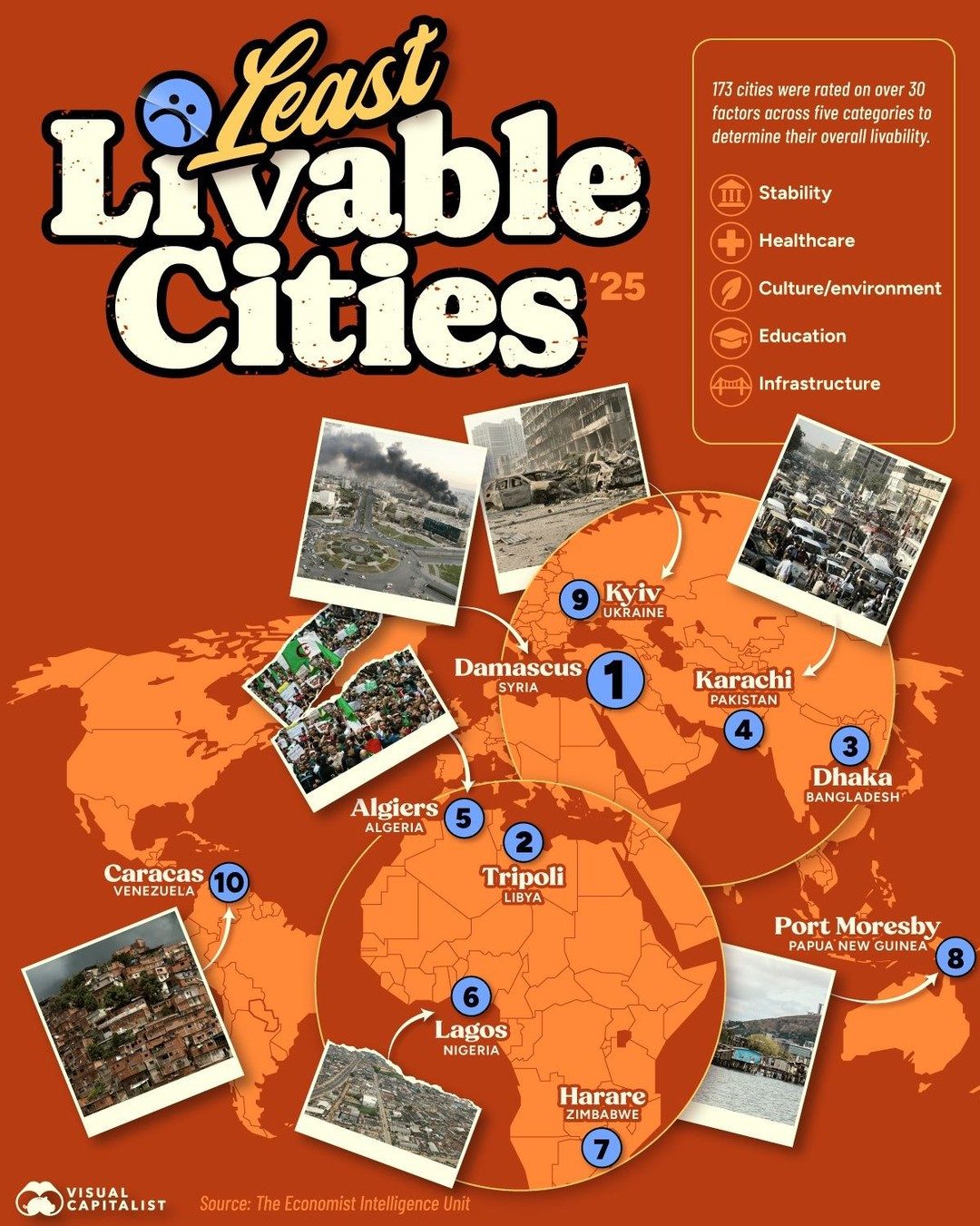
Least Livable Cities in 2025
The least livable cities in 2025 face significant challenges from conflict, infrastructure deficiencies, and climate risks. Damascus, the capital of Syria, tops the list as the world's least livable city. This ranking is based on the Economist Intelligence Unit’s Global Liveability Index for 2025, which evaluates cities across five key categories: stability, healthcare, culture/environment, education, and infrastructure.
Why This Matters
Understanding which cities are the least livable in 2025 sheds light on the global challenges faced in urban planning, public health, and environmental sustainability. These rankings highlight the critical issues that cities around the world must address to improve the quality of life for their residents.
Main Discussion
Global Livability Index Methodology
The Economist Intelligence Unit evaluates 173 cities based on over 30 factors across five categories to determine their overall livability. This comprehensive evaluation provides a detailed picture of the challenges and strengths of each city. The five categories are:
- Stability: This includes factors like crime rates, political stability, and the risk of conflict.
- Healthcare: The availability and quality of healthcare services.
- Culture/Environment: Access to cultural attractions, environmental quality, and climate.
- Education: The quality and accessibility of education.
- Infrastructure: The development and maintenance of public infrastructure, including transportation and utilities.
Top 10 Least Livable Cities
The infographic maps out the least livable cities, highlighting the specific challenges each city faces. Here are the top 10 least livable cities in 2025, along with their respective rankings:
- Damascus, Syria (Rank 1) - Damascus remains the least livable city due to ongoing conflict, infrastructure damage, and limited access to healthcare and education.
- Tripoli, Libya (Rank 2) - Tripoli struggles with political instability, poor healthcare, and inadequate infrastructure.
- Port Moresby, Papua New Guinea (Rank 3) - Despite improvements in infrastructure, Port Moresby continues to face significant issues with stability, healthcare, and education.
- Dhaka, Bangladesh (Rank 4) - Dhaka's rapid urbanization has led to severe overcrowding, poor air quality, and major challenges in public health.
- Karachi, Pakistan (Rank 5) - Karachi's challenges include high crime rates, inadequate healthcare, and poor infrastructure.
- Algiers, Algeria (Rank 6) - Algiers faces issues with political stability, limited access to healthcare, and a lack of cultural amenities.
- Caracas, Venezuela (Rank 7) - Caracas is plagued by economic instability, a high crime rate, and severe shortages in healthcare and education.
- Harare, Zimbabwe (Rank 8) - Harare's economy is struggling, leading to poor healthcare and infrastructure, and limited access to education.
- Lagos, Nigeria (Rank 9) - Lagos faces severe challenges with overcrowding, poverty, and inadequate infrastructure.
- Kyiv, Ukraine (Rank 10) - Ongoing conflict and political instability have significantly impacted Kyiv's stability, healthcare, and infrastructure.
Key Challenges Faced by These Cities
The least livable cities in 2025 face a range of challenges that impact their overall quality of life. These challenges can be categorized into several groups:
- Conflict and Political Instability: Cities like Damascus, Tripoli, and Caracas are severely affected by conflict and political instability, which disrupts daily life and undermines the delivery of essential services.
- Infrastructure Deficiencies: Many of these cities struggle with inadequate infrastructure, including poorly maintained roads, limited access to clean water, and unreliable energy supplies.
- Healthcare and Education: Limited access to quality healthcare and education is a significant issue in many of these cities, impacting the overall well-being and future prospects of their residents.
- Environmental and Climate Risks: Urban areas like Dhaka and Lagos face severe environmental challenges, including air pollution, water scarcity, and the impacts of climate change.
Practical Tips
For City Planners
City planners in the least livable cities can take several steps to improve their urban environments:
- Invest in Infrastructure: Prioritize the development and maintenance of public infrastructure, including transportation, utilities, and housing.
- Enhance Healthcare and Education: Improve access to quality healthcare and education by investing in hospitals, clinics, and schools.
- Promote Stability and Security: Work towards political stability and public safety by addressing crime and conflict.
- Sustainable Urban Planning: Implement sustainable urban planning practices to mitigate environmental challenges and climate risks.
For Residents
Residents of these cities can also play a role in improving their living conditions:
- Community Engagement: Get involved in local community initiatives to address specific issues in your neighborhood.
- Advocacy and Awareness: Advocate for policy changes and raise awareness about the challenges faced by your city.
- Personal Preparedness: Take steps to protect yourself and your family from environmental risks and health issues.
Important Takeaways
The ranking of the least livable cities in 2025 provides valuable insights into the global challenges that cities face. It is essential to recognize that these challenges are interconnected and require comprehensive solutions. Addressing issues like conflict, infrastructure, and climate risks can significantly improve the quality of life in these cities.
Conclusion
Understanding the least livable cities in 2025 highlights the urgent need for global action in urban planning, public health, and environmental sustainability. By addressing the key challenges faced by these cities, we can create more livable and resilient urban environments for all.
Watch the Reel
Questions readers ask
Which city is ranked as the least livable in 2025?
Damascus, Syria, is ranked as the least livable city in 2025 due to ongoing conflict and severe infrastructure issues. This ranking is based on the Economist Intelligence Unit’s Global Liveability Index, which assesses various factors contributing to the quality of life in urban areas.
What factors contribute to a city being classified as least livable?
A city's ranking as least livable is influenced by several key factors, including stability, healthcare, culture and environment, infrastructure, and climate risks. These elements collectively determine the overall quality of life and the challenges residents face.
How does the 2025 ranking help in understanding global urban challenges?
The 2025 ranking of least livable cities provides insights into the significant challenges faced by urban areas worldwide. It highlights issues such as conflict, infrastructure deficiencies, and climate risks, which are crucial for urban planners, policymakers, and residents to address.
What specific challenges does Damascus face that contribute to its ranking?
Damascus, Syria, faces severe challenges such as ongoing conflict, which impacts stability and safety, and significant infrastructure issues that hinder access to basic services. These factors collectively contribute to its position as the least livable city in 2025.
What is the methodology behind the list of least livable cities in 2025?
The list is based on the Economist Intelligence Unit’s Global Liveability Index, which evaluates cities using five key categories: stability, healthcare, culture and environment, infrastructure, and climate risks. This comprehensive approach ensures a well-rounded assessment of urban livability.
What can be done to improve the livability of cities ranked low in 2025?
Improving the livability of cities ranked low in 2025 involves addressing specific challenges such as conflict resolution, infrastructure development, and climate risk mitigation. Policymakers and urban planners can focus on enhancing stability, healthcare services, and overall urban infrastructure to elevate the quality of life in these cities.
Related deep dives
Similar reads based on topic and creator.



Recent articles
Fresh deep dives from the latest Reels we unpacked.




Comments
Be the first to comment.