Digital Heists: The Art of Exploiting Human Trust
Digital heists, particularly those involving cryptocurrency, have become increasingly prevalent. These heists often exploit human trust rather than relying on brute-force hacking methods. By understanding the most significant digital heists and the strategies employed by cybercriminals, individuals and organizations can better protect themselves from falling victim to similar attacks.
Why This Matters
In the digital age, cybersecurity is paramount. Digital heists not only result in financial losses but also undermine trust in digital systems and financial institutions. The most effective heists exploit human trust, making it crucial to recognize and mitigate this vulnerability.
The Biggest Digital Heists: A Breakdown
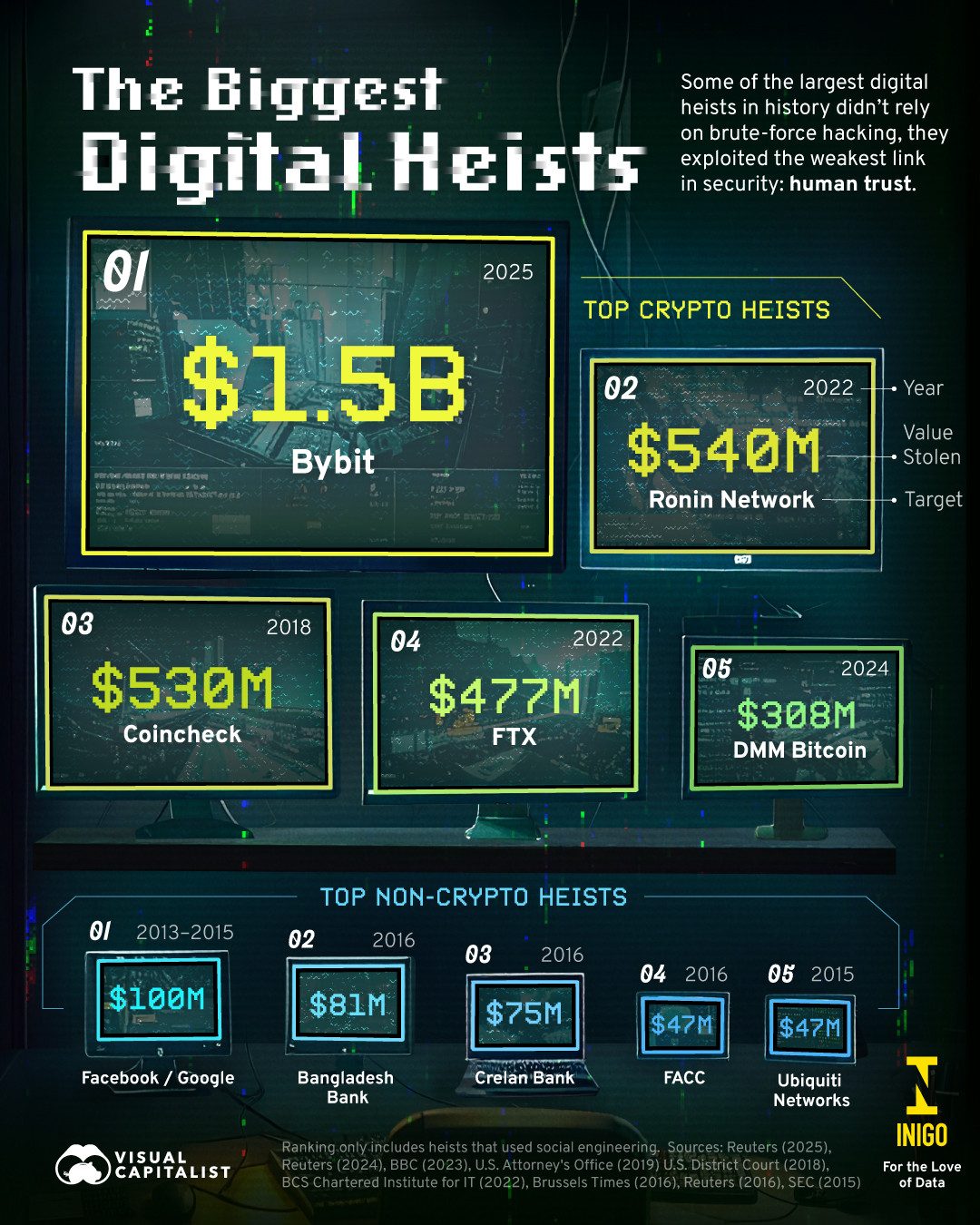
The largest digital heists in history have targeted both crypto and non-crypto platforms. These heists highlight the critical role of human trust in cybersecurity vulnerabilities.
Top Crypto Heists
1. Bybit
In 2025, Bybit, a leading cryptocurrency exchange, experienced the largest digital heist to date, with a staggering $1.5 billion stolen. The heist exploited human trust, demonstrating the vulnerability of even the most advanced cybersecurity systems when social engineering is involved.
2. Ronin Network
The Ronin Network, a sidechain for blockchain games, suffered a significant heist in 2022. Cybercriminals exploited human trust to steal $540 million. This heist underscores the importance of vigilance in the rapidly evolving world of blockchain technology.
3. Coincheck
Coincheck, a Japanese cryptocurrency exchange, was targeted in 2018. The heist resulted in a loss of $530 million. The attack utilized social engineering tactics, highlighting the need for robust security measures and employee training.
4. FTX
FTX, a prominent cryptocurrency exchange, experienced a heist in 2022, losing $477 million. The attack leveraged human trust, showcasing the critical need for comprehensive security protocols.
5. DMM Bitcoin
In 2024, DMM Bitcoin, a Japanese cryptocurrency exchange, was targeted in a heist resulting in a $308 million loss. The attack exploited human trust, reinforcing the importance of continuous vigilance in the crypto industry.
Top Non-Crypto Heists
Digital heists extend beyond the crypto world, targeting major corporations and institutions. These heists often result in significant financial losses and damage to reputations.
1. Facebook/Google
In a notable heist, Facebook and Google were targeted for a combined $100 million. The attackers exploited human trust, emphasizing the need for stringent security measures in corporate environments.
2. Other Notable Heists
Several other digital heists, including those targeting various companies and institutions, have resulted in substantial financial losses. These heists, such as the one targeting a company for $81 million, and others for $75 million and $47 million, underscore the pervasive nature of digital heists and the need for comprehensive security measures.
The Role of Social Engineering
Social engineering plays a critical role in digital heists. Attackers exploit human trust to gain access to sensitive information or systems. Understanding the tactics used in social engineering is essential for developing effective countermeasures.
Tactics Used in Social Engineering
- Phishing: Attackers use deceptive emails or messages to trick individuals into revealing sensitive information.
- Pretexting: Attackers create a false scenario to persuade a target to divulge information or perform an action.
- Baiting: Attackers offer something enticing to lure victims into a trap, such as downloading malware.
- Quid Pro Quo: Attackers offer a service in exchange for information, often posing as IT support.
Preventing Social Engineering Attacks
To protect against social engineering attacks, organizations and individuals should implement the following measures:
- Employee Training: Regular training programs can help employees recognize and respond to social engineering tactics.
- Multi-Factor Authentication (MFA): MFA adds an extra layer of security, making it harder for attackers to gain unauthorized access.
- Strong Passwords: Encouraging the use of strong, unique passwords can significantly reduce the risk of unauthorized access.
- Regular Security Audits: Conducting regular security audits can help identify and address vulnerabilities in security systems.
- Incident Response Plans: Having a well-defined incident response plan can help organizations quickly and effectively respond to security breaches.
Practical Tips for Protecting Against Digital Heists
Protecting against digital heists requires a proactive approach. Here are some practical tips for individuals and organizations:
For Individuals
- Be Cautious of Unsolicited Requests: Avoid clicking on links or downloading attachments from unknown sources.
- Verify Requests: Always verify requests for sensitive information, especially if they come from unexpected sources.
- Use Security Software: Install and regularly update security software to protect against malware and other threats.
- Monitor Financial Accounts: Regularly check financial accounts for any unusual activity.
- Report Suspicious Activity: Report any suspicious activity to the relevant authorities or organizations.
For Organizations
- Implement Comprehensive Security Measures: Use a combination of technical controls, such as firewalls and encryption, along with regular security audits and incident response plans.
- Conduct Regular Training: Provide regular training on cybersecurity best practices and social engineering tactics.
- Encourage a Culture of Security: Foster a culture of security awareness within the organization, encouraging employees to report any suspicious activity.
- Limit Access to Sensitive Information: Restrict access to sensitive information to only those who need it, reducing the risk of unauthorized access.
- Stay Updated on Threats: Keep abreast of the latest cybersecurity threats and trends, adjusting security measures as necessary.
Important Takeaways
Digital heists, particularly those exploiting human trust, pose a significant threat to both individuals and organizations. By understanding the tactics used in these heists and implementing effective countermeasures, it is possible to mitigate the risk of falling victim to such attacks. Regular training, robust security measures, and a culture of vigilance are essential for protecting against digital heists.
Conclusion
The biggest digital heists in history have highlighted the critical role of human trust in cybersecurity vulnerabilities. By understanding the tactics used in these heists and implementing effective countermeasures, individuals and organizations can better protect themselves from falling victim to similar attacks. Whether targeting crypto exchanges or major corporations, digital heists underscore the need for continuous vigilance and comprehensive security measures.
Watch the Reel
Questions readers ask
What are some common techniques used in digital heists to exploit human trust?
Digital heists often employ social engineering tactics such as phishing emails, impersonation, and fake websites to manipulate individuals into divulging sensitive information or transferring funds. These methods rely on the target's trust and can be surprisingly effective, even against those who are technically savvy. Cybercriminals may also use fear or a sense of urgency to pressure victims into acting quickly without thinking critically about the situation.
Why are cryptocurrency exchanges and blockchain games common targets for digital heists?
Cryptocurrency exchanges and blockchain games are attractive targets due to the high value of the assets they hold and the pseudo-anonymous nature of cryptocurrency transactions, which can make it difficult to trace stolen funds. Additionally, these platforms often have a large number of users, increasing the potential pool of targets for cybercriminals to exploit. The complex and rapidly evolving nature of these technologies can also make it challenging for users to stay informed about the latest security best practices.
How can individuals and organizations protect themselves from digital heists that exploit human trust?
To protect against digital heists, it's crucial to implement robust security measures, such as multi-factor authentication and strong, unique passwords. Regular security awareness training can help individuals recognize and avoid social engineering tactics. Organizations should also have clear protocols in place for handling sensitive information and responding to potential security incidents. Encouraging a culture of vigilance and skepticism can help individuals stay alert to potential threats.
What are some of the most notable digital heists from 2022?
2022 saw several significant digital heists, including the Ronin Network hack, where cybercriminals exploited vulnerabilities to steal nearly $600 million in cryptocurrency. Other notable heists include the Wormhole exploit, which resulted in a loss of $325 million, and the Nomad Bridge hack, where attackers took advantage of a vulnerability to steal around $190 million. These incidents highlight the ongoing threat of digital heists and the need for improved security measures in the cryptocurrency and blockchain sectors.
What is the difference between digital heists that exploit human trust and brute-force cyberattacks?
Digital heists that exploit human trust, such as those using social engineering, focus on manipulating people into performing actions that compromise security. In contrast, brute-force cyberattacks rely on automated methods to systematically guess passwords, encryption keys, or other security credentials. While brute-force attacks can be effective, they often require significant computational resources and can be more easily detected and mitigated through strong security protocols, unlike the more subtle and deceptive methods of exploiting human trust.
What are the consequences of digital heists beyond financial loss?
Beyond the direct financial losses, digital heists can have far-reaching consequences. They can erode trust in digital systems and financial institutions, leading to a decrease in user confidence and potentially driving users away from affected platforms. Additionally, the personal information compromised during these heists can be used for other forms of fraud and identity theft, causing ongoing harm to individuals and organizations. The reputational damage to the affected companies can also be significant, impacting their market position and future business prospects.
Related deep dives
Similar reads based on topic and creator.


Recent articles
Fresh deep dives from the latest Reels we unpacked.




Comments
Be the first to comment.