Currency Trading: Understanding the Top 10 Most Traded Currencies with the U.S. Dollar
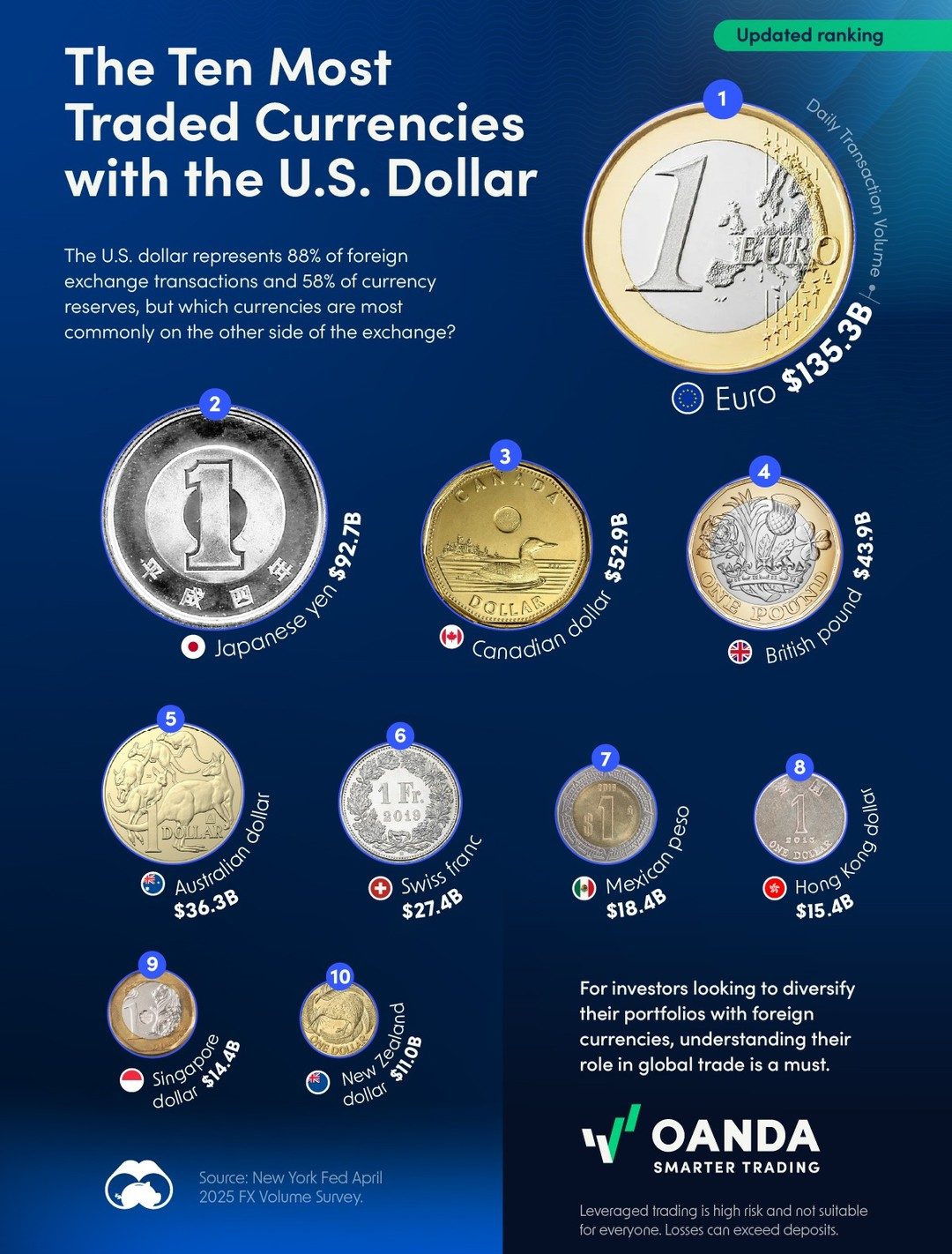
The U.S. dollar plays a pivotal role in global foreign exchange (FX) transactions, dominating 88% of all trades. This dominance leads to a natural question: which currencies are most commonly traded against the U.S. dollar? Understanding this dynamic is crucial for investors and traders looking to diversify their portfolios with foreign currencies and gain insights into global trade patterns.
Why This Matters
The significance of the U.S. dollar in FX trades cannot be overstated. With 88% of foreign exchange transactions and 58% of currency reserves tied to the U.S. dollar, it is clear that this currency is the backbone of international trade. For investors, recognizing the top currencies traded against the U.S. dollar can provide valuable insights into market trends, liquidity, and potential opportunities. This ranking helps investors and traders navigate the complex landscape of global finance.
The Top 10 Most Traded Currencies with the U.S. Dollar
1. Euro (€)
The Euro is the most traded currency against the U.S. dollar, with a daily transaction volume of $135.3 billion. The Eurozone's economic stability and the euro's status as a reserve currency make it a significant player in global FX markets. The high transaction volume reflects the robust trading activity between the U.S. and European economies.
2. Japanese Yen (¥)
Following the Euro, the Japanese Yen has a daily transaction volume of $92.7 billion. The yen's popularity can be attributed to Japan's status as the world's third-largest economy and its role as a safe-haven asset. Traders often turn to the yen during times of market uncertainty, contributing to its high trading volume.
3. Canadian Dollar (CAD)
The Canadian Dollar comes in third with a daily transaction volume of $52.9 billion. Canada's close economic ties with the U.S., particularly in sectors like energy and commodities, drive the high trading volume between the two currencies. The Canadian dollar is also known for its correlation with commodity prices, making it a popular choice for traders.
4. British Pound (£)
The British Pound, with a daily transaction volume of $43.9 billion, is the fourth most traded currency against the U.S. dollar. The UK's historical financial significance and its status as a global financial hub contribute to the pound's high trading volume. Political events and economic policies in the UK also influence the pound's volatility, making it an attractive option for traders.
5. Swiss Franc (CHF)
The Swiss Franc has a daily transaction volume of $36.3 billion. Known for its stability and neutrality, the Swiss Franc is often seen as a safe-haven currency. Traders turn to the Swiss Franc during times of economic uncertainty, contributing to its high trading volume.
6. Australian Dollar (AUD)
The Australian Dollar, with a daily transaction volume of $14.8 billion, is the sixth most traded currency against the U.S. dollar. Australia's strong economic ties with Asia and its rich natural resources make the Australian Dollar a popular choice for traders. The Australian dollar's correlation with commodity prices, particularly gold and iron ore, adds to its appeal.
7. New Zealand Dollar (NZD)
The New Zealand Dollar has a daily transaction volume of $11.0 billion. Similar to the Australian Dollar, the New Zealand Dollar benefits from its country's strong ties with Asia and its status as a commodity-driven currency. The New Zealand dollar's volatility often leads to trading opportunities, making it an attractive option for traders.
8. Singapore Dollar (SGD)
The Singapore Dollar, with a daily transaction volume of $14.4 billion, is another significant player in the FX market. Singapore's status as a global financial hub and its stable economy contribute to the high trading volume of the Singapore Dollar. The currency's correlation with Asian economic trends makes it a valuable asset for traders.
9. Mexican Peso (MXN)
The Mexican Peso has a daily transaction volume of $15.4 billion. Mexico's proximity to the U.S. and its role as a key trading partner contribute to the high trading volume of the Mexican Peso. The currency's volatility, influenced by economic policies and trade agreements, makes it an attractive option for traders.
10. Hong Kong Dollar (HKD)
The Hong Kong Dollar, with a daily transaction volume of $15.4 billion, rounds out the top 10 most traded currencies against the U.S. dollar. Hong Kong's status as a global financial center and its pegged exchange rate with the U.S. dollar contribute to its high trading volume. The Hong Kong Dollar's stability and liquidity make it a popular choice for traders.
Practical Tips for Trading These Currencies
1. Stay Informed About Economic Indicators
Economic indicators such as GDP growth, inflation rates, and unemployment figures can significantly impact currency values. Keeping track of these indicators for the countries whose currencies you are trading can provide valuable insights into potential market movements.
2. Monitor Central Bank Policies
Central banks play a crucial role in shaping currency values through monetary policies. Changes in interest rates, quantitative easing, and other policy measures can have a profound impact on currency markets. Staying informed about central bank decisions can help traders make more informed decisions.
3. Consider Political Events
Political events and geopolitical tensions can also influence currency values. Elections, trade agreements, and diplomatic relations can all affect currency markets. Keeping an eye on political developments can help traders anticipate market movements and adjust their strategies accordingly.
4. Use Technical Analysis
Technical analysis involves studying historical price data and trading volumes to identify patterns and trends. This approach can help traders predict future price movements and make more informed trading decisions. Common technical analysis tools include moving averages, relative strength index (RSI), and Bollinger Bands.
5. Diversify Your Portfolio
Diversification is key to managing risk in currency trading. By spreading investments across multiple currencies, traders can reduce the impact of adverse market movements on their overall portfolio. Diversification can also provide opportunities to capitalize on different market trends and economic conditions.
6. Understand the Risks of Leveraged Trading
Leveraged trading involves using borrowed capital to increase trading positions, potentially amplifying both profits and losses. It is essential to understand the risks associated with leveraged trading, as losses can exceed deposits. Traders should carefully manage their risk and use appropriate risk management strategies to mitigate potential losses.
Important Takeaways
The U.S. dollar's dominance in foreign exchange transactions highlights its central role in global finance. Understanding the top 10 most traded currencies against the U.S. dollar can provide valuable insights into market trends, liquidity, and potential opportunities. By staying informed about economic indicators, central bank policies, and political events, traders can make more informed decisions and manage risks effectively.
Conclusion
Navigating the complexities of currency trading requires a solid understanding of market dynamics, economic indicators, and risk management strategies. Knowing which currencies are most commonly traded against the U.S. dollar can help investors and traders make more informed decisions and capitalize on market opportunities. Whether you are a seasoned trader or just starting out, staying informed and adapting to market changes is crucial for success in the ever-evolving world of currency trading.
Watch the Reel
Questions readers ask
What does the high volume of U.S. dollar trading indicate about the global economy?
The high volume of U.S. dollar trading signifies the dollar's status as the world's primary reserve currency. It indicates that the U.S. dollar is widely accepted and used in international transactions, influencing global market trends and liquidity.
Why are the Euro and Japanese Yen among the most traded currencies against the U.S. dollar?
The Euro and Japanese Yen are among the most traded currencies against the U.S. dollar due to their economic significance. The Eurozone and Japan are major economic powers, and their currencies are heavily influenced by factors like monetary policy and economic health. This makes them attractive for trading.
How does the U.S. dollar's dominance in FX trades benefit investors?
The U.S. dollar's dominance in FX trades provides investors with ample opportunities for liquidity and market trends. Investors can easily enter and exit positions, making it easier to execute strategies like diversification with foreign currencies. The high trading volume also ensures that there are always buyers and sellers in the market.
What are the most traded currency pairs involving the U.S. dollar?
The most traded currency pairs involving the U.S. dollar include the USD/EUR (U.S. dollar to Euro), USD/JPY (U.S. dollar to Japanese Yen), and USD/CAD (U.S. dollar to Canadian Dollar). These pairs are highly liquid and have significant trading volume, making them popular among investors.
How can understanding the top currencies traded with the U.S. dollar help in currency trading analysis?
Understanding the top currencies traded with the U.S. dollar helps in currency trading analysis by providing insights into market dynamics, liquidity, and volatility. This knowledge can assist in making informed decisions and developing effective trading strategies, especially for those involved in FX trades.
Why is the Canadian Dollar a significant currency to trade against the U.S. dollar?
The Canadian Dollar is a significant currency to trade against the U.S. dollar due to the close economic ties between the U.S. and Canada. These ties include substantial trade in commodities, such as oil and gas, and a shared border, which fosters a high level of economic integration and currency exchange.
How do market trends in USD trading affect global financial markets?
Market trends in USD trading can have a profound impact on global financial markets. Since the U.S. dollar is a primary reserve currency and is used in a large portion of international transactions, fluctuations in its value can influence everything from commodity prices to interest rates in other countries.
Recent articles
Fresh deep dives from the latest Reels we unpacked.




Comments
Be the first to comment.