Millionaire Populations
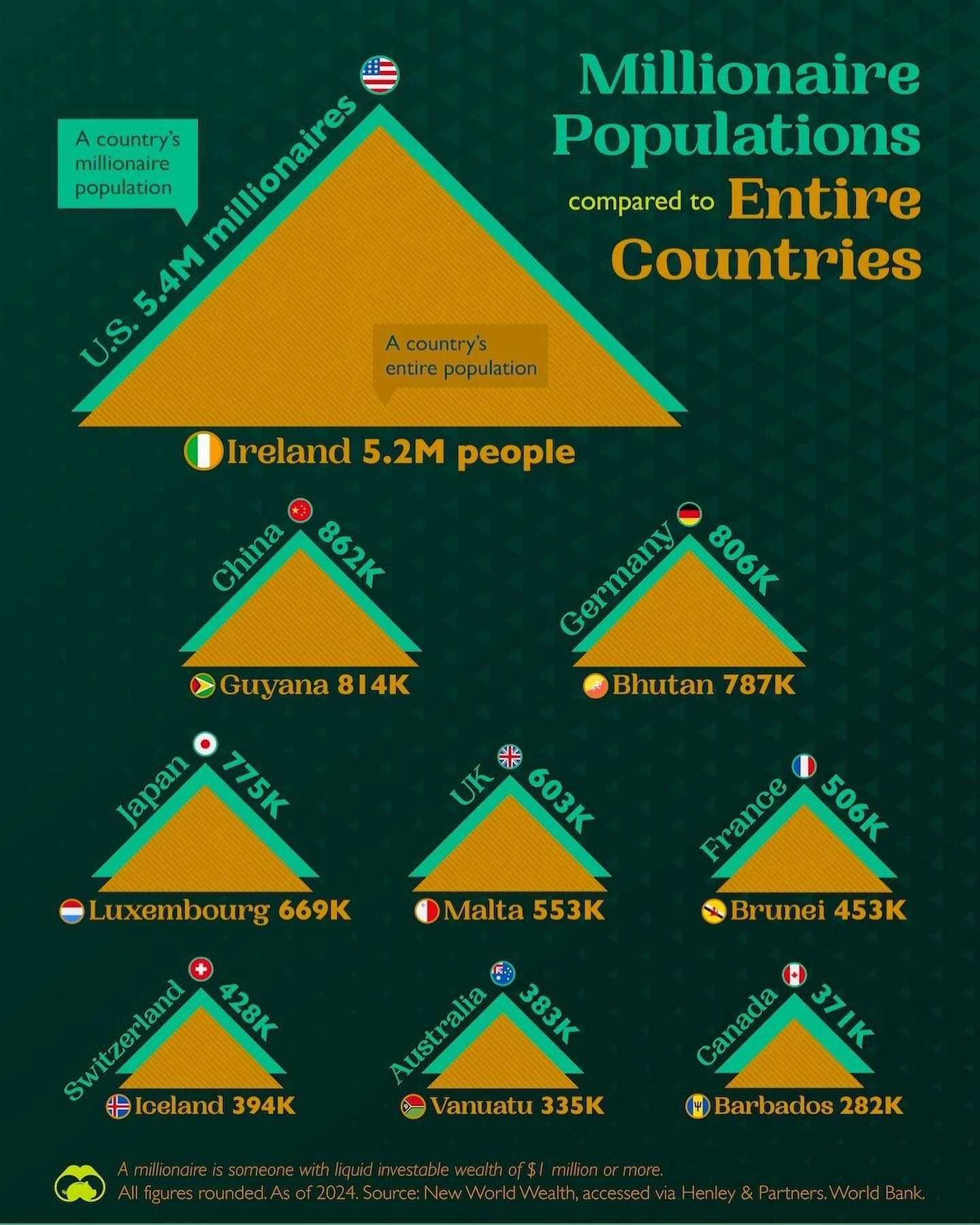
The U.S. leads the world with nearly 5.5 million millionaires, outpacing the entire population of Ireland. Globally, there are around 15 million millionaires, exceeding the population of Rwanda, the 28th most populous country in Africa. This article compares the top 10 countries with the largest millionaire populations to nations with similar population sizes, providing a unique perspective on global wealth distribution.
Context
Understanding the distribution of millionaires across different countries offers insights into global economic disparities and financial trends. While the U.S. stands out with the highest number of millionaires, other countries present intriguing comparisons when their millionaire populations are juxtaposed with their total populations.
Countries with large millionaire populations often have robust economies, advanced financial markets, and favorable tax policies. However, the concentration of wealth within a country can also reveal social and economic inequalities. By comparing millionaire populations to entire populations, we gain a clearer picture of where wealth is most concentrated and how it relates to the overall population size.
Millionaire Populations Around the World
United States
The U.S. tops the list with 5.4 million millionaires. This significant number reflects the country's large economy, diverse financial opportunities, and established financial institutions. The U.S. has long been a hub for entrepreneurship and innovation, attracting wealth from around the globe.
Ireland
Ireland, with a population of 669,000, has a significant number of millionaires relative to its size. This can be attributed to its favorable tax policies, particularly for corporations, and its role as a hub for multinationals. Ireland's strategic location and skilled workforce have made it an attractive destination for businesses, contributing to its high concentration of wealthy individuals.
China
China boasts 862,000 millionaires, reflecting its rapid economic growth and increasing wealth. The country's massive population and expanding middle class provide a large pool of potential millionaires. China's economic policies and initiatives, such as the Belt and Road Initiative, have further fueled its wealth accumulation.
Europe
Several European countries, including Germany, France, and the UK, have significant millionaire populations. Germany has 806,000 millionaires, while France has 506,000. The UK follows closely with 603,000 millionaires. These countries benefit from strong economies, well-established financial sectors, and historical wealth accumulation. Luxembourg stands out with 69,000 millionaires, making it one of the wealthiest countries per capita.
Asia and Oceania
Japan, with 775,000 millionaires, is a major economic power in Asia. Its advanced economy and strong financial sector contribute to its large millionaire population. Australia, with 383,000 millionaires, and Switzerland, with 428,000 millionaires, are also notable. These countries have stable economies, high standards of living, and robust financial systems.
Small Nations
Smaller countries like Guyana, Bhutan, and Barbados present interesting comparisons. Guyana, with 814,000 millionaires, has a high concentration of wealth relative to its population. Bhutan and Barbados, with 787,000 and 282,000 millionaires respectively, also showcase significant wealth concentrations. These countries often have unique economic structures and opportunities that contribute to their wealthy populations.
Practical Tips
For individuals interested in understanding global wealth distribution, consider the following tips:
-
Invest in Diversified Markets: Investing in countries with strong economies and diverse financial opportunities can be a strategic move. Look for countries with favorable tax policies and robust financial sectors.
-
Understand Regional Trends: Stay informed about economic trends in different regions. For example, Asia's rapid economic growth and Europe's established financial markets offer unique investment opportunities.
-
Explore Tax Policies: Countries with favorable tax policies can be attractive for wealth accumulation. Research tax incentives and policies in different countries to make informed decisions.
-
Consider Population Size: The concentration of wealth relative to population size can provide valuable insights. Countries with a high concentration of millionaires relative to their population may offer unique opportunities for investment and wealth management.
Important Takeaways
-
Wealth Concentration: The concentration of wealth in certain countries highlights the importance of understanding global economic disparities. Countries with large millionaire populations often have robust economies and favorable financial conditions.
-
Economic Policies: Favorable tax policies, strong financial sectors, and strategic economic initiatives play a crucial role in wealth accumulation. Countries like Ireland and Luxembourg have leveraged these factors to attract and retain wealth.
-
Diverse Opportunities: The global distribution of millionaires reveals diverse opportunities for investment and wealth management. Whether in established markets like the U.S. and Europe or emerging economies like China, there are unique avenues for wealth accumulation.
Conclusion
The global distribution of millionaires provides a fascinating look into wealth concentration and economic trends. The U.S. leads with the highest number of millionaires, but countries like Ireland, China, and Luxembourg offer unique insights into how wealth is accumulated and maintained. By understanding these trends and the factors that contribute to them, individuals can make more informed decisions about investing, wealth management, and economic participation.
Watch the Reel
Questions readers ask
Why does the United States have the highest millionaire population?
The United States has the highest millionaire population due to several factors, including a large and dynamic economy, a strong entrepreneurial culture, and favorable policies for business growth and investment. Additionally, the U.S. has a well-developed financial system that provides ample opportunities for wealth accumulation.
How does Ireland's millionaire population compare to its total population?
Ireland's millionaire population is significant when compared to its total population. With favorable tax policies, Ireland has attracted many high net worth individuals, contributing to a substantial millionaire population relative to its overall population size. This makes Ireland an interesting case study in global wealth distribution.
What factors contribute to China's significant millionaire population?
China's rapid economic growth, driven by industrialization and urbanization, has led to a significant increase in its millionaire population. The country's large market, coupled with a growing middle class and a thriving business environment, has created opportunities for wealth creation on a large scale.
How many millionaires are there globally, and how does it compare to country populations?
Globally, there are around 15 million millionaires. This number is significant when compared to the entire populations of smaller countries. For instance, 15 million is more than the population of Rwanda, the 28th most populous country in Africa, highlighting the substantial wealth concentration in the world.
Which countries are in the top 10 for millionaire populations?
While the article specifies the United States as the leader, other countries in the top 10 include Japan, Germany, China, and the United Kingdom. These countries have large economies and robust financial systems that support wealth accumulation, contributing to their significant millionaire populations.
How can understanding the distribution of millionaires provide insights into global financial trends?
Examining the distribution of millionaires across different countries offers a unique perspective on global financial trends. It can reveal economic disparities, highlight regions with favorable wealth-creation opportunities, and provide insights into the effectiveness of tax policies and economic strategies implemented by various nations.
What is the significance of comparing millionaire populations to total population size?
Comparing millionaire populations to total population size can provide a more accurate picture of wealth distribution within a country. It helps to contextualize the concentration of wealth and can highlight economic and policy factors that contribute to wealth accumulation in a given region.
Recent articles
Fresh deep dives from the latest Reels we unpacked.




Comments
Be the first to comment.