Arms Export Statistics
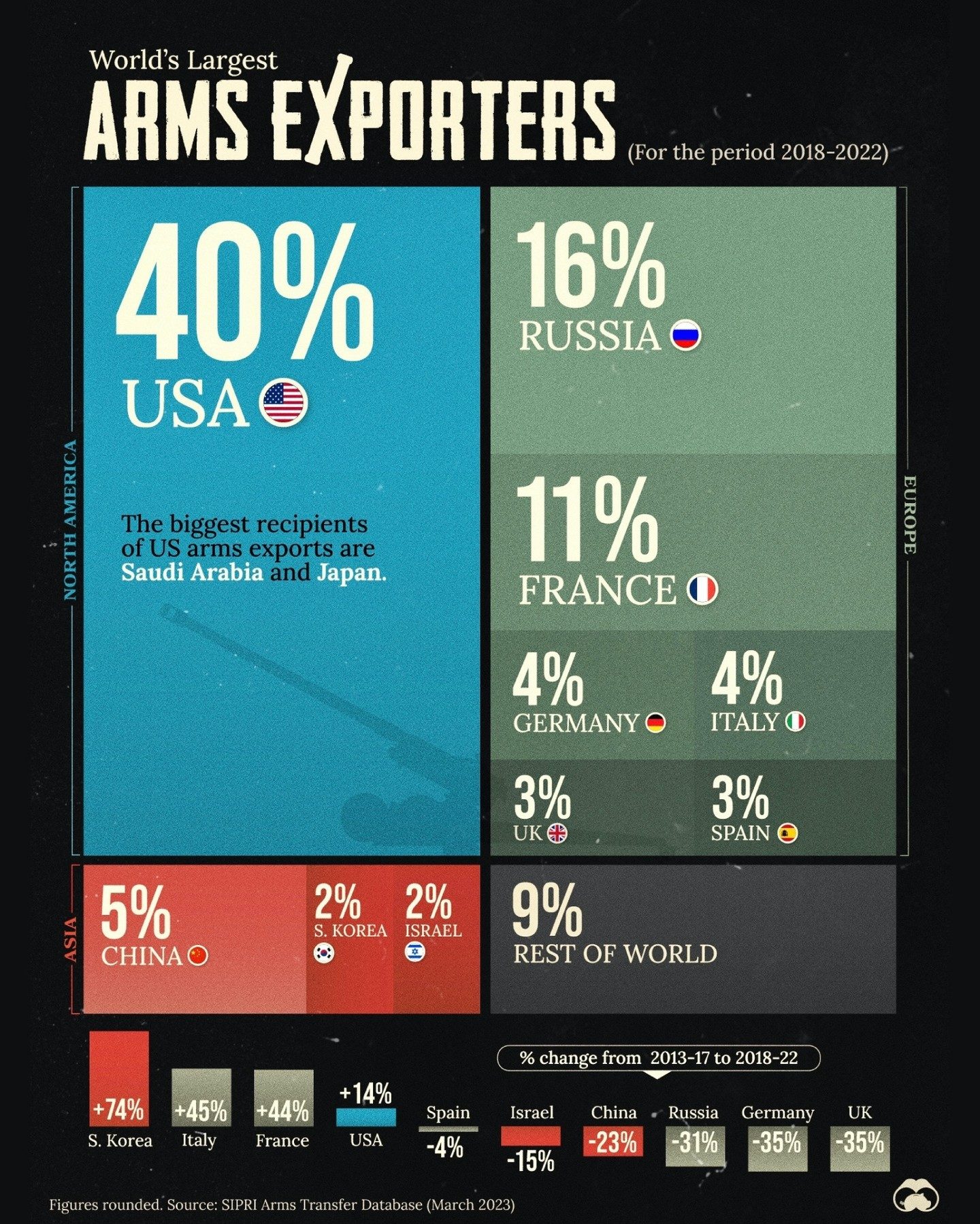
Global military budgets reached an unprecedented $2.2 trillion in 2022, continuing an eight-year upward trend. A significant portion of these budgets is allocated to the procurement of arms, making it crucial to understand which countries are the major suppliers and how they influence the global arms trade. By examining data from the Stockholm International Peace Research Institute (SIPRI), we can identify the top 10 countries with the largest share of global arms exports.
Context / Why this matters
The global arms trade is a complex and influential sector that affects geopolitical dynamics, economic stability, and international security. Understanding the key players and their roles in this trade can provide valuable insights into global power structures and defense strategies. The data highlights the significance of arms exports in shaping international relations and economic policies, making it essential to explore the trends and changes in this sector.
Main discussion
Top Arms Exporters (2018-2022)
The data from SIPRI reveals that the United States is the world's largest arms exporter, accounting for 40% of all global arms exports. This dominance underscores the USA's significant role in the global defense industry, driven by its advanced military technology and extensive international alliances. Following the USA, Russia, France, and Germany are the next major exporters, contributing 16%, 11%, and 4% of global arms exports, respectively. Italy and Spain each account for 3% of the global market, while the rest of the world accounts for 9%.
Key Export Trends
The data also highlights notable shifts in arms exports over the past decade. South Korea, for instance, has seen a significant increase in its arms exports, with a +74% change from 2013-17 to 2018-22. This surge can be attributed to the country's growing defense capabilities and increased international demand for its military products.
Italy and France have also experienced substantial growth in their arms exports, with increases of +45% and +44%, respectively. In contrast, the UK, Russia, and Spain have seen decreases in their exports, with the UK experiencing a -31% drop. These fluctuations reflect changes in global demand, shifts in military priorities, and evolving geopolitical landscapes.
Major Recipients of US Arms Exports
The United States, as the leading arms exporter, supplies a significant portion of its military products to key allies. Saudi Arabia and Japan are the biggest recipients of US arms exports, highlighting the strategic importance of these countries in the USA's defense strategy. Other notable recipients include South Korea and Israel, indicating the USA's broader influence in the Middle East and Asia.
Practical tips
Understanding the Arms Trade
For those interested in the global arms trade, it's essential to stay informed about the key players and their influence. Regularly consulting reports from organizations like SIPRI can provide up-to-date information on trends and changes in the arms trade. Additionally, tracking geopolitical events and defense policies can offer insights into why certain countries are increasing or decreasing their arms exports.
Analyzing Export Data
When analyzing export data, it's important to consider the broader context. For example, a significant increase in exports from a country like South Korea might reflect its growing defense capabilities and international alliances. Conversely, a decrease in exports from a country like the UK could indicate changes in military priorities or shifts in international demand.
Important takeaways
The global arms trade is a dynamic and influential sector that affects international relations and economic stability. The USA's dominance in this sector underscores its significant role in the defense industry, while the trends in other countries reflect broader geopolitical dynamics. By staying informed about the key players and their influence, one can gain a deeper understanding of the global arms trade and its implications.
Conclusion
The global arms trade is a complex and influential sector that affects geopolitical dynamics, economic stability, and international security. Understanding the key players and their roles in this trade can provide valuable insights into global power structures and defense strategies. By analyzing data from the Stockholm International Peace Research Institute (SIPRI), we can identify the top 10 countries with the largest share of global arms exports and explore the trends and changes in this sector. This information is crucial for gaining a deeper understanding of the global arms trade and its implications for international relations and economic stability.
Watch the Reel
Questions readers ask
Which countries are the top three global arms exporters in 2022?
According to SIPRI data, the United States, Russia, and France are the top three global arms exporters in 2022. These countries have consistently been among the largest suppliers of weapons and military equipment worldwide.
How much was spent globally on military budgets in 2022?
In 2022, global military budgets reached a record high of $2.2 trillion. This figure reflects an eight-year trend of increasing military expenditure, with a significant portion of these budgets allocated to arms procurement.
What makes the global arms trade significant?
The global arms trade shapes international dynamics by influencing geopolitical power, impacting economic stability, and affecting worldwide security. Major arms exporters contribute significantly to these dynamics, and monitoring the trends is crucial for understanding global affairs.
Why was South Korea's surge in arms exports notable?
South Korea's notable surge in arms exports is significant because it reflects a shift in the global arms trade landscape. This increase suggests that South Korea is emerging as a more prominent player in the international market for weapons and military technology.
How does SIPRI contribute to understanding the global arms trade?
The Stockholm International Peace Research Institute (SIPRI) provides comprehensive data on global arms exports, helping to identify the top suppliers and monitor trends in the weapons trade. Their reports are essential for gaining insights into the key players and their roles in the global arms market.
What trends are observed in the global weapons trade in 2022?
In 2022, the global weapons trade saw a continuation of trends from previous years, with the United States, Russia, and France remaining the dominant players. Additionally, there was significant growth in arms exports from South Korea, indicating a potential realignment in the global arms trade.
Which other countries made it to the top 10 global arms exporters in 2022 besides the USA, France, and Russia?
Besides the USA, France, and Russia, the other top global arms exporters in 2022 include Germany, China, Italy, Spain, the United Kingdom, and South Korea. These countries, along with the top three, collectively shape the global weapons trade and influence international security dynamics.
Recent articles
Fresh deep dives from the latest Reels we unpacked.




Comments
Be the first to comment.