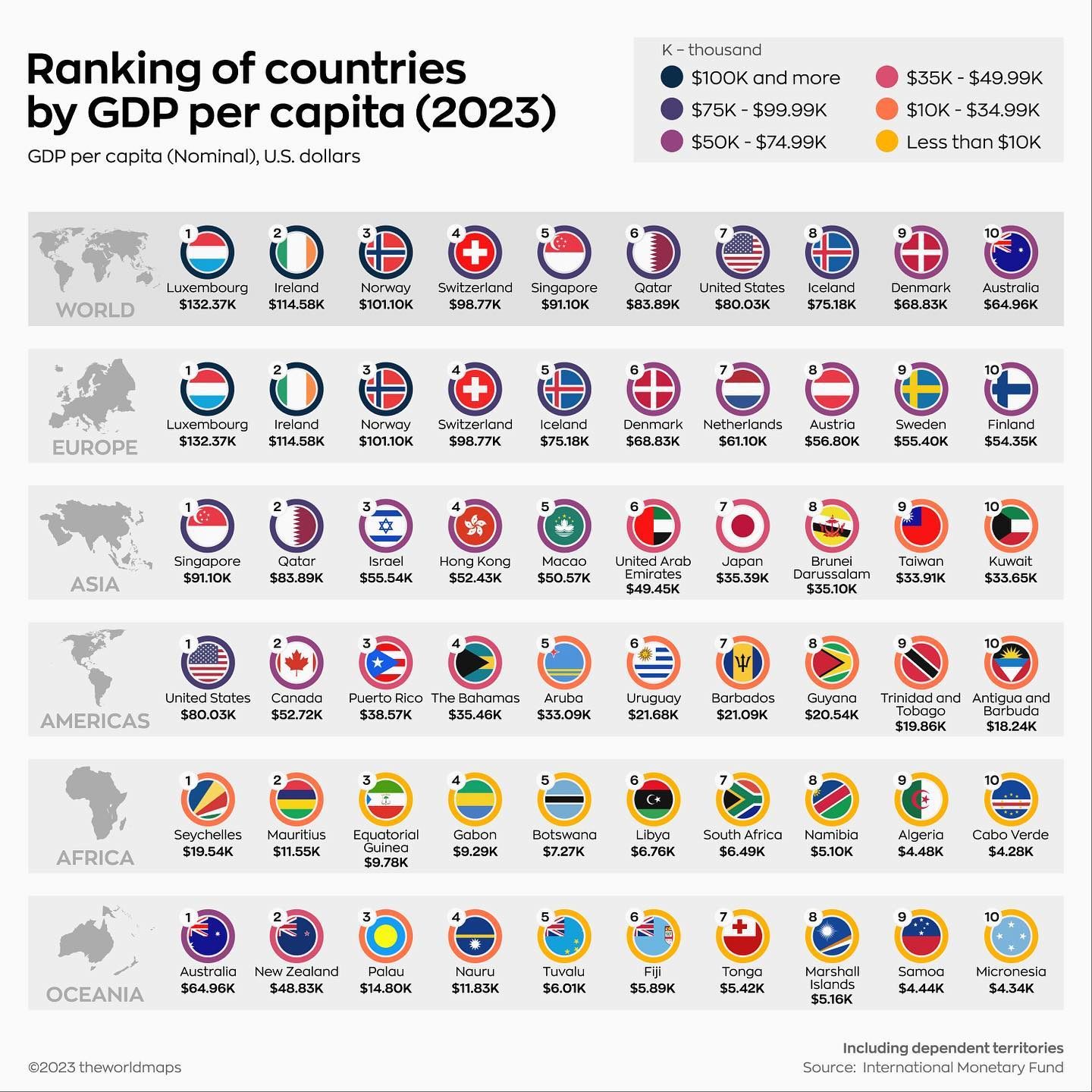
Comparing the economies of different countries can be approached through various metrics, but one of the most widely used and reliable methods is by examining GDP per capita. GDP per capita is a measure that divides a country’s total economic output by its population, providing a snapshot of the average income per person. This metric is particularly useful because it helps level the playing field, allowing for more accurate comparisons between countries of varying sizes.
Why GDP Per Capita Matters
GDP per capita is a critical indicator for several reasons. Firstly, it correlates strongly with a country's standard of living. Higher GDP per capita generally means higher disposable income, increased consumption, and better access to goods and services. This correlation makes GDP per capita a valuable tool for assessing the economic well-being of a population.
Secondly, GDP per capita is useful for comparing the economic performance of countries. For instance, a country with a high GDP per capita may have a more robust economy with higher productivity and greater economic stability. This metric is also crucial for policymakers and economists who use it to evaluate a country's economic health and make informed decisions.
Thirdly, GDP per capita provides insights into a country's development stage. Countries with higher GDP per capita are often more developed and industrialized, with sophisticated infrastructure and advanced technological capabilities. Conversely, countries with lower GDP per capita may still be in the process of developing their economies and infrastructure.
GDP Per Capita Rankings
GDP per capita (Nominal) in U.S. dollars is a straightforward measure that reflects the value of all goods and services produced by a country in a given year, divided by its population. This measure provides a direct comparison of economic output without adjusting for the cost of living.
Top Countries by Nominal GDP per Capita
Luxembourg tops the list with a GDP per capita of $132,370, reflecting its highly developed economy and strong financial sector. Following Luxembourg, Norway and Switzerland also rank high, with GDP per capita values of $114,580 and $101,100, respectively. These countries are known for their robust economies and high standards of living. Additionally, Singapore and Qatar are also among the top performers, with GDP per capita values of $98,770 and $83,890, respectively.
The ranking also includes the United States, which has a GDP per capita of $80,030, and other high-income countries such as Denmark and Iceland. Interestingly, the United States ranks lower in the nominal GDP per capita rankings compared to several smaller nations.
GDP Per Capita (Purchasing Power Parity)
Purchasing Power Parity (PPP) adjusts for the cost of living in different countries, providing a more accurate comparison of the actual purchasing power of a country's residents. This measure is particularly useful for understanding the real living standards and economic performance of a country.
Top Countries by GDP Per Capita (PPP)
In the PPP rankings, Luxembourg remains at the top with a GDP per capita of $145,200, followed by Qatar and Macao, both with $124,830. Ireland and Switzerland also rank high, with GDP per capita values of $142,490 and $82,650, respectively.
Global Economic Trends
The rankings reveal several important trends in the global economy. For example, many of the countries at the top of the list are small in terms of population but have highly developed economies. These countries often specialize in specific industries, such as finance, technology, or natural resources, which drive their high economic output.
Regional Insights
Europe and North America are home to several high-income countries, reflecting the region's advanced economies and high standards of living. In contrast, many countries in Africa and Asia have lower GDP per capita values, indicating ongoing economic development and challenges in achieving higher living standards.
Economic Performance
The rankings also highlight the economic performance of different regions. For instance, Oceania has several countries with high GDP per capita values, reflecting the region's economic stability and strong economic performance. The presence of Singapore and Singapore in the top ranks reflects the country's strategic location and strong economic policies, making it a hub for international trade and investment.
Practical Tips for Understanding GDP Per Capita
Understanding GDP per capita involves more than just looking at the numbers. Here are some practical tips to better grasp this metric:
- Compare with Other Indicators: GDP per capita should be considered alongside other economic indicators, such as the Human Development Index (HDI) and the Gini coefficient, to get a comprehensive view of a country's economic and social performance.
- Adjust for Inflation: Ensure that the GDP per capita values are adjusted for inflation to account for changes in the cost of living over time.
- Consider Population Size: A higher GDP per capita does not always mean a higher total GDP. Larger countries may have a lower GDP per capita but a higher total GDP due to their significant population.
- Look at Economic Growth: Analyze how GDP per capita has changed over time to understand a country's economic growth and development trajectory.
Important Takeaways
GDP per capita is a powerful tool for comparing the economic performance and living standards of different countries. By examining the nominal and PPP values, policymakers, economists, and investors can gain valuable insights into a country's economic health and development stage.
Moreover, understanding the rankings and trends in GDP per capita helps identify regions and countries with high economic potential and those that may require support for further development. This information is crucial for making informed decisions in international trade, investment, and policy-making.
Conclusion
GDP per capita remains a tried-and-true method for measuring and comparing different economies. By providing a snapshot of a country's average income per person, this metric offers valuable insights into economic performance, living standards, and development stages. Whether using nominal values or PPP, GDP per capita remains a critical indicator for understanding the global economic landscape and making informed decisions in business and policy.
Watch the Reel
Questions readers ask
What does GDP per capita ranking tell us about a country's economic wellbeing?
The GDP per capita ranking provides insights into a country's economic health by showing the average income per person. A high ranking indicates that, on average, citizens have more disposable income, which can lead to better access to goods, services, and overall improved living standards.
Which country has the highest GDP per capita?
As of recent data, Luxembourg typically holds the top spot for the highest GDP per capita. However, rankings can change year to year, so it's always a good idea to check the most current statistics.
How is GDP per capita calculated and why is it useful for comparing countries?
GDP per capita is calculated by dividing a country's total economic output (GDP) by its population. It is useful for comparing countries because it provides a standardized measure of average income per person, allowing for a more accurate comparison between countries of different sizes.
What are the top 10 countries by GDP per capita?
The top 10 countries by GDP per capita can vary slightly depending on the source and year of the data. However, countries like Luxembourg, Singapore, Ireland, Qatar, and Switzerland frequently appear at the top of these lists due to their robust economies and high standards of living.
How does Singapore's GDP ranking reflect its economic development?
Singapore consistently ranks high in GDP per capita, which reflects its strong economic development. This high ranking is a result of its strategic policies, robust financial sector, and strong productivity, making it a global economic leader.
Why is Qatar's per capita GDP notable?
Qatar's per capita GDP is notable due to its extremely high value, largely driven by its substantial oil and natural gas reserves. This high GDP per capita indicates that, on average, Qataris have a very high disposable income, contributing to a very high standard of living.
How can understanding GDP per capita help in assessing a country's standard of living?
Understanding GDP per capita helps in assessing a country's standard of living because it provides a clear picture of the average income per person. Generally, a higher GDP per capita correlates with better access to goods and services, improved healthcare, and enhanced quality of life.
Recent articles
Fresh deep dives from the latest Reels we unpacked.




Comments
Be the first to comment.