The Gender Gap in Workforce Participation: A Global Perspective
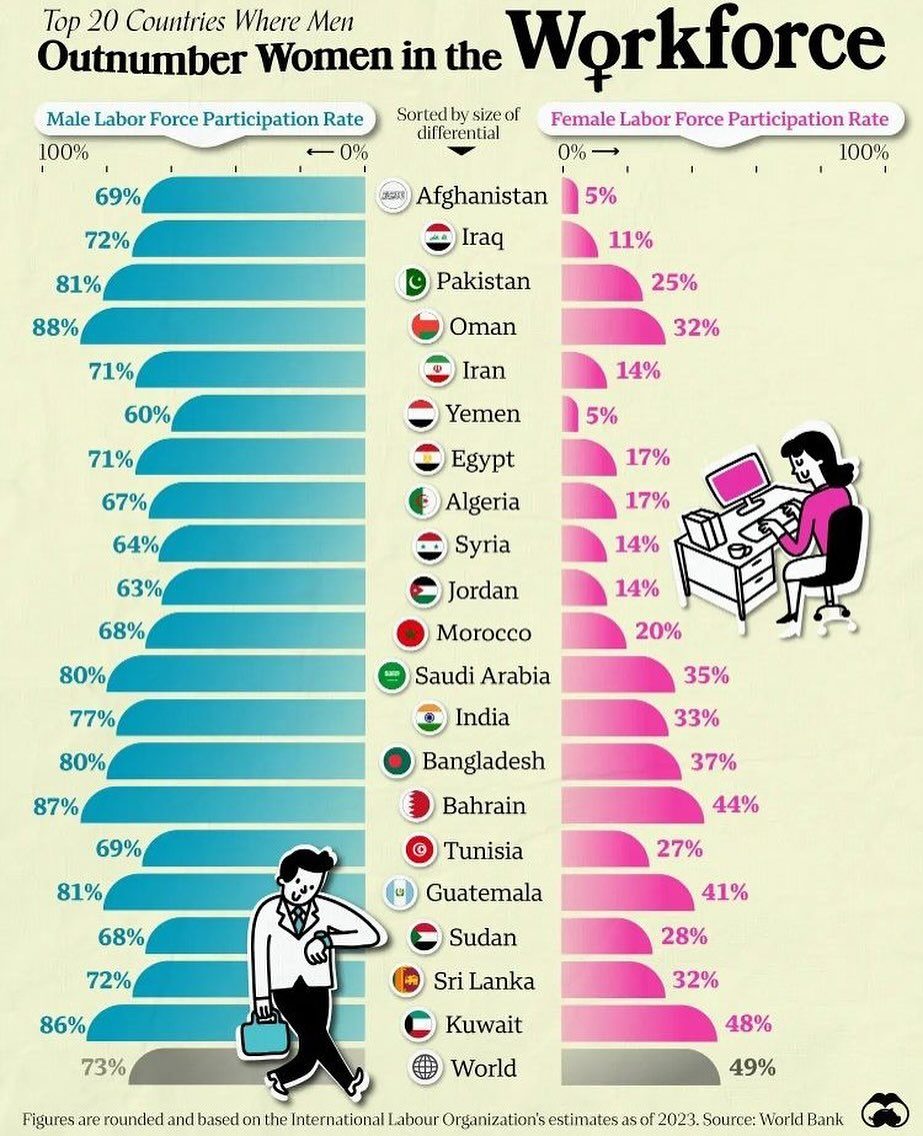
A comparative look at the gender gaps in workforce participation across 20 countries reveals striking disparities, particularly in Islamic nations. This analysis highlights the chasm between male and female labor force participation rates, offering a nuanced view of global economic opportunities and barriers.
Why This Matters
Understanding the gender gap in workforce participation is crucial for a variety of reasons. It sheds light on broader economic inequalities, the status of women's rights, and the overall health of a nation's labor market. Countries with significant gender disparities often face challenges related to economic growth, social development, and overall well-being. The data from the World Bank, as illustrated in the infographic, provides a clear picture of where these gaps are most pronounced.
Main Discussion
Top Countries with the Biggest Gender Gaps
Afghanistan leads the list with a staggering disparity, where men participate in the labor force at 69% compared to a mere 5% for women. This indicates a stark gender imbalance, highlighting both societal and economic barriers that women face in entering the workforce.
Pakistan and Iraq follow, with men participating at 88% and 87%, respectively, while women lag significantly behind at 11% in each country. This disparity is equally alarming, reflecting deep-seated issues in gender equality and economic opportunities.
Oman and Yemen show moderate differences, with male participation rates of 73% and 68% respectively, against female participation rates of 25% and 32%. These statistics underscore the regional challenges faced by women in the workforce.
Iran, Egypt, Syria, Jordan, and Morocco present a mixed picture, with male participation rates ranging from 76% to 86%. Female participation in these countries varies from 14% to 20%, indicating a moderate but significant gap in opportunities.
Regional Insights and Economic Opportunities
The data reveals that many of these countries also have below-average male participation rates, hinting at a broader lack of economic opportunities. This suggests that the low female participation rates are not just a gender issue but also reflect broader systemic problems in the economy.
For instance, Saudi Arabia shows a substantial gender gap with a significant male participation rate of 80% compared to 35% for women. This disparity, while notable, is less extreme than in countries like Afghanistan.
India, Bangladesh, and Bahrain present a relatively better picture with female participation rates around 33%, 37%, and 44% respectively. However, the male participation rates are also higher, indicating that while there are improvements, the gap remains substantial.
Global Comparison
The World average shows a smaller gap with men participating at 71% and women at 49%. This comparison underscores the need for targeted interventions in countries with disproportionately low female participation rates.
Notable Observations
Countries like Bahrain, Guatemala, and Sri Lanka present a more balanced picture with female participation rates significantly higher than in other countries on the list. However, the male participation rates in these countries are still higher, indicating that while progress has been made, there is still room for improvement.
Countries like Kuwait and Guinea demonstrate a moderate gap, with male participation rates at 75% and 72% and female participation rates at 48% and 44% respectively. These figures suggest that while there are efforts to bridge the gap, more needs to be done to achieve equality.
Key Takeaways
The data from the World Bank's estimates for 2023, as presented in the infographic, highlights several key points. Many of the countries with the biggest gender gaps in workforce participation are Islamic nations, indicating a region-specific challenge. However, the issue is not limited to these countries; it is a global concern that requires attention and action.
Practical Tips for Addressing the Gender Gap
Policy Reforms
Governments can play a crucial role in addressing the gender gap by implementing policies that promote women's participation in the workforce. This includes providing equal opportunities for education, vocational training, and job placements.
Economic Incentives
Encouraging private sector involvement through economic incentives can also help bridge the gap. Companies that actively promote gender equality and provide equal pay can be rewarded through tax breaks and other financial incentives.
Education and Awareness
Investing in education and awareness campaigns can also make a significant difference. By promoting gender equality from an early age, future generations can grow up with a more balanced view of societal roles.
Important Takeaways
Economic Opportunities
The data highlights a broader lack of economic opportunities, which is not limited to gender. Countries with significant gender gaps often have lower overall participation rates, indicating systemic issues that need to be addressed.
Regional Challenges
Many Islamic nations face unique challenges that contribute to the gender gap. While cultural and societal norms play a role, economic factors and policy barriers are equally significant.
Global Efforts
Addressing the gender gap requires a global effort. International organizations and NGOs can play a crucial role in providing support and resources to countries that need it the most.
Conclusion
The gender gap in workforce participation is a complex issue that requires a multifaceted approach. By understanding the specific challenges faced by different countries, targeted interventions can be developed to promote gender equality and economic empowerment. While the data from the World Bank provides a clear picture of the current state, it also serves as a call to action for policymakers, organizations, and individuals to work towards bridging this gap and creating a more equitable world.
Watch the Reel
Questions readers ask
Which countries have the most significant gender gaps in workforce participation?
The article highlights Afghanistan, Pakistan, and Iraq as countries with some of the most pronounced gender gaps in workforce participation. These countries, along with others in the analysis, show notable disparities between male and female labor force participation rates.
Why are gender gaps in workforce participation important to consider?
Understanding gender gaps in workforce participation is essential for several reasons. It provides insights into economic inequalities, the status of women's rights, and the overall health of a nation's labor market. Significant gender disparities can also impact economic growth, social development, and overall well-being.
How do gender gaps in workforce participation vary across different regions?
The analysis reveals that gender gaps in workforce participation can vary significantly across different regions. In particular, Islamic nations often exhibit some of the largest gender disparities, indicating regional challenges and barriers for women in the workforce.
What are the key challenges faced by countries with significant gender disparities in their workforce?
Countries with significant gender disparities in their workforce often face challenges related to economic growth, social development, and overall well-being. These disparities can limit economic opportunities and hinder the full participation of women in the labor market.
How can understanding the gender gap in workforce participation help in addressing global economic inequalities?
By understanding the gender gap in workforce participation, policymakers and organizations can develop targeted strategies to address economic inequalities. This understanding can lead to better policies and initiatives aimed at promoting gender equality in labor force participation, benefiting both men and women.
What role does the World Bank play in analyzing gender gaps in workforce participation?
The World Bank provides valuable data and analysis on gender gaps in workforce participation. This data helps to shed light on global economic opportunities and barriers, offering a nuanced view of the disparities between male and female labor force participation rates across different countries.
How do gender gaps in workforce participation affect economic opportunities for women?
Gender gaps in workforce participation can limit economic opportunities for women by restricting their ability to enter and advance in the labor market. This, in turn, can impact their economic empowerment and overall well-being, as well as that of their families and communities.
Related deep dives
Similar reads based on topic and creator.


Recent articles
Fresh deep dives from the latest Reels we unpacked.




Comments
Be the first to comment.