Political Contributions in the 2024 U.S. Election Cycle
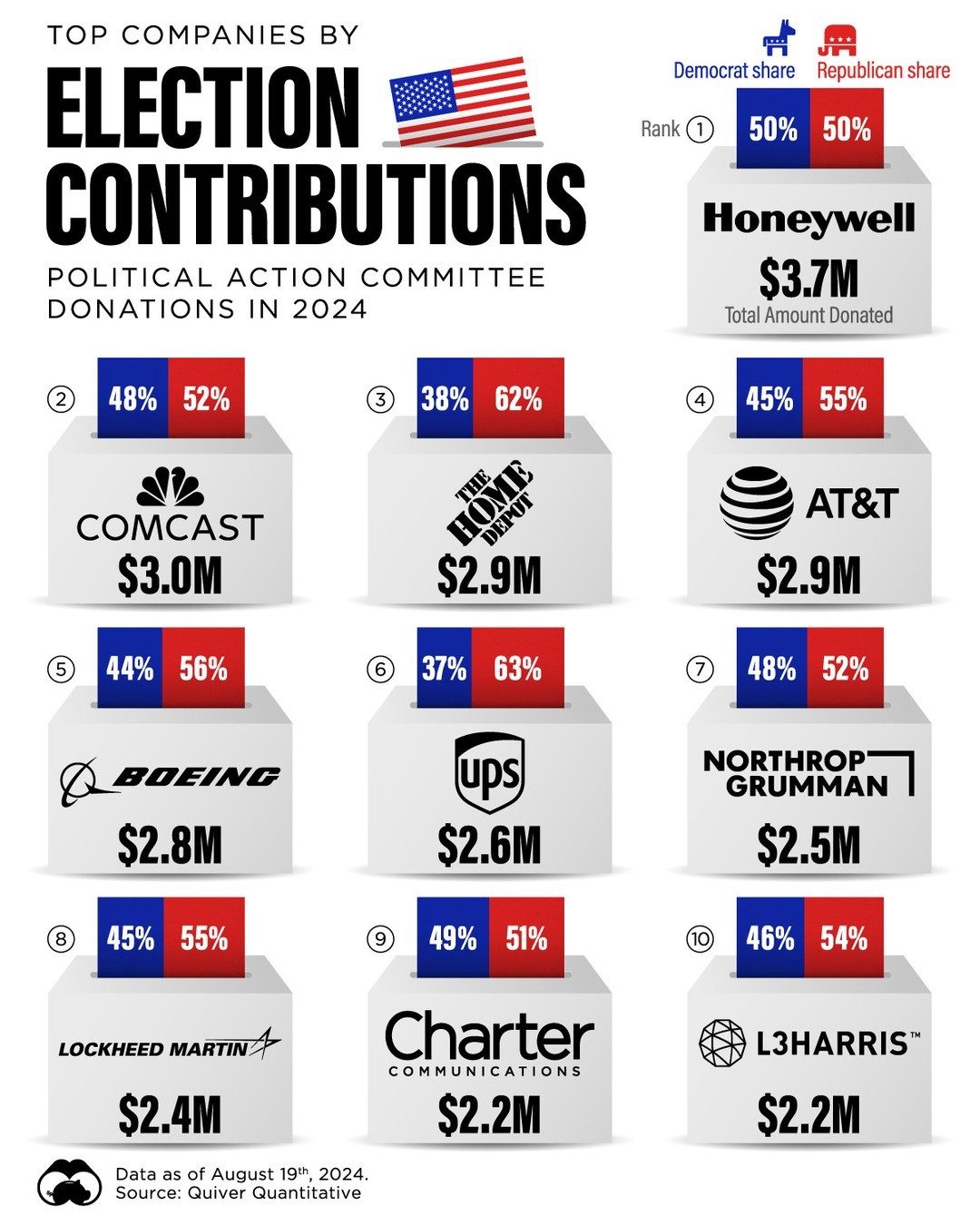
Publicly-traded companies are playing a significant role in the 2024 U.S. election cycle through their political action committees (PACs). In the first 12 months of this cycle, PACs have already raised a staggering $3.7 billion. While donations from the top contributing companies were fairly evenly split between the two major political parties, Republicans received a larger overall share. Here, we delve into the top 10 publicly-traded companies by U.S. campaign contributions to company-associated PACs, based on data current as of August 19, 2024.
Context / Why This Matters
Political donations from corporations can significantly influence the political landscape. Understanding which companies are contributing and to which parties can provide insights into potential policy directions and corporate interests. This information is crucial for voters, policymakers, and stakeholders who want to stay informed about the financial backing behind political campaigns.
Main Discussion
The Top Contributors
The list of top contributors includes a mix of well-known companies from various sectors, each with significant financial muscle. Here’s a breakdown of the top 10 companies and their contributions:
- Honeywell: Contributed $3.7 million, with an even split of 50% to Democrats and 50% to Republicans.
- Comcast: Donated $3.0 million, with 48% going to Democrats and 52% to Republicans.
- The Home Depot: Contributed $2.9 million, with 38% to Democrats and 62% to Republicans.
- AT&T: Donated $2.9 million, with 45% to Democrats and 55% to Republicans.
- Boeing: Contributed $2.8 million, with a 45% to 55% split favoring Republicans.
- UPS: Donated $2.6 million, with a 43% to 57% split favoring Republicans.
- Northrop Grumman: Contributed $2.5 million, with a 42% to 58% split favoring Republicans.
- Lockheed Martin: Donated $2.4 million, with a 45% to 55% split favoring Republicans.
- Charter Communications: Contributed $2.2 million, with a 41% to 59% split favoring Republicans.
- L3Harris: Donated $2.2 million, with a 40% to 60% split favoring Republicans.
Sector Breakdown
The top contributing companies span several industries, including aerospace and defense, telecommunications, retail, and logistics. This diversification reflects the broad impact of corporate political spending across different economic sectors. Companies in these sectors often have vested interests in regulatory policies, infrastructure projects, and defense contracts, making their political contributions a strategic move to influence policymaking.
Aerospace and Defense
Companies like Boeing, Northrop Grumman, and Lockheed Martin are major players in the aerospace and defense industry. Their substantial contributions reflect the critical role of defense and aerospace policies in their business operations. These companies often benefit from government contracts and regulatory frameworks that support research and development in defense technologies.
Telecommunications
Comcast and AT&T, two giants in the telecommunications sector, are also significant contributors. Their donations likely aim to influence policies related to telecommunications infrastructure, net neutrality, and regulatory oversight. With the rapid evolution of technology and increasing reliance on digital communications, these companies have a strong interest in shaping the regulatory environment.
Retail and Logistics
The Home Depot and UPS, representing the retail and logistics sectors, are also among the top contributors. These companies have a keen interest in policies that affect supply chains, labor laws, and retail regulations. Their donations are likely aimed at influencing legislation that impacts their operational costs and market competitiveness.
Practical Tips
For those interested in tracking political contributions, here are some practical tips:
Stay Informed with Public Databases
Websites like the Federal Election Commission (FEC) and OpenSecrets provide comprehensive databases of political contributions. These resources allow users to search for specific companies, political action committees, and individual contributors. This information can be invaluable for understanding the financial landscape of political campaigns.
Understand the Impact of Donations
It’s essential to consider the potential influence of corporate donations on policy decisions. While corporations have the right to contribute to political campaigns, understanding their motivations and the potential returns on their investments can provide clearer insights into their strategic goals.
Follow Industry News and Analysis
Staying updated with industry-specific news and analysis can provide deeper context on why certain companies are making significant contributions. Publications focusing on specific sectors, such as aerospace, telecommunications, and retail, often provide in-depth coverage of these issues.
Important Takeaways
Political contributions from publicly-traded companies play a pivotal role in the 2024 U.S. election cycle. The top 10 companies, with their contributions and political leanings, reflect a diverse range of industries and interests. These companies are strategically allocating their funds to influence policies that directly impact their business operations. Understanding these contributions can provide valuable insights into the broader political and economic landscape.
Conclusion
The $3.7 billion raised by political action committees in the first 12 months of the 2024 U.S. election cycle underscores the significant role of corporate political spending. The top 10 contributors, including Honeywell, Comcast, and The Home Depot, are making substantial investments to shape the political environment in their favor. By staying informed about these contributions and their potential impact, stakeholders can better understand the dynamics at play in the upcoming elections.
Watch the Reel
Recent articles
Fresh deep dives from the latest Reels we unpacked.




Comments
Be the first to comment.