Tesla and BYD: A Closer Look at Global EV Production Capacity
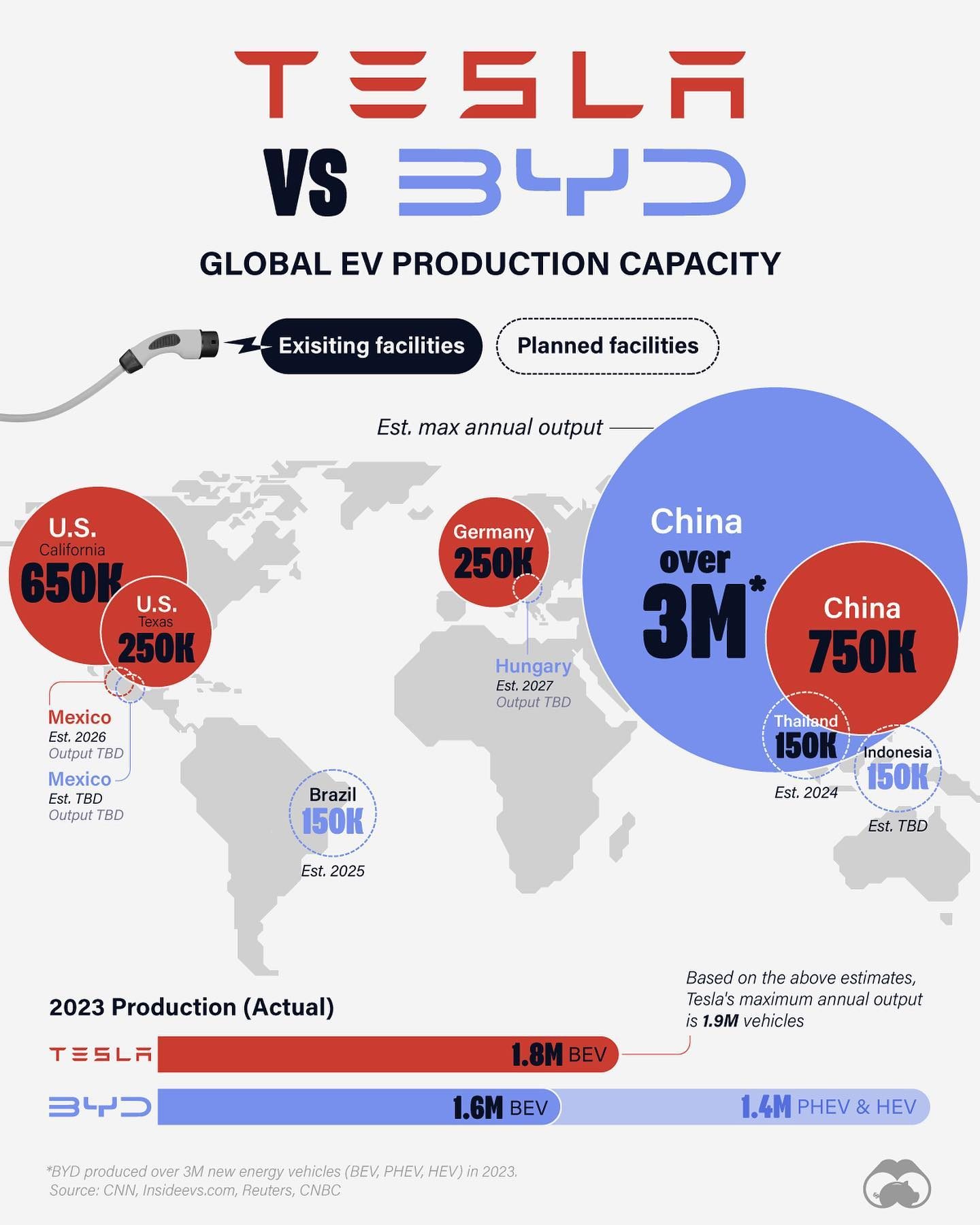
The global electric vehicle (EV) market is dominated by Tesla and BYD, with market shares of 19.9% and 17.1%, respectively. Understanding the production capacities and strategies of these two giants can provide valuable insights into the future of the EV industry. Here, we analyze the global production capacities of Tesla and BYD, including their current and future factories, and their estimated maximum annual outputs.
Why This Matters
The electric vehicle market is rapidly evolving, with significant investments and expansions planned by major players. Tesla and BYD, in particular, are at the forefront of this transformation. As both companies expand globally, their production capacities and strategic locations will play a crucial role in shaping the future of the EV market. This analysis aims to provide a detailed look at the current and future production capacities of Tesla and BYD, highlighting key locations and their estimated outputs.
Detailed Analysis: Tesla's EV Production Capacity
Current Production Capacities
Tesla has established a strong global presence with production facilities in key markets. The company's maximum annual output is estimated at 1.9 million Battery Electric Vehicles (BEVs). Key production locations include:
- United States: Tesla's primary production facilities in the U.S. are based in Texas and Nevada. These locations are crucial for meeting domestic demand and supporting Tesla's expanding customer base.
- Mexico: Tesla's facility in Mexico is an important addition, enhancing the company's production capabilities in North America.
- Germany: Tesla's European production hub is located in Berlin, which is pivotal for serving the European market and reducing logistics costs.
Future Expansion
Tesla has ambitious plans for future expansion. The company is establishing new facilities in various regions to meet growing demand and diversify its production base. Estimates for planned facilities and outputs include:
- Texas: Expected to produce 650,000 vehicles annually.
- Bering: Output TBD.
- Mexico: Estimated to produce 250,000 vehicles annually.
- Germany: Expected to produce 750,000 vehicles annually.
- China: Estimated to produce over 3 million vehicles annually, making it Tesla's largest production hub.
Strategic Locations
Tesla's strategic choice of locations reflects its global market strategy. By establishing production facilities in key regions, Tesla can reduce logistics costs, comply with local regulations, and respond more promptly to market demands.
Detailed Analysis: BYD's EV Production Capacity
Current Production Capacities
BYD, another major player in the EV market, has a significant production capacity, with the company producing 1.6 million BEV and 1.4 million Plug-in Hybrid Electric Vehicles (PHEV) & Hybrid Electric Vehicles (HEV) annually. Key production locations include:
- China: BYD's primary production hub is in China, which is pivotal for meeting domestic demand and supporting the company's growing customer base in Asia.
- Germany: BYD's European production hub ensures a steady supply to the European market, reducing logistics costs and enhancing market responsiveness.
Future Expansion
BYD is also expanding its global footprint with new facilities in various regions. Estimates for planned facilities and outputs include:
- Thailand: Output TBD.
- Brazil: Estimated to produce 150,000 vehicles annually.
- Hungary: Output TBD.
- India: Estimated to produce 250,000 vehicles annually.
Strategic Locations
BYD's strategic locations are chosen to optimize logistics, reduce costs, and comply with local regulations. These factors are crucial for maintaining a competitive edge in the global market.
Practical Tips for Evaluating EV Production Capacity
Evaluating the production capacity of EV manufacturers involves considering several key factors. Here are some practical tips to help you analyze and understand the production capabilities of companies like Tesla and BYD:
1. Assess Production Locations
Understanding the geographical distribution of production facilities can provide insights into a company's strategic goals and market focus. For example, Tesla and BYD have established facilities in key markets to reduce logistics costs and enhance market responsiveness.
2. Analyze Output Estimates
Estimating the maximum annual output of production facilities is crucial for understanding a company's production capacity. This information can help you gauge the company's ability to meet market demand and expand its customer base.
3. Track Expansion Plans
Keeping an eye on upcoming production facilities and their estimated outputs can provide valuable insights into a company's future growth and market strategy. This information can help you stay ahead of industry trends and make informed investment decisions.
4. Consider Market Share and Growth
Evaluating a company's market share and growth potential is essential for understanding its production capacity and future prospects. Companies like Tesla and BYD, with significant market shares, are well-positioned to capitalize on the growing demand for electric vehicles.
Important Takeaways
The global EV market is highly competitive, with major players like Tesla and BYD vying for market share. Understanding the production capacities and strategies of these companies is crucial for evaluating their future prospects and making informed investment decisions. Here are some key takeaways from our analysis:
- Tesla and BYD Dominate the EV Market: With market shares of 19.9% and 17.1%, respectively, Tesla and BYD are the leading players in the global EV market.
- Strategic Production Locations: Both companies have established production facilities in key regions to optimize logistics, reduce costs, and comply with local regulations.
- Future Expansion Plans: Tesla and BYD have ambitious plans for future expansion, with new facilities and increased production capacities expected in the coming years.
- Market Share and Growth: Companies with significant market shares and growth potential, like Tesla and BYD, are well-positioned to capitalize on the growing demand for electric vehicles.
Conclusion
The global EV market is rapidly evolving, with major players like Tesla and BYD expanding their production capacities and strategic locations. By understanding the current and future production capacities of these companies, investors and industry analysts can gain valuable insights into the future of the EV market. Tesla's estimated maximum annual output of 1.9 million BEVs and BYD's production of 1.6 million BEVs and 1.4 million PHEVs/HEVs highlight their dominant positions in the industry. As both companies continue to expand globally, their strategic locations and production capacities will play a crucial role in shaping the future of the EV market.
Watch the Reel
Questions readers ask
What are the current market shares of Tesla and BYD in the global EV market?
As of the latest data, Tesla holds a market share of 19.9%, while BYD holds 17.1%. These figures highlight their significant presence and influence in the global EV landscape.
Where are Tesla and BYD planning to expand their EV production capacities?
Tesla has been expanding its production capabilities in multiple regions, including Texas, Germany, and Mexico. BYD, on the other hand, is focusing on its domestic market in China while also exploring international markets.
What are the estimated maximum annual outputs of Tesla and BYD?
Tesla's estimated maximum annual output is projected to reach approximately 20 million units by 2030, driven by its extensive global production network. BYD, with its strong foothold in China and expanding international presence, is also expected to achieve significant annual outputs, though exact figures can vary based on market demand and production capabilities.
How does the location of Tesla and BYD's factories impact their production capacity?
The strategic locations of Tesla and BYD's factories play a crucial role in their production capacity. Tesla's factories in the US, Europe, and Mexico provide a global reach, reducing transport costs and enhancing supply chain efficiency. BYD's factories in China, along with its expansion into other countries, allow for efficient production and market accessibility in key regions.
What are some key factors driving the future trajectory of the EV industry?
The future trajectory of the EV industry is driven by factors such as investment in research and development, expansion of production capacities, strategic global expansions, and market demand. Additionally, regulatory policies and advances in battery technology will significantly impact the industry's growth and competitiveness.
How do Tesla and BYD's production capacities compare in terms of global reach?
Tesla's production capacities are characterized by a more widespread global presence, with factories and production facilities in North America, Europe, and Asia. BYD, while having a stronghold in China, is also making strides in international markets, enhancing its global production capabilities.
What are the implications of Tesla and BYD's expansions on the EV industry?
The expansions by Tesla and BYD have significant implications for the EV industry, including increased competition, potential price reductions, and advancements in technology. These expansions will also drive greater awareness and adoption of EVs, shaping the future of the automotive market.
Recent articles
Fresh deep dives from the latest Reels we unpacked.




Comments
Be the first to comment.