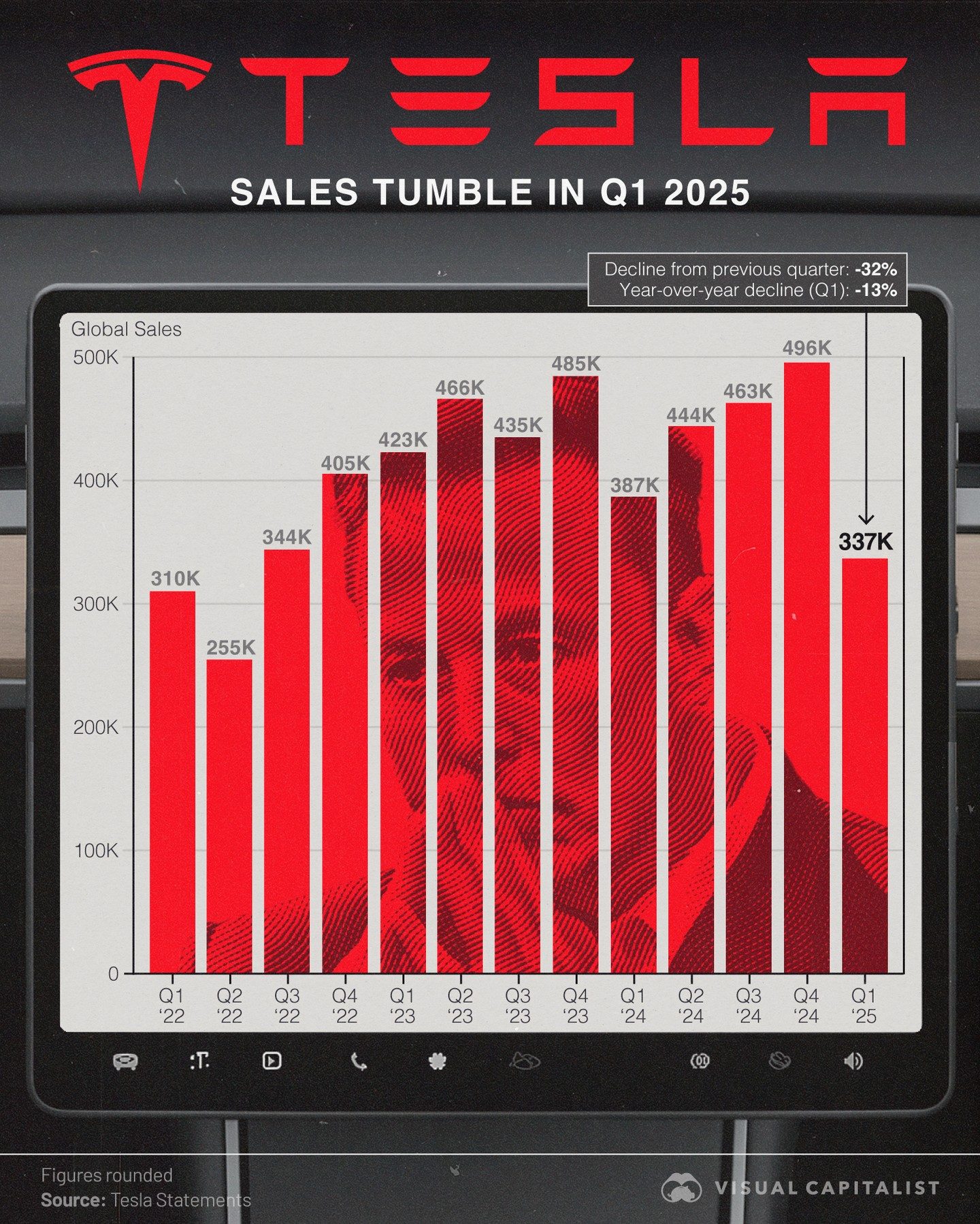
Tesla's Global Vehicle Sales Decline in Q1 2025
Tesla's global vehicle sales experienced a notable decline of 13% in the first quarter of 2025. This drop marks the company's lowest quarterly result since 2022, making it a significant event to examine. Despite this decline, Tesla shares saw an unexpected jump due to reports about Elon Musk potentially stepping down from his role as a top adviser to Donald Trump. This dynamic financial movement underscores the volatility and complexity of Tesla's market position.
Context / Why this matters
Tesla's performance is a key indicator of the broader electric vehicle (EV) market. The company has historically been a leader in EV sales and innovation, and its quarterly performance often influences market sentiment and investor confidence. Understanding the factors behind Tesla's recent decline in sales provides valuable insights into the current state and future trends of the EV market.
The broader context of Tesla’s performance is crucial for several reasons. Firstly, it is the largest electric vehicle manufacturer and a pioneer in autonomous driving. Therefore, its sales trends can be indicative of the overall market sentiment for EVs. Secondly, Tesla's market movements also have implications for other automakers and tech companies focusing on electric and connected vehicles. Tesla's innovations and disruption in the industry have influenced other manufacturers to develop or transition to electric vehicles.
Main discussion
Sales Performance Overview
Tesla's sales figures from Q1 2022 to Q1 2025 show a mixed performance. Starting from 500,000 units in Q1 2022, the sales declined to 337,000 units in Q1 2025. This marks a significant downturn, with the most dramatic drop occurring in the most recent quarter. The decline from the previous quarter (Q4 2024) to Q1 2025 was 32%, indicating a sharp decrease in demand or production issues.
Market and Economic Factors
Several factors could contribute to the decline in Tesla's sales. Economic conditions, including global inflation and rising interest rates, can affect consumer spending on high-value items like vehicles. The slowdown in the global economy might have led to reduced consumer confidence and lower demand for electric vehicles. Additionally, supply chain disruptions and production issues could have impacted Tesla's ability to deliver vehicles to customers, affecting sales figures.
Competition and Market Dynamics
The EV market has seen an influx of new competitors, both from traditional automakers and startups. Companies like Rivian, Lucid Motors, and established players like Ford and General Motors have been ramping up their EV offerings. Increased competition could lead to market share erosion for Tesla, as consumers have more options to choose from.
Regulatory and Policy Changes
Regulatory changes and policy shifts can also influence Tesla's sales. Government incentives and subsidies for EV purchases can boost demand, while the removal of these incentives can have the opposite effect. Additionally, changes in environmental regulations and emission standards can impact the overall EV market and Tesla's sales performance.
Geopolitical Influences
Geopolitical factors, including trade tensions and policy changes, can affect Tesla's global sales. For instance, changes in trade agreements or tariffs can impact the cost of vehicles and production, influencing sales figures. Likewise, political instability in key markets can affect consumer demand and supply chain operations.
Share Price and Market Sentiment
Despite the decline in sales, Tesla's share price saw a jump. This counterintuitive movement can be attributed to investor sentiment and speculation about the company's future. Reports about Elon Musk stepping down from his role as a top adviser to Donald Trump could signal changes in the company's leadership and strategic direction, potentially influencing investor sentiment.
Practical tips
Investors
For investors, it's crucial to stay informed about the underlying factors affecting Tesla’s sales performance. Keep an eye on economic indicators, competitive dynamics, and regulatory changes that could impact the company's bottom line. Diversifying your investment portfolio can also help mitigate risks associated with volatility in the EV market.
Consumers
Consumers considering a Tesla purchase should assess their financial situation and the long-term benefits of owning an electric vehicle. Researching available incentives and subsidies in your region can help offset the cost. It's also wise to compare Tesla's offerings with competitors to find the best fit for your needs.
Automotive Industry Professionals
Automotive industry professionals should monitor Tesla's performance as an indicator of broader market trends. Staying updated on technological advancements, regulatory changes, and consumer preferences can help in strategic planning and product development.
Important takeaways
Tesla's 13% decline in global vehicle sales in Q1 2025 is a significant development in the EV market. Understanding the factors contributing to this decline provides valuable insights into the broader market dynamics. Economic conditions, competition, regulatory changes, and geopolitical influences all play a role in shaping Tesla's performance. Despite the decline, investor sentiment remains positive, as indicated by the jump in Tesla's share price. This highlights the importance of considering various factors when analyzing Tesla's market position and future prospects.
Conclusion
Tesla’s global vehicle sales figures for Q1 2025 paint a complex picture of the EV market. The decline in sales underscores the challenges faced by Tesla and the broader industry. However, the jump in share price amidst these challenges highlights the resilience and potential of the electric vehicle market. For investors, consumers, and industry professionals, staying informed about these dynamics is crucial for making strategic decisions.
Watch the Reel
Questions readers ask
What caused Tesla's Q1 2025 sales to drop by 13%?
The article does not provide a specific reason for the 13% sales drop in Q1 2025. However, it is important to note that this decline is the lowest quarterly result since 2022. The drop could be due to a variety of factors, such as changes in consumer demand, competition, or market conditions.
How did Tesla's stock perform during this period?
Tesla's stock experienced an unexpected jump due to external factors, specifically reports about Elon Musk potentially stepping down from his role as a top adviser to Donald Trump. This illustrates the volatility of the EV market and Tesla's significant influence on it. Tesla's stock performance can be influenced by a range of factors beyond sales figures, including news about the company and its leadership.
Why is Tesla's sales performance important for the broader EV market?
Tesla has historically been a leader in electric vehicle sales and innovation. Therefore, its quarterly performance often influences market sentiment and investor confidence in the broader EV market. A decline in Tesla's sales can indicate broader trends or challenges within the EV industry, such as shifts in consumer behavior or increased competition.
How does Tesla's Q1 2025 performance compare to previous years?
Tesla's Q1 2025 sales performance marks the company's lowest quarterly result since 2022. This comparison highlights the significance of the 13% sales decline and suggests that Tesla has faced similar or more challenging market conditions in the past.
What factors contribute to the volatility in the EV market?
The EV market is subject to various factors that can cause volatility, including changes in consumer demand, regulatory policies, technological advancements, and competition. Tesla's influential role in the market means that its performance can also contribute to this volatility, as investors and consumers react to the company's successes and setbacks.
What are the implications of Elon Musk's potential role change on Tesla's performance?
Elon Musk's potential step down as a top adviser to Donald Trump led to an unexpected jump in Tesla's stock. This dynamic highlights how external factors and news about the company's leadership can influence Tesla's market position and financial performance. However, the actual impact of such a role change on Tesla's long-term sales and market influence remains uncertain.
Related deep dives
Similar reads based on topic and creator.


Recent articles
Fresh deep dives from the latest Reels we unpacked.




Comments
Be the first to comment.