Electric Vehicle Profit Margins: Tesla's Dominance and Competitor Challenges
Automotive price cuts are a common tactic, but Tesla has taken a significant step by reducing its prices recently. This move comes at a time when the company's order backlog has shrunk dramatically. This means that the days of "endless" demand may be over for Tesla, and the company is feeling the pressure to stay competitive. This price reduction has put pressure on competitors but has also upset existing Tesla owners. Understanding the financial performance of different EV manufacturers can provide valuable insights into the industry's dynamics.
Why This Matters
For any investor or enthusiast in the electric vehicle (EV) sector, staying informed about the financial health of key players is essential. The new price cuts by Tesla have sparked discussions and questions about the company's strategy and the larger market implications. Understanding the current profit margins and financial performances of various EV manufacturers in the market, including Tesla.
Tesla's Profit Dominance
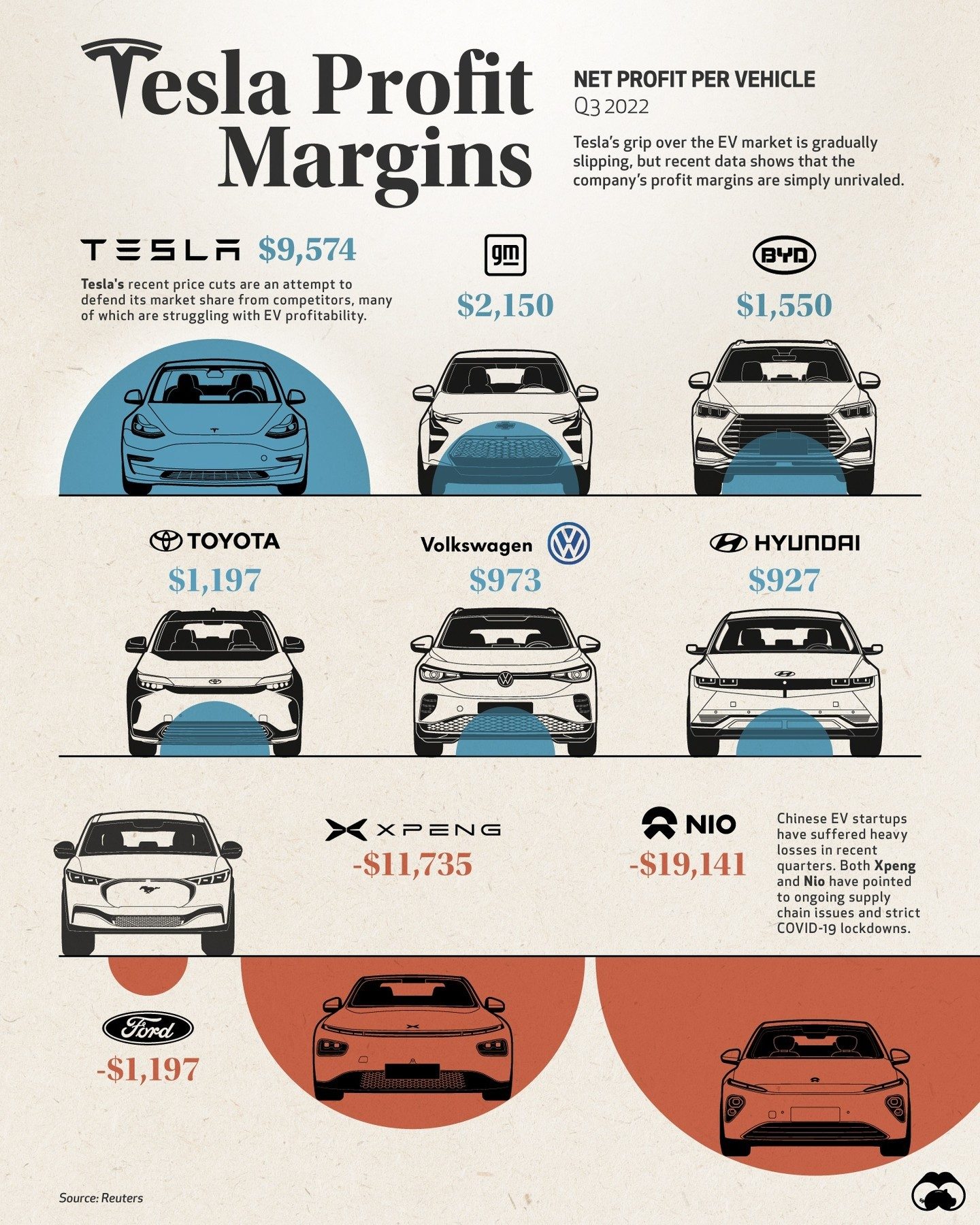
Profit margins are a critical indicator of a company's financial health and operational efficiency. Tesla stands out in this regard, with the highest profit per vehicle at $9,574. This figure significantly outpaces other major EV manufacturers, highlighting Tesla's strong market position and operational efficiency. Tesla's ability to maintain high profit margins while competing with traditional and emerging EV manufacturers is a testament to its innovative technology, production efficiency, and strong brand appeal.
Competitor Analysis
BYD: Steady Performance
BYD, another prominent player in the EV market, shows a profit of $1,550 per vehicle. While this is considerably lower than Tesla, it still indicates a healthy financial performance. BYD's success can be attributed to its focus on affordable and reliable electric vehicles, as well as its strong presence in the Chinese market.
Traditional Automakers: Mixed Results
Toyota, Volkswagen, and Hyundai all report similar profit margins, with figures of $973, $927, and $927 respectively. These traditional automakers have been gradually expanding their EV portfolios and are making inroads into the EV market. Their financial performance in the EV sector is promising, although they still face challenges in competing with Tesla's profitability.
Emerging Market Challenges
Xpeng, NIO, and Ford face significant financial challenges, with losses of -$11,735, -$19,141, and -$1,197 per vehicle, respectively. These losses indicate the difficulties emerging EV manufacturers and traditional automakers face in achieving profitability. Factors contributing to these losses include high production costs, intense competition, and the need for substantial investments in research and development.
Xpeng and NIO, in particular, are Chinese EV startups that have gained attention for their innovative technologies and rapid growth. However, their current financial losses suggest that they are still in the process of scaling their operations and achieving economies of scale. Ford, on the other hand, is a well-established automaker with a long history in the industry. Its losses in the EV sector highlight the challenges traditional automakers face in transitioning to electric vehicles.
Strategic Implications
Tesla's aggressive pricing strategy and high-profit margins put significant pressure on competitors. This move could lead to a price war, where other manufacturers are forced to reduce their prices to remain competitive. Such a scenario would be detrimental to companies already operating on thin margins, potentially leading to further consolidation in the EV market.
Moreover, Tesla's price cuts have angered existing owners, who feel that their investment in the company's vehicles has been devalued. This reaction underscores the delicate balance Tesla must maintain between maintaining customer loyalty and achieving financial success.
Practical Tips for Investors and Enthusiasts
Given the dynamic nature of the EV market, staying informed about the financial health and strategic moves of key players is crucial. Here are some practical tips:
- Monitor Financial Reports: Regularly review the financial reports of major EV manufacturers to understand their profitability and financial health.
- Track Market Trends: Stay updated on market trends, consumer preferences, and regulatory changes that could impact the EV industry.
- Diversify Investments: Consider investing in a diversified portfolio of EV stocks to mitigate risks associated with individual companies.
- Engage with the Community: Participate in online forums and communities to stay informed about the latest developments and insights from industry experts and enthusiasts.
Important Takeaways
- Tesla's high profit margins and aggressive pricing strategy give it a competitive edge over other EV manufacturers.
- Traditional automakers and emerging EV startups face significant challenges in achieving profitability, as evidenced by their financial performance.
- The EV market is dynamic and evolving, with intense competition and rapid technological advancements.
- Staying informed about the financial health and strategic moves of key players is essential for investors and enthusiasts in the EV sector.
Conclusion
The EV market is characterized by intense competition and rapid technological advancements. Tesla's high profit margins and strategic pricing moves highlight its dominant position, while other manufacturers face significant financial challenges. Understanding the financial performance and strategic implications of key players in the EV market is crucial for investors and enthusiasts. By staying informed and engaged, one can navigate the dynamic landscape of the EV industry effectively.
Watch the Reel
Questions readers ask
What made Tesla's profit margins in 2022 stand out against competitors?
Tesla's profit margins in 2022 were notably high due to its strong market dominance, efficient operations, and high demand for its vehicles. This allowed Tesla to maintain a significant lead over competitors in terms of financial performance.
Why did Tesla cut prices in 2022, and what does this mean for the EV market?
Tesla implemented price cuts in 2022 to stimulate demand as its order backlog decreased. Demand had been slowing and competitors were also stepping up, making Tesla respond to maintain its competitive edge and market share.
How does the Tesla price cut affect existing Tesla owners?
The Tesla price cuts upset existing owners because it reduced the perceived value of their vehicles. Owners who bought at higher prices might feel they've lost out financially, leading to frustration and potential brand dissatisfaction.
How do Tesla's profit margins compare to those of competitors like BYD and Toyota?
In 2022, Tesla maintained higher profit margins compared to competitors like BYD and Toyota. These competitors, while growing, still lag behind Tesla in terms of profitability, highlighting Tesla's robust financial position in the EV market.
What does the slowdown in Tesla's demand signify for the EV market?
The slowdown in Tesla's demand indicates that the once 'endless' demand for their vehicles is waning. It also suggests that the EV market is maturing, with competitors gaining traction and customers having more choices.
What challenges do Tesla's competitors face in matching Tesla’s profit margins?
Competitors face challenges in matching Tesla's profit margins due to Tesla's strong brand, superior technology, and efficient production processes. Additionally, competitors are still scaling up their operations and may not have the same economies of scale as Tesla.
What should investors consider when evaluating the financial health of EV manufacturers?
Investors should look at profit margins, market share, production efficiency, and the ability to innovate. Considerations should also include how well a company can adapt to market changes and maintain competitiveness, such as Tesla's recent price adjustments.
Related deep dives
Similar reads based on topic and creator.


Recent articles
Fresh deep dives from the latest Reels we unpacked.




Comments
Be the first to comment.