Tech Layoffs
The tech industry has experienced significant turbulence since 2020, marked by a global pandemic, a shift to remote work, a hiring frenzy, and most recently, widespread layoffs. These events have reshaped the industry, affecting countless professionals. The following examination provides context for the current layoffs and ranks the 20 largest tech layoffs of the 2020s.
Context / Why this matters
The tech industry's dramatic fluctuations over the past few years have been driven by several factors. The global pandemic accelerated the shift to remote work, leading to an unprecedented hiring surge. Companies expanded their workforce to meet the demand for digital services. However, as the economy began to recover and inflation rose, many tech firms found themselves overstaffed and overleveraged.
The consequences of these economic shifts are evident in the recent wave of layoffs. Understanding the scale and scope of these layoffs is crucial for professionals in the tech industry. It provides insights into the broader economic trends and helps individuals make informed career decisions.
Main discussion
The Biggest Layoffs
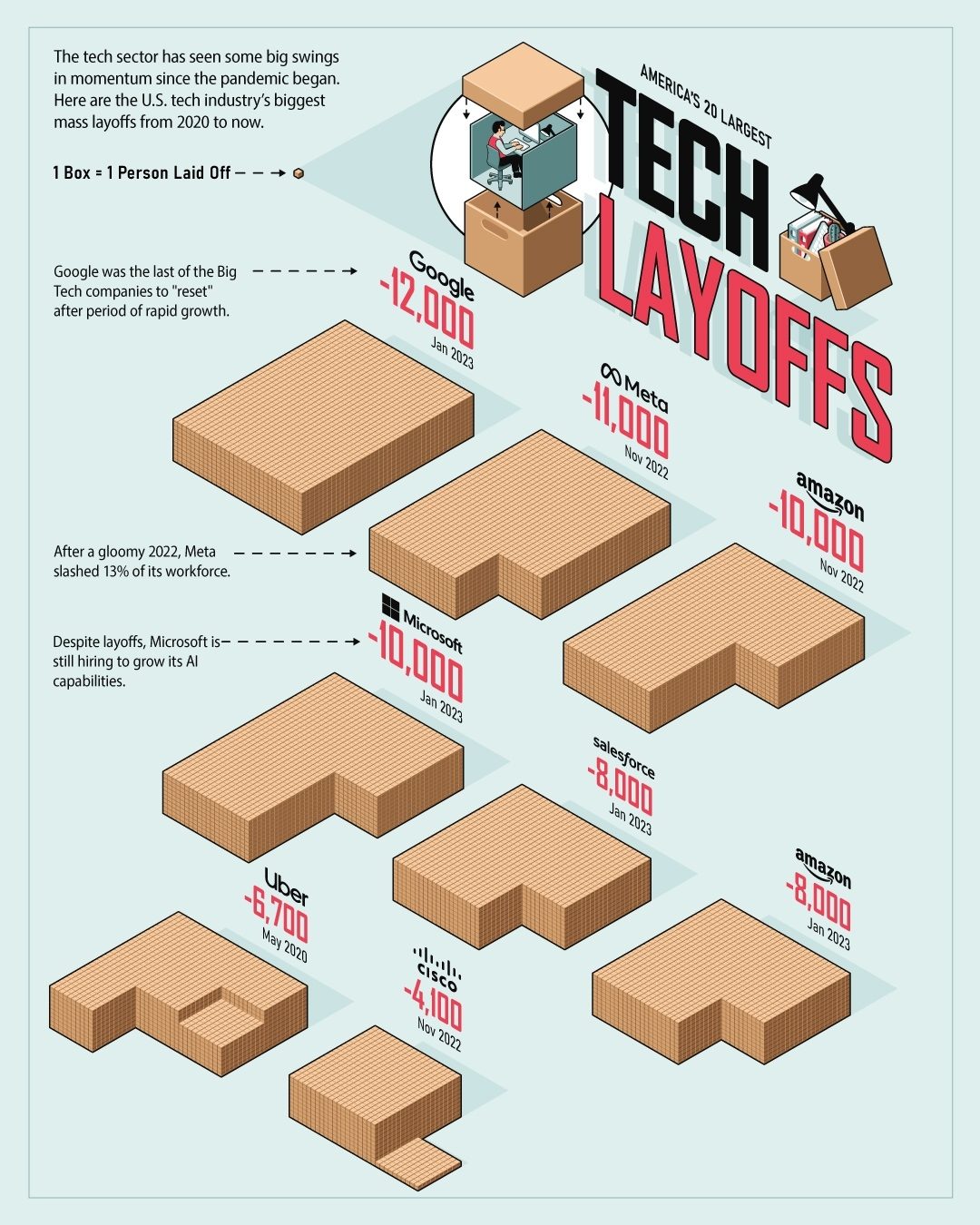
Several tech giants have conducted significant layoffs in recent years. Here are some of the most notable:
- Google laid off 11,000 employees in January 2023.
- Meta had two significant layoff events: 10,000 in November 2022 and an unspecified number in a separate event.
- Amazon conducted layoffs of 10,000 employees in November 2022.
- Microsoft laid off 10,000 employees in January 2023.
- Salesforce laid off 8,000 employees in January 2023.
- Uber laid off 6,700 employees in May 2020.
- Cisco laid off 4,100 employees in November 2022.
- IBM laid off 3,000 employees in January 2023.
- Groupon laid off 2,800 employees in April 2020.
- Peloton laid off 2,800 employees in February 2022.
- Carvana laid off 2,500 employees in May 2022.
- Katerra laid off 2,434 employees in June 2021.
- Zillow laid off 2,000 employees in November 2021.
- PayPal laid off 2,000 employees in January 2023.
- Airbnb laid off 1,900 employees in May 2020.
- Instacart laid off 1,877 employees in January 2021.
- Wayfair laid off 1,750 employees in January 2023.
- Better laid off 3,000 employees in March 2022.
The Impact on the Industry
The layoffs have had a profound impact on the tech industry. Many professionals who were hired during the hiring frenzy now find themselves out of work. The layoffs have also created a sense of uncertainty and job insecurity among those who remain employed. Companies are now more cautious about hiring, leading to a more competitive job market.
The layoffs have also highlighted the challenges of managing a remote workforce. Many companies that expanded rapidly during the pandemic are now grappling with the complexities of downsizing and restructuring their remote teams. This has required significant adjustments in company culture, operations, and management practices.
Industry Adaptations
In response to the layoffs, many tech companies are adopting new strategies to navigate the changing landscape. Some are focusing on cost-cutting measures, such as reducing expenses and streamlining operations. Others are pivoting to new business models and markets to diversify their revenue streams. Additionally, there is a growing emphasis on reskilling and upskilling employees to adapt to evolving job requirements.
Companies are also investing in automation and artificial intelligence to enhance productivity and efficiency. This trend is expected to continue as businesses look for ways to do more with fewer resources. The shift to remote work has also accelerated the adoption of digital tools and platforms, further driving the demand for tech talent.
Practical tips
For Job Seekers
The current job market for tech professionals is more competitive than ever. Here are some practical tips to help job seekers navigate the landscape:
- Networking: Build and leverage your professional network. Attend industry events, join online communities, and connect with peers on platforms like LinkedIn.
- Skill Development: Continuously update your skills to stay relevant. Focus on in-demand technologies and certifications that can enhance your employability.
- Tailored Resumes: Customize your resume and cover letter for each job application. Highlight your relevant skills and experiences to stand out to potential employers.
- Job Search Strategies: Use multiple job search strategies, including job boards, company websites, and recruitment agencies. Be proactive in your search and follow up with potential employers.
For Employers
For companies looking to hire in this challenging environment, here are some practical tips:
- Evaluate Needs: Assess your company's needs carefully before hiring. Ensure that new hires align with your long-term goals and can add value to your organization.
- Diversity and Inclusion: Foster a diverse and inclusive workplace. This can attract a wider pool of talent and create a more innovative and collaborative work environment.
- Employee Retention: Focus on employee retention by offering competitive salaries, benefits, and opportunities for professional development.
- Cultural Fit: Prioritize cultural fit when hiring. Employees who align with your company's values and culture are more likely to be productive and stay with the organization.
Important takeaways
The tech industry has undergone significant changes in recent years, driven by the global pandemic, remote work, and economic fluctuations. The wave of layoffs has reshaped the job market, creating new challenges and opportunities for both job seekers and employers.
Understanding the context and impact of these layoffs is crucial for professionals in the tech industry. The insights gained can help individuals make informed career decisions and navigate the competitive job market more effectively.
The tech industry's future will likely be characterized by continued uncertainty and rapid change. Companies and professionals who adapt to these challenges and stay resilient will be best positioned to thrive in the evolving landscape.
Conclusion
The tech industry's recent layoffs are a stark reminder of the industry's volatility. Understanding the factors driving these layoffs and their impact on the job market is essential for professionals and companies alike. By staying informed, adapting to changes, and focusing on continuous improvement, both individuals and organizations can navigate the challenges ahead and emerge stronger. The resilience and adaptability demonstrated by the tech industry in recent years will be critical in shaping its future.
Watch the Reel
Questions readers ask
What are the primary reasons behind the tech layoffs in the 2020s?
The primary reasons behind the tech layoffs in the 2020s include economic shifts, such as post-pandemic recovery and inflation, which led to reduced demand for certain services. Additionally, many companies overstaffed during the pandemic-driven hiring surge and now face the need to adjust their workforce.
Which major tech companies have conducted significant layoffs in the 2020s?
Several major tech companies have conducted significant layoffs in the 2020s, including Google, Amazon, and Microsoft. These companies have all reduced their workforce substantially in response to changing economic conditions and the need to manage costs.
How have economic shifts influenced tech industry trends in 2023?
Economic shifts, particularly inflation and the post-pandemic recovery, have significantly influenced tech industry trends in 2023. These shifts have led to reduced demand for certain services, prompting companies to reassess their workforce and implement layoffs.
What was the impact of the hiring surge during the pandemic on current layoffs?
The hiring surge during the pandemic led many tech companies to expand their workforce rapidly to meet increased demand for digital services. However, as demand stabilized and economic conditions changed, many of these companies found themselves overstaffed, contributing to the current wave of layoffs.
Why are tech companies resorting to layoffs in 2022 and 2023?
Tech companies are resorting to layoffs in 2022 and 2023 due to a combination of factors, including reduced demand for certain services, economic uncertainty, and the need to manage costs. Many companies overhired during the pandemic and are now adjusting their workforce to align with current market conditions.
How have layoff events in 2022 shaped the tech industry?
Layoff events in 2022 have significantly reshaped the tech industry by reducing the workforce in many major companies. These layoffs have led to a more cautious approach to hiring and a greater focus on cost management, as companies adapt to the changing economic landscape.
What insights can be gained from a visual analysis of tech layoffs in the 2020s?
A visual analysis of tech layoffs in the 2020s provides a clear picture of the scale and impact of job cuts across the industry. It highlights the most affected companies, the timing of layoff events, and the overall trend of workforce reduction, offering a comprehensive view of the industry's changes.
Related deep dives
Similar reads based on topic and creator.


Recent articles
Fresh deep dives from the latest Reels we unpacked.




Comments
Be the first to comment.