Semiconductor Market Share
The semiconductor market is a pivotal component of the rapidly evolving tech industry, with advanced semiconductors driving innovation across numerous sectors. These tiny, powerful chips power everything from smartphones to healthcare equipment, making their production and distribution a crucial piece of the modern technological puzzle. Understanding the current and future landscape of the semiconductor market can provide valuable insights into the direction of tech innovation.
Why This Matters
The semiconductor market is not just about chips; it’s about the future of technology. Advanced semiconductors are the backbone of modern devices, enabling faster processing speeds, reduced power consumption, and enhanced functionality. As the demand for these advanced chips continues to grow, so does the importance of understanding the market dynamics.
Market Overview
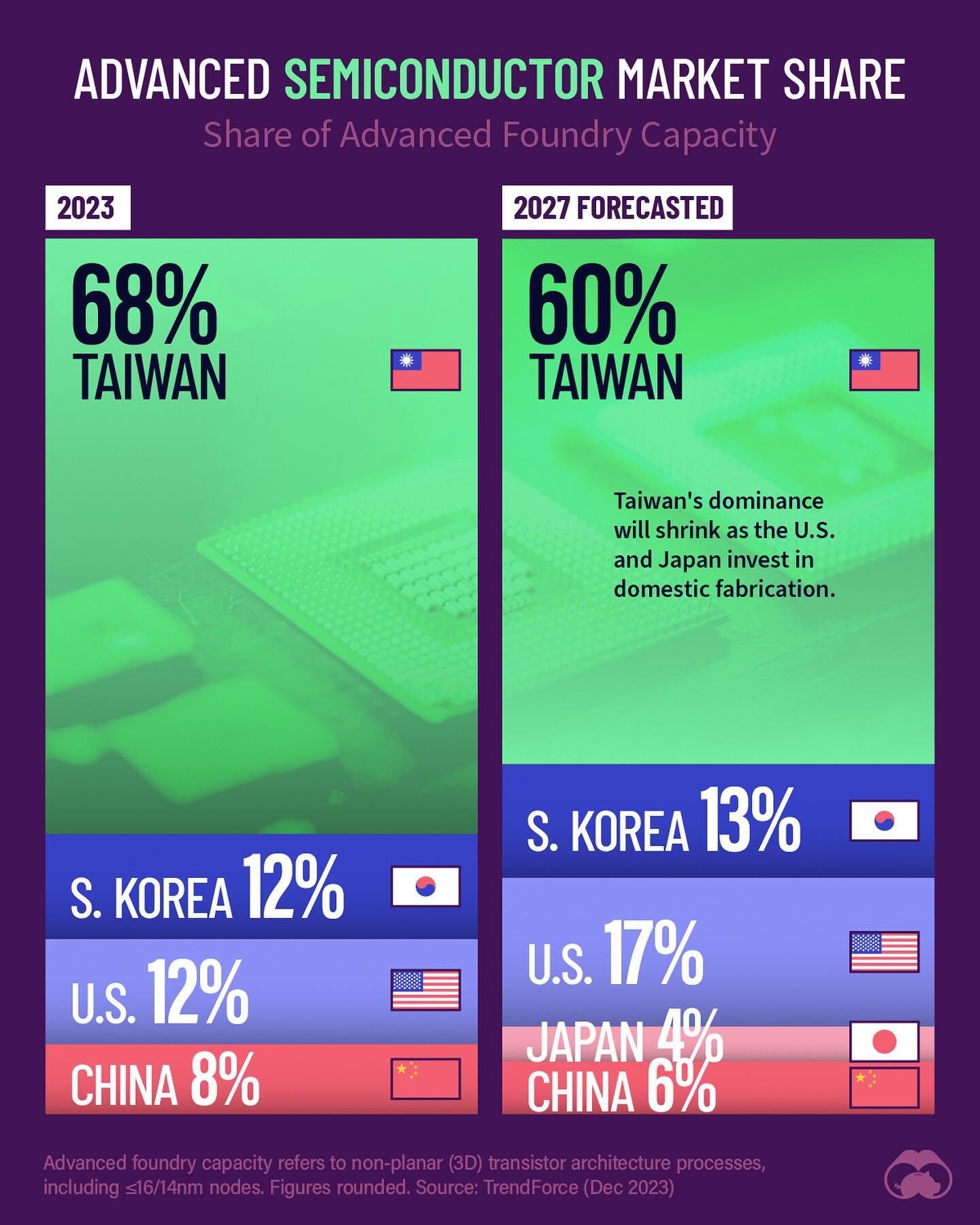
As of 2023, Taiwan holds a commanding 68% of the advanced semiconductor foundry capacity market. This dominance is attributed to the country's robust infrastructure, skilled workforce, and longstanding reputation as a global hub for semiconductor manufacturing. Taiwan Semiconductor Manufacturing Company (TSMC), one of the world’s leading semiconductor manufacturers, is a significant contributor to this market share.
Key Players and Their Roles
While Taiwan leads the pack, other countries are making significant strides to capture a larger portion of the market. South Korea, with companies like Samsung, holds a 13% market share. The U.S., home to giants like Intel and AMD, holds a 12% share. Japan and China, with 4% and 6% shares respectively, are also players in the market. These percentages are set to shift in the coming years, driven by strategic investments and technological advancements.
Shifting Market Dynamics
By 2027, the market dynamics are expected to change significantly. Taiwan's dominance is projected to decrease to 60%, marking a strategic shift in the semiconductor landscape. Several factors contribute to this anticipated decline, including increased investment in domestic fabrication by the U.S. and Japan. These investments aim to reduce reliance on foreign semiconductor suppliers and enhance national security.
U.S. and Japan’s Strategic Moves
The U.S. is planning to boost its market share to 17% by 2027, a substantial increase from its current 12%. This push is driven by significant government and private sector investments in advanced chip fabrication. The CHIPS Act, for example, is designed to bolster domestic semiconductor production and innovation. Japan, too, is expected to increase its market presence with targeted investments in the semiconductor industry.
Technological Advancements
The semiconductor industry is constantly evolving, with new technological advancements pushing the boundaries of what is possible. For instance, the transition to non-planar (3D) transistor architecture, including processes at the 16/14nm nodes, has significantly improved chip performance and efficiency. These advancements are a testament to ongoing research and development efforts worldwide.
Impact on Various Industries
The semiconductor market’s evolution impacts various industries, from consumer electronics to automotive and healthcare. Smartphones, which rely heavily on advanced semiconductors, are expected to see further enhancements in processing power and battery life. Similarly, the healthcare sector, with its growing need for advanced diagnostic and treatment tools, will benefit from more efficient and powerful semiconductor technology.
Practical Tips for Investors and Stakeholders
For those looking to stay ahead in the semiconductor market, it’s crucial to keep a close eye on the following:
Stay Informed
The semiconductor landscape is dynamic, with new players and technologies emerging regularly. Stay informed about market trends, technological advancements, and policy changes that could impact the industry.
Diversify Investments
Given the shifting market dynamics, diversifying investments across different regions and technologies can help mitigate risks. For example, investing in both established players like TSMC and emerging markets like Japan can offer a balanced portfolio.
Important Takeaways
The semiconductor market is a cornerstone of the tech industry, with significant implications for various sectors. Understanding the current market dynamics and future projections is essential for investors, policymakers, and tech enthusiasts. With Taiwan’s dominance set to shrink by 2027, the U.S. and Japan’s strategic investments, and ongoing technological advancements, the semiconductor market is poised for exciting transformations.
Conclusion
The advanced semiconductor market is a dynamic and critical sector that drives innovation across numerous industries. Taiwan's current dominance, set to decline by 2027, is a pivotal shift that will reshape the industry landscape. Strategic investments by the U.S. and Japan, along with continuous technological advancements, will play a crucial role in this transformation. Staying informed and diversifying investments are key strategies for navigating this ever-evolving market.
Watch the Reel
Questions readers ask
What is the current state of Taiwan's dominance in the semiconductor market?
Taiwan currently leads the advanced semiconductor market with a significant 68% share. This dominance is supported by a strong infrastructure and a highly skilled workforce, which have been key factors in their success.
Which countries are investing in semiconductor technology to challenge Taiwan's market share?
Countries like South Korea and the US are making substantial investments in semiconductor technology. These strategic investments aim to enhance their competitiveness, potentially reducing Taiwan’s market share by 2027.
How is the global semiconductor market expected to change by 2027?
By 2027, the global semiconductor market is expected to see a shift in dynamics due to advancements and investments from other countries. This could lead to a more competitive landscape, with Taiwan’s dominance possibly decreasing.
What factors are driving the demand for advanced semiconductors?
The demand for advanced semiconductors is driven by the need for faster processing speeds, reduced power consumption, and enhanced functionality in various devices. These chips are essential for modern technologies, from smartphones to healthcare equipment.
What role does semiconductor fabrication capacity play in market share?
Semiconductor fabrication capacity is crucial in determining market share. Countries and companies with advanced fabrication capabilities can produce more efficient and powerful chips, giving them a competitive edge in the market.
How is the US contributing to the global semiconductor market trends?
The US is contributing through significant technological advancements and investments in the semiconductor industry. These efforts aim to boost domestic production and innovation, making the US a stronger competitor in the global market.
What challenges does Taiwan's semiconductor industry face in maintaining its market share?
Taiwan's semiconductor industry faces challenges from increasing competition, particularly from countries like South Korea and the US. Maintaining its market share will require continuous innovation, investment, and adaptation to new technological trends.
Related deep dives
Similar reads based on topic and creator.


Recent articles
Fresh deep dives from the latest Reels we unpacked.




Comments
Be the first to comment.