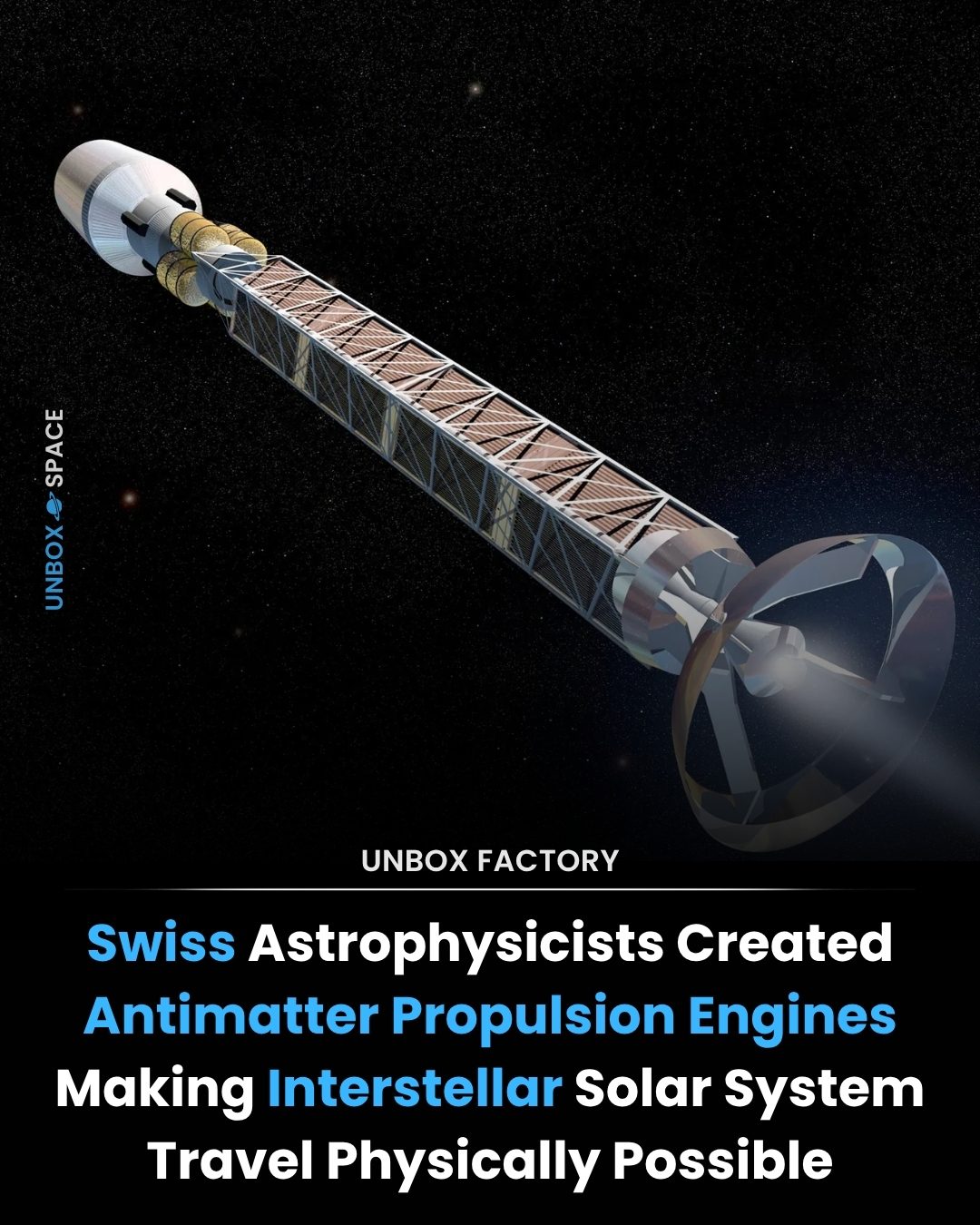
Antimatter Propulsion Engines
Antimatter propulsion engines, a cutting-edge development in space exploration, represent a transformative concept in the realm of propulsion technology. Researchers in Switzerland have leveraged antimatter annihilation, one of the most energy-dense reactions in physics, to create theoretical propulsion concepts that could redefine interstellar travel.
Context / Why this matters
The significance of antimatter propulsion lies in its potential to revolutionize space exploration. By harnessing the immense energy released from antimatter-matter annihilation, these engines could dramatically reduce travel times within the Solar System and even enable interstellar missions, making distant stars and exoplanets more accessible for scientific exploration.
Main discussion
The science behind antimatter propulsion
At its core, antimatter propulsion relies on the annihilation of antimatter particles with matter particles. This process releases an enormous amount of energy—far greater than any chemical reaction. For instance, just one gram of antimatter annihilating with one gram of matter would release energy equivalent to roughly 43 kilotons of TNT, surpassing the explosive power of the Hiroshima atomic bomb. This energy output is what makes antimatter such an attractive fuel source for future spacecraft.
Engineering Challenges
Despite its potential, designing and building antimatter propulsion engines present substantial engineering hurdles. The primary challenges include:
- Production and Storage of Antimatter: Current global production of antimatter is extremely limited, amounting to only nanograms per year. Additionally, storing antimatter is a complex task due to its tendency to annihilate with ordinary matter. This requires advanced containment techniques, such as magnetic or electrostatic traps.
- Efficiency and Safety: Ensuring that the high-energy output of antimatter annihilation can be effectively harnessed into useful thrust for a spacecraft is another major challenge. Safety concerns also need to be addressed, as the uncontrolled release of such energy could be catastrophic.
Current Research and Advancements
Swiss astrophysicists, in collaboration with CERN, have made significant strides in this field. Theoretical models and experimental setups have been developed to better understand how antimatter can be used for propulsion. Although these are still in the early stages, the progress is encouraging. Researchers are exploring various methods to produce, store, and use antimatter more efficiently. These efforts aim to overcome the current limitations and pave the way for practical antimatter propulsion systems.
Visualization and Model Development
A key aspect of advancing this technology is through visualization and model development. Detailed 3D models of spacecraft equipped with antimatter propulsion systems, like the one showcased, help researchers and engineers conceptualize and refine their designs. Visualizing the integration of these engines within a spacecraft provides insights into potential configurations and operational efficiencies.
Practical tips
When considering the practical applications of antimatter propulsion, it's essential to focus on the following:
- Incremental Development: Given the current technological and economic constraints, it's crucial to approach the development of antimatter propulsion in incremental steps. Start with small, controlled experiments and gradually scale up as advancements are made.
- Collaboration: Collaboration between scientific institutions, private companies, and space agencies is vital. Sharing knowledge, resources, and technologies can accelerate progress and drive innovation.
- Public and Private Investment: Both public funding and private investments are necessary to support the high costs associated with antimatter research and development. Public-private partnerships can help bridge the financial gap and foster a thriving ecosystem for advanced propulsion technologies.
- Public Engagement: Engaging the public in the journey of antimatter propulsion can generate interest and support. Sharing progress, challenges, and successes through media and public outreach can inspire future generations of scientists and engineers.
Important takeaways
-
Potential for Interstellar Travel: Antimatter propulsion holds the promise of enabling interstellar travel, making it possible to explore distant stars and exoplanets.
-
High Energy Output: The energy released from antimatter-matter annihilation is immense, surpassing the explosive power of nuclear reactions, which makes it an ideal fuel source for deep-space missions.
-
Engineering Challenges: Overcoming the production, storage, and efficiency issues are critical to the practical implementation of antimatter propulsion.
-
Collaborative Efforts: Progress in this field requires collaboration between scientific institutions, private companies, and space agencies.
Conclusion
Antimatter propulsion engines represent a frontier in space exploration, offering the potential to dramatically reduce travel times and open up new horizons for interstellar missions. While significant challenges remain, the ongoing research and development efforts, spearheaded by Swiss astrophysicists and institutions like CERN, are paving the way for a future where antimatter propulsion becomes a reality. As advancements continue, the dream of exploring distant stars and exoplanets may soon become a tangible goal, transforming our understanding of the universe and our place within it.
Watch the Reel
Questions readers ask
What are antimatter propulsion engines and how do they work?
Antimatter propulsion engines are a revolutionary concept in space travel. They use the energy released from the annihilation of antimatter and matter to generate thrust. This process is one of the most energy-dense reactions in physics, making it a highly efficient fuel source for spacecraft.
How can antimatter propulsion engines benefit space travel?
These engines have the potential to dramatically reduce travel times within our Solar System and even enable interstellar missions. By making distant stars and exoplanets more accessible, antimatter propulsion could open up new frontiers for exploration and discovery.
What makes antimatter such a promising fuel source for space travel?
Antimatter is a promising fuel source due to its high energy density. The annihilation of antimatter and matter releases an enormous amount of energy, which can be converted into thrust, making it far more efficient than conventional rocket fuels.
What makes the Swiss research in antimatter propulsion significant?
The Swiss research is significant because it represents a cutting-edge development in propulsion technology. By harnessing antimatter annihilation, Swiss astrophysicists are at the forefront of making interstellar travel a feasible reality.
What are the potential challenges in developing antimatter propulsion engines?
One of the main challenges is the production and storage of antimatter. Additionally, the infrastructure for handling and utilizing such a volatile substance, especially in space, is still under development. Furthermore, the safety and stability of antimatter within an engine must be ensured.
How do antimatter propulsion engines compare to traditional rocket engines?
Traditional rocket engines rely on chemical reactions, which are less energy-dense. Antimatter engines, on the other hand, utilize the energy released from antimatter-matter annihilation, providing a far more powerful and efficient source of propulsion. This allows for far greater speeds and shorter travel times.
What are the implications of successful antimatter propulsion technology for future missions?
Successful antimatter propulsion technology could revolutionize the way we approach space travel. It would make distant stars, exoplanets, and other celestial bodies more accessible, allowing for more ambitious and far-reaching missions in the future.
Related deep dives
Similar reads based on topic and creator.


Recent articles
Fresh deep dives from the latest Reels we unpacked.




Comments
Be the first to comment.