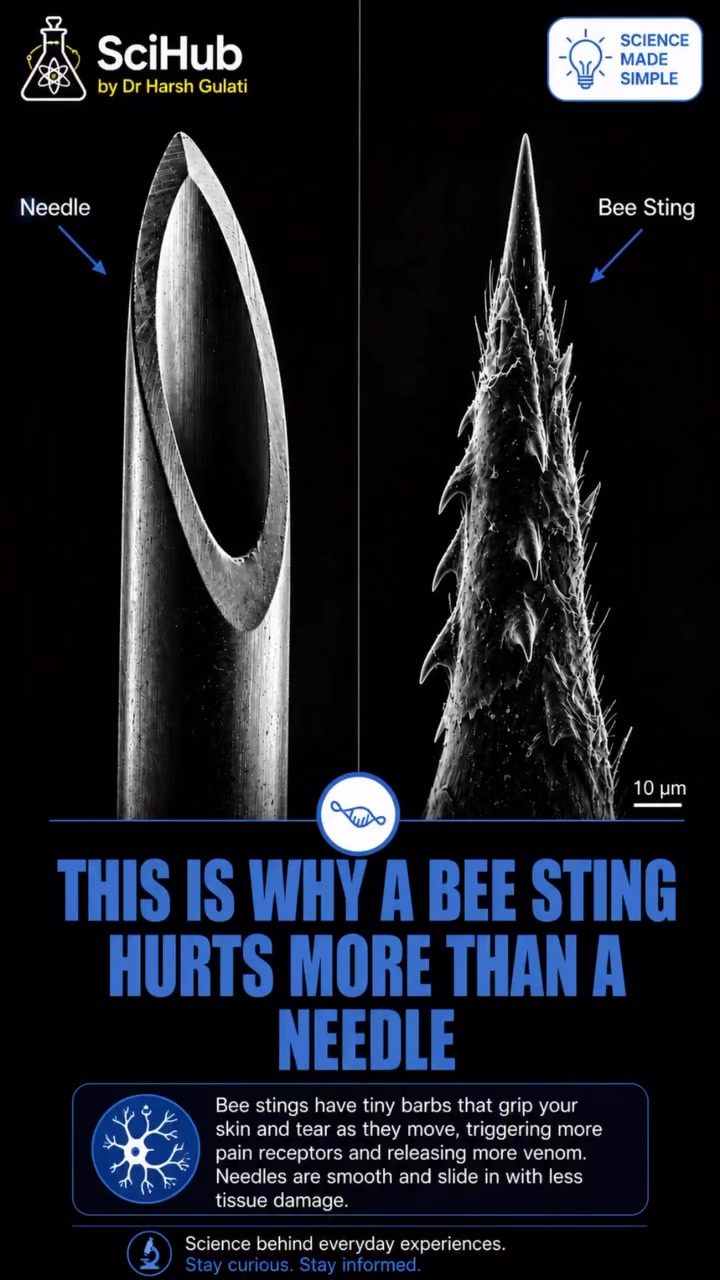
The Science Behind Bee Stings and Needles
Bee stings and needles are both sharp, but their designs serve vastly different purposes. Bee stings cause significantly more pain, and the reason goes beyond just the venom. Let's examine the biological design of bee stingers, the engineering of needles, and the underlying science that makes bee stings so much more painful.
Why This Matters
Understanding the difference between a bee sting and a needle provides insight into both biological evolution and human engineering. This knowledge can help appreciate the complex mechanisms that nature and technology employ to achieve their goals.
The Design of a Bee Sting
Evolutionary Purpose
A bee sting is a natural defense mechanism. It is designed to protect the bee and its colony from predators. In honeybees, the stinger is a modified ovipositor, a structure typically used for laying eggs. Over time, it has evolved into a highly effective weapon.
Microscopic Barbs
Under a microscope, a bee's stinger reveals tiny, backward-facing barbs. These barbs act like tiny anchors, gripping the skin and tearing as they move. This tearing motion increases tissue damage and activates more pain receptors, making the sting more painful.
Venom Delivery
The venom delivered by a bee sting contains compounds like melittin and phospholipase A₂. These substances trigger inflammation, swelling, redness, and a burning sensation. In honeybees and other social species, the stinger remains in the victim, continuing to pump venom even after the bee flies away. This prolonged venom delivery exacerbates pain and inflammation.
The Design of a Medical Needle
Engineering for Minimal Pain
Medical needles are engineered to minimize pain and tissue damage. They are designed to be smooth and sharp, allowing them to pass through the skin with minimal resistance. This design reduces tissue trauma and pain, making the experience less painful than a bee sting.
Medication Delivery
The primary function of a needle is to deliver medication efficiently. The smooth surface and sharp point ensure that the needle can penetrate the skin with minimal tissue damage, reducing discomfort and facilitating effective drug delivery.
The Key Differences
Tissue Damage
Bee stings cause more tissue damage due to their barbed structure. The barbs grip the skin and tear as they move, activating more pain receptors. In contrast, needles are designed to slide in smoothly, causing minimal tissue disruption.
Pain Receptors
The barbed structure of a bee sting triggers more pain receptors, intensifying the sensation of pain. Needles, with their smooth design, cause less activation of pain receptors, resulting in a less painful experience.
Venom vs. Medication
Bee venom contains compounds that trigger inflammation and pain. In contrast, needles deliver medications that can counteract inflammation and pain, or are used to inject anesthetics for pain relief.
Practical Tips
How to Handle a Bee Sting
If you're stung by a bee, follow these steps to minimize pain and discomfort:
- Remove the Stinger: If the stinger is still in your skin, remove it as quickly as possible by scraping it out with a fingernail or a credit card. Do not squeeze the stinger, as this can release more venom.
- Clean the Area: Wash the affected area with soap and water to reduce the risk of infection.
- Apply a Cold Compress: Use an ice pack or a cold compress to reduce swelling and numb the pain.
- Over-the-Counter Remedies: Apply a topical cream like hydrocortisone or take an oral antihistamine to reduce itching and swelling.
- Monitor for Allergic Reactions: Some people have severe allergic reactions to bee stings. If you experience symptoms like difficulty breathing, swelling of the throat, or rapid heartbeat, seek immediate medical attention.
Avoiding Bee Stings
While it's impossible to avoid all bee encounters, you can take steps to reduce your risk of getting stung:
- Stay Calm and Still: Bees are less likely to sting if you remain calm and still. Sudden movements can provoke them.
- Wear Protective Clothing: If you're working outdoors or in areas with lots of bees, wear long-sleeved shirts, pants, and gloves.
- Avoid Perfumes and Fragrances: Bees are attracted to sweet scents, so avoid wearing perfumes, lotions, or scented products.
- Check for Nests: Inspect your outdoor spaces for bee nests, especially in areas where you plan to spend time, like patios or gardens.
Important Takeaways
Bee stings and needles differ in their design and purpose, leading to vastly different experiences in terms of pain and tissue damage. Bee stings are more painful due to their barbed structure and venomous content, while needles are designed to minimize pain and tissue damage for effective medication delivery.
Conclusion
While both bee stings and needles are sharp objects that penetrate the skin, their biological and engineering purposes are vastly different. Understanding the design and function of both can provide insight into the intricate mechanisms of nature and human engineering.
Watch the Reel
Questions readers ask
Why do bee stings hurt more than needle pokes?
Bee stings inflict more pain due to several factors. The stinger's microscopic barbs cause additional tissue damage upon extraction, and the venom contains compounds like melittin and apamin which directly affect pain receptors in the skin. Additionally, the rapid injection of venom triggers an immediate inflammatory response, amplifying the sensation of pain.
What makes bee stingers different from medical needles?
Bee stingers and needles differ fundamentally in design and purpose. Bee stingers are equipped with microscopic barbs that latch onto skin, ensuring the venom is injected deep into the tissue. In contrast, needles are smooth and engineered to minimize tissue damage and pain upon insertion and extraction, as their primary function is to deliver or extract fluids efficiently.
Can the pain from a bee sting be managed like needle pain?
Managing the pain from a bee sting and a needle poke involves different approaches. Needle pain is often mitigated through techniques like using smaller gauges, applying topical anesthetics, or distracting the patient. However, bee sting pain is often more intense and immediate, and may require different strategies like applying a cold compress, using antihistamines, or, in severe cases, seeking medical attention for allergic reactions.
What are the medical implications of a bee sting?
While a typical bee sting results in localized pain and swelling, it can have more serious medical implications for those with allergies. In severe cases, a sting can trigger anaphylaxis, a life-threatening reaction that requires immediate medical intervention. It is crucial for individuals with known allergies to carry epinephrine auto-injectors and be aware of the signs of an allergic reaction.
Why do bee stings penetrate skin more painfully than needles?
Bee stings penetrate skin more painfully due to the combination of the stinger's design and the venom's potency. The barbs on the stinger cause significant tissue damage as the bee attempts to extract itself, while the venom's active compounds trigger an intense, immediate pain response. Needles, on the other hand, are designed to penetrate the skin smoothly, reducing tissue damage and pain.
Recent articles
Fresh deep dives from the latest Reels we unpacked.




Comments
Be the first to comment.