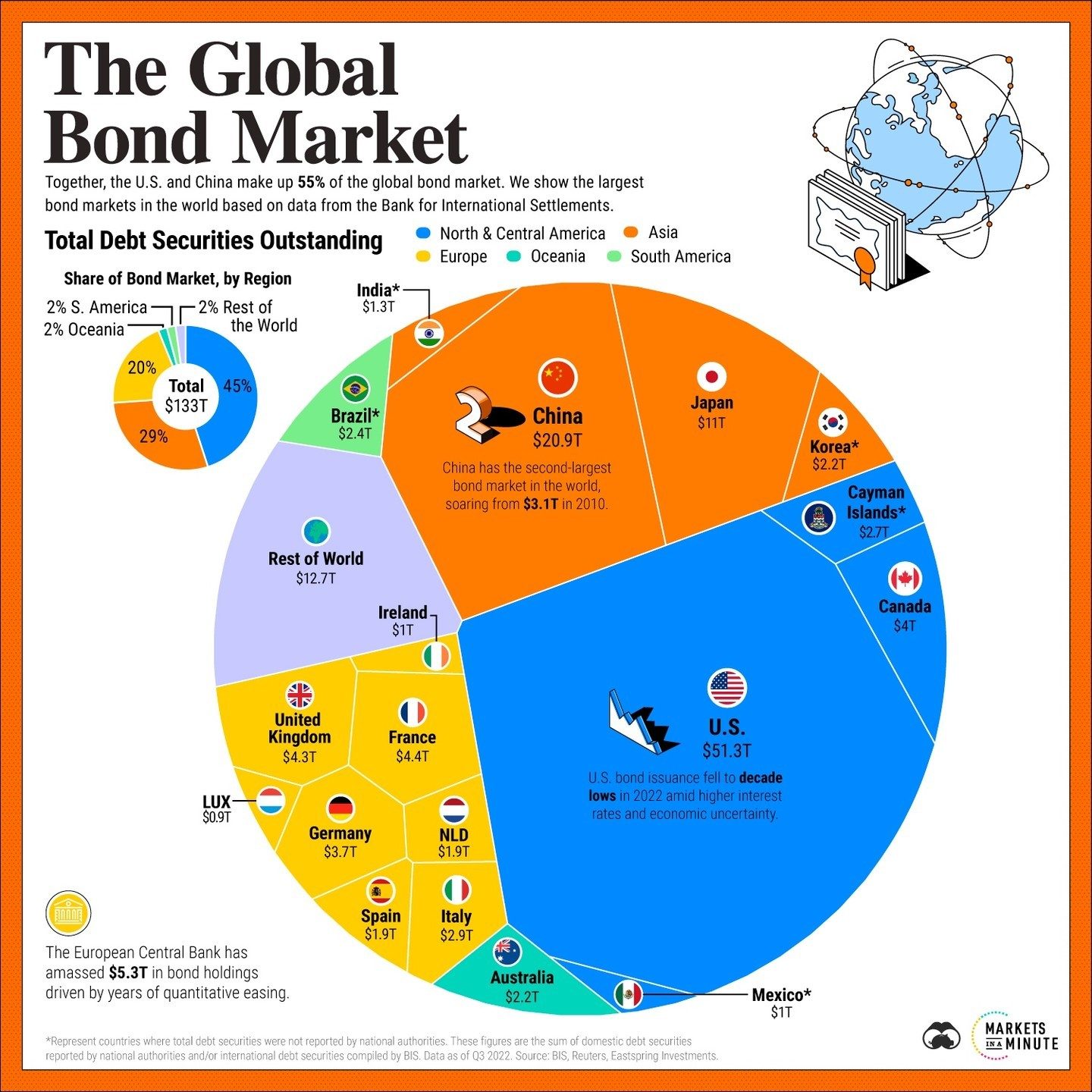
The Global Bond Market in 2022
The global bond market in 2022 reached an astonishing $133 trillion, solidifying its position as one of the world's largest capital markets. This figure represents a sevenfold increase over the past four decades, driven largely by government and corporate debt sales across both major economies and emerging markets.
Why This Matters
Understanding the global bond market is crucial for investors, policymakers, and economists alike. Bond markets play a pivotal role in global financial systems, influencing interest rates, monetary policies, and economic stability. The size and growth of the bond market reflect the collective debt levels and financial health of governments and corporations worldwide.
Global Bond Market Dynamics
Regional Breakdown
The global bond market is not evenly distributed. The United States and China together account for 55% of the total market, with the U.S. holding the largest share at $51.3 trillion and China following closely with $20.9 trillion. Japan, another significant player, holds $11 trillion in debt securities.
Other notable regions include:
- Europe: The European Central Bank holds a substantial $5.3 trillion in bond holdings, a result of years of quantitative easing. Major European economies like the United Kingdom ($4.3 trillion), France ($4.4 trillion), Germany ($3.7 trillion), and Italy ($2.9 trillion) are also significant contributors.
- Asia-Pacific: Japan, China, and Australia ($2.2 trillion) are key players in this region. The Cayman Islands, Ireland, and the Netherlands also have significant holdings, although the exact figures are sometimes not reported by national authorities.
- Latin America: Brazil ($2.4 trillion) and Mexico ($1 trillion) are the largest holders in this region, which collectively makes up 2% of the global bond market.
- Oceania: This region, including Australia, holds $2.2 trillion, accounting for 2% of the global bond market.
Key Drivers of Growth
Several factors have contributed to the growth of the global bond market:
- Government Debt: Governments issue bonds to finance public projects, social programs, and economic stimulus packages. The increased government borrowing, especially during economic downturns, significantly contributes to the growth of the bond market.
- Corporate Debt: Companies issue bonds to raise capital for expansions, acquisitions, and operational needs. The corporate bond market has seen robust growth, fueled by low-interest rates and the need for capital in a competitive business environment.
- Quantitative Easing: Central banks, particularly the European Central Bank, have employed quantitative easing to stimulate economic growth. This involves purchasing bonds to inject liquidity into the market, thereby increasing the demand for debt securities.
Emerging Markets
Emerging markets, while smaller in size compared to major economies, are becoming increasingly important. Countries like Brazil and Mexico are expanding their bond markets, attracting foreign investment and contributing to global economic stability.
Practical Tips for Investors
Diversifying Your Portfolio
Given the size and complexity of the global bond market, diversification is key. Investors should consider spreading their investments across different regions and types of bonds to mitigate risk. For instance, a portfolio might include a mix of U.S. Treasury bonds, European government bonds, and corporate bonds from emerging markets.
Monitoring Economic Indicators
Staying informed about economic indicators such as interest rates, inflation, and GDP growth is essential. These factors can significantly impact bond prices and yields. For example, rising interest rates usually lead to a fall in bond prices, while economic instability can increase demand for government bonds as a safe haven.
Analyzing Central Bank Policies
Central bank policies, such as quantitative easing and interest rate adjustments, have a direct impact on bond markets. Investors should closely monitor announcements from central banks like the Federal Reserve, the European Central Bank, and the Bank of Japan to anticipate market movements.
Important Takeaways
- The global bond market is a critical component of the world's financial landscape, with a total value of $133 trillion in 2022.
- The United States and China are the largest contributors, accounting for 55% of the market.
- Diversification, monitoring economic indicators, and understanding central bank policies are key strategies for investors.
- The European Central Bank's bond holdings and the growth of emerging markets are significant factors in the global bond market.
Conclusion
The global bond market's expansion and complexity underscore its importance in the global financial ecosystem. From the dominant roles of the U.S. and China to the strategic policies of the European Central Bank, every component of this market has a significant impact on global economics. Whether you are an investor, a policymaker, or an economist, keeping abreast of these dynamics is essential for navigating the ever-evolving financial landscape.
Watch the Reel
Questions readers ask
What are the largest bond markets in the world in 2022?
The largest bond markets in 2022 are the United States and China. These two countries, along with other major economies, have significantly contributed to the record $133 trillion global bond market.
How has the global bond market size evolved over the past few decades?
The global bond market has seen remarkable growth, expanding to $133 trillion in 2022. This represents a sevenfold increase from 40 years ago, driven by extensive government and corporate debt issuance worldwide.
What role does the global bond market play in the broader economy?
The global bond market influences interest rates and monetary policies, which are crucial for economic stability and growth. It reflects the financial health of governments and corporations, making it a key indicator for investors and policymakers.
Which regions have the most significant presence in the global bond market?
The regions with the most significant presence in the global bond market include the United States, China, Europe, and Japan. Each of these regions contributes substantially to the overall market size and dynamics.
How do central banks influence the global bond market?
Central banks play a critical role in the global bond market through their bond holdings and monetary policies. Their actions can impact interest rates and the overall stability of the market, making them key players in the global financial system.
What trends should investors watch in the 2022 global bond market?
Investors should monitor trends such as government and corporate debt levels, interest rate changes, and the performance of major economies like the US and China. These trends can provide insights into the overall health and potential shifts in the global bond market.
How can I visualize the global bond market data for 2022?
To visualize the 2022 global bond market data, look for infographics and statistical reports that break down the market by region. These visual aids can help you understand the distribution and growth of the world bond market, particularly the contributions from major economies.
Recent articles
Fresh deep dives from the latest Reels we unpacked.




Comments
Be the first to comment.