US Household Finances
State-By-State Overview
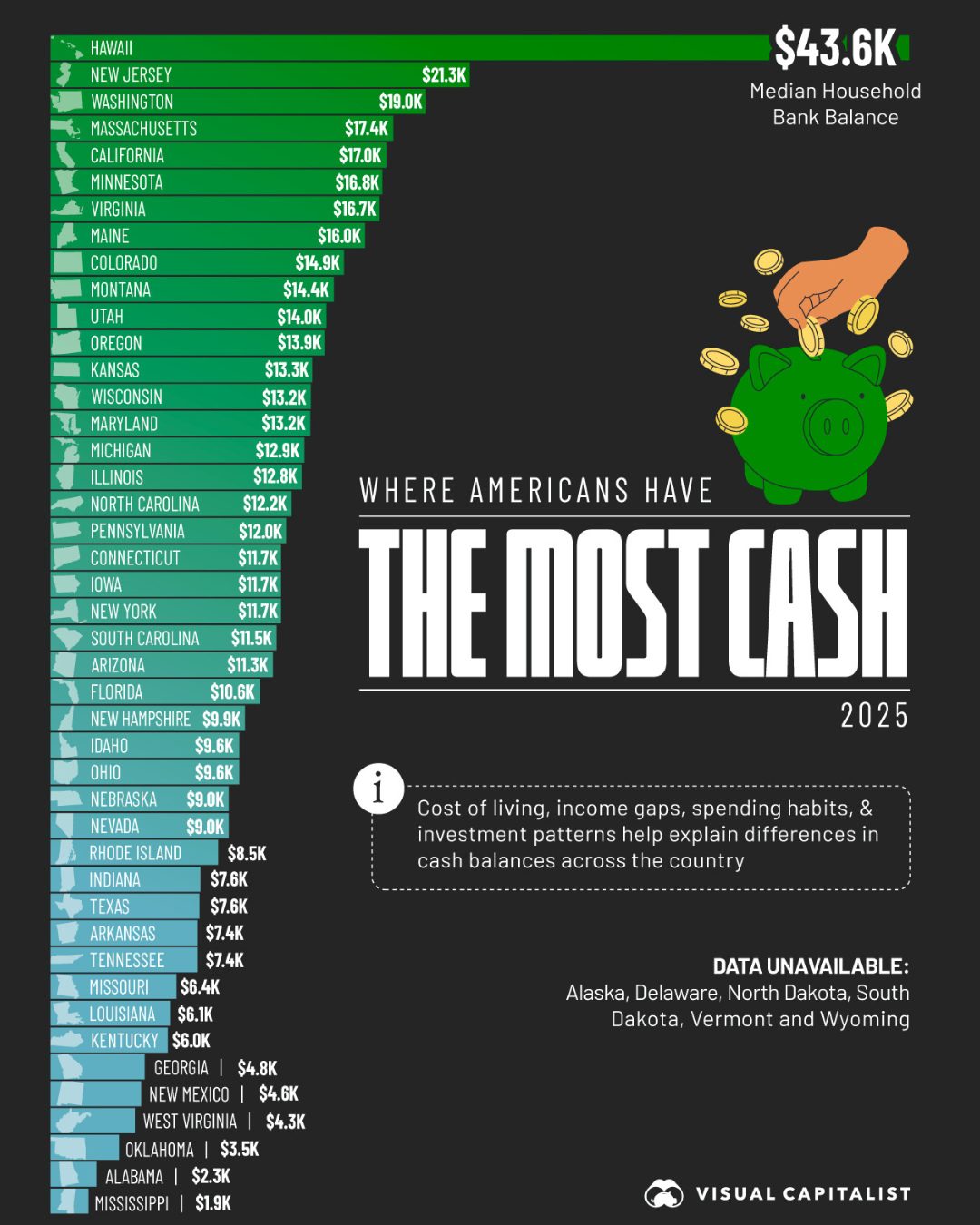
Understanding the median bank balances of households across the United States reveals significant disparities. Recent data show that Hawaii leads the nation with the highest median bank balance at $43,599, while Mississippi holds the lowest at $1,914. These figures highlight the stark economic differences between states, influenced by factors like cost of living, income gaps, and investment patterns.
Why This Matters
The variation in median bank balances across states can provide valuable insights into the overall financial health and economic stability of different regions. This information is crucial for policymakers, financial institutions, and individuals looking to understand the broader economic landscape. By examining these data points, we can better grasp the financial challenges and opportunities in different parts of the country.
Cost of Living and Income Gaps
State with Highest and Lowest Median Bank Balances
-
Hawaii: At the top, Hawaii's high median bank balance reflects several factors, including a robust tourism industry, which drives high wages and significant income for many residents. The state also has a higher cost of living, which might encourage residents to save more money.
-
Mississippi: At the other end, Mississippi has the lowest median bank balance, influenced by a lower median household income and a higher poverty rate. The cost of living in Mississippi is also lower, which might contribute to lower savings.
Economic Trends and Anomalies
Households in states with large economies generally have more money in the bank. However, Texas and New York are notable exceptions. Texas, despite having a strong economy, has a median bank balance of $7,600, significantly lower than expected. New York, with its high cost of living and significant economic activity, has a median balance of $11,500, which is also relatively low given the state's overall economic performance. These anomalies can be attributed to various factors, including high living costs, diverse economic activities, and different spending habits among residents.
Cultural and Economic Influences
High-Balance States
States like Hawaii, New Jersey, and Massachusetts consistently rank high in median bank balances. These states often have higher median incomes and a strong emphasis on financial planning. Additionally, these regions typically have lower unemployment rates and higher standards of living, which contribute to higher savings.
Low-Balance States
Conversely, states like Mississippi, Alabama, and West Virginia have the lowest median bank balances. These states often face higher unemployment rates, lower median incomes, and a higher cost of living relative to income. The economic challenges in these regions can make it difficult for households to save money, leading to lower bank balances.
Cost of Living and Spending Habits
The cost of living varies significantly across the United States, influencing how much money households have in the bank. States with higher living costs, such as Hawaii and California, tend to have higher median bank balances, despite the financial strain. This trend might reflect a higher standard of living and a stronger emphasis on savings and financial planning.
In contrast, states with lower living costs, like Mississippi and Alabama, might have lower bank balances due to limited financial resources. The lower cost of living can lead to less savings, as residents may prioritize immediate needs over long-term financial planning.
Key Takeaways
-
Economic Disparities: The significant differences in median bank balances across states highlight the economic disparities in the United States. Understanding these differences can help policymakers and financial institutions develop targeted solutions to address financial challenges.
-
Influence of Cost of Living: The cost of living plays a crucial role in determining how much money households have in the bank. Higher living costs in some states can lead to higher savings, while lower living costs in other states might result in lower balances.
-
Financial Planning: States with higher median bank balances often have a stronger emphasis on financial planning and savings. Encouraging financial literacy and planning can help improve the financial health of households in states with lower balances.
Practical Tips
For individuals and families looking to improve their financial situation, consider the following tips:
-
Budgeting: Create and stick to a budget to track your income and expenses. This can help you identify areas where you can save money and reduce unnecessary spending.
-
Saving: Make saving a priority by setting aside a portion of your income regularly. Even small amounts can add up over time, contributing to your financial security.
-
Investing: Explore investment opportunities that align with your financial goals and risk tolerance. Investing can help grow your wealth and provide long-term financial stability.
-
Financial Planning: Consult with a financial advisor to develop a comprehensive financial plan tailored to your needs. A financial plan can help you manage your finances effectively and achieve your financial goals.
Important Takeaways
-
Understanding the Data: The data on median bank balances across states provides valuable insights into the financial health and economic stability of different regions. By examining these data points, we can better understand the challenges and opportunities in different parts of the country.
-
Addressing Economic Disparities: Recognizing the significant differences in median bank balances can help policymakers and financial institutions develop targeted solutions to address financial challenges. This can lead to improved financial health and economic stability for households across the nation.
-
Improving Financial Health: By focusing on budgeting, saving, investing, and financial planning, individuals and families can improve their financial health and achieve long-term financial stability.
Conclusion
The variation in median bank balances across the United States highlights the significant economic disparities between states. Factors like cost of living, income gaps, and spending habits play a crucial role in determining household financial health. By understanding these factors, we can develop targeted solutions to address financial challenges and improve the overall economic stability of the nation.
Watch the Reel
Questions readers ask
Which state has the highest median bank balance in the US?
Hawaii has the highest median bank balance in the U.S., with an impressive $43,599. This figure reflects the state's robust economy and higher cost of living, which often correlates with greater financial resources among residents.
What is the median bank balance in Mississippi?
Mississippi has the lowest median bank balance in the U.S., at $1,914. This figure indicates significant financial challenges and economic disparities within the state, which may be influenced by factors such as lower income levels and higher poverty rates.
How does Texas compare in terms of median bank balance?
Texas has a median bank balance of $5,453, ranking it among the middle of all states. This figure provides insight into the state's financial landscape, showing a balance between economic opportunities and financial stability for its residents.
Why is it important to consider median bank balances by state?
Examining median bank balances by state offers a glimpse into the broader economic trends and financial health of different regions. This information can help inform policy decisions, financial planning, and a deeper understanding of the economic disparities across the country.
Which other states have high median bank balances besides Hawaii?
In addition to Hawaii, states like New York and South Dakota also have high median bank balances. New York's median bank balance is $12,268, while South Dakota is $11,397. These figures reflect the diverse economic landscapes and financial opportunities present in these states.
How does North Carolina's median bank balance compare to the national average?
North Carolina's median bank balance is $3,400, which is lower than the national average. This indicates that while the state has opportunities for economic growth, a significant portion of its residents may face financial challenges.
Recent articles
Fresh deep dives from the latest Reels we unpacked.




Comments
Be the first to comment.