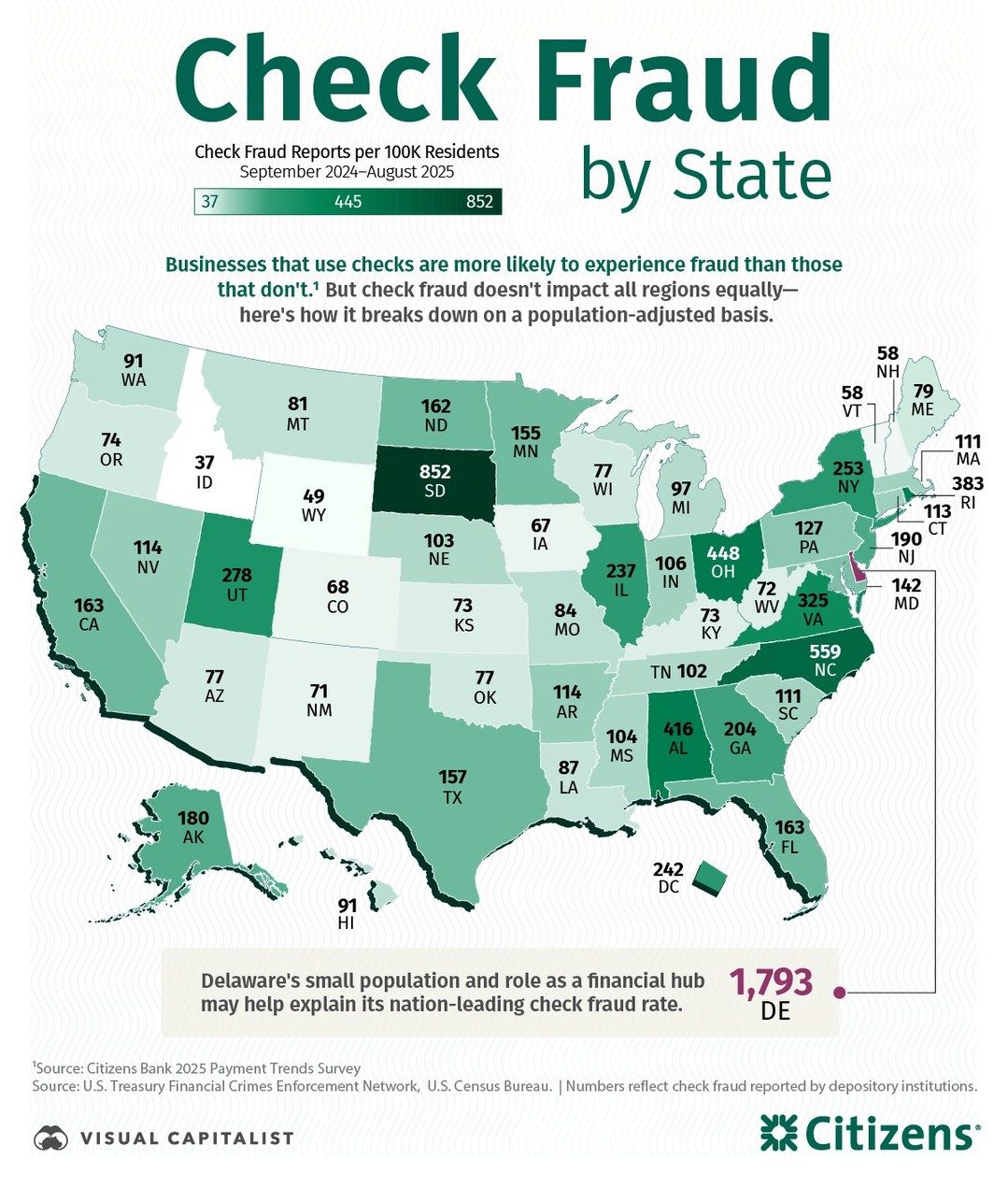
Check fraud is a significant issue across the United States, with some states experiencing higher rates than others. This disparity is often influenced by a variety of factors, including population density and the prevalence of check usage in business transactions. To better understand these dynamics, let's delve into the data and explore the key factors contributing to check fraud on a state-by-state basis.
Context / Why this matters
Check fraud is not just a problem for individuals; it significantly impacts businesses as well. According to an infographic from Citizens Bank, businesses that use checks are more likely to experience fraud than those that do not. This highlights the importance of understanding the geographic distribution and underlying factors of check fraud across the country.
Main discussion
Check Fraud Reports Across the U.S.
To get a clear picture of where check fraud is most prevalent, it's essential to look at the data on a population-adjusted basis. This approach helps normalize the figures, making comparisons between states more meaningful, especially when considering the varying population densities.
The infographic from Citizens Bank provides a comprehensive breakdown of check fraud reports per 100,000 residents across various U.S. states. This data, sourced from the U.S. Treasury Financial Crimes Enforcement Network and the U.S. Census Bureau, covers the period from September 2024 to August 2025.
Key Findings
-
Delaware: One of the standout states in the data is Delaware. Despite its small population, Delaware reports a high number of check fraud incidents. This can be attributed to its role as a financial hub, where a large volume of corporate transactions occur. The state's small population amplifies the per-capita fraud rates, making it appear disproportionately high.
-
Large vs. Small States: Larger states with denser populations, such as California or Texas, might have higher absolute numbers of check fraud incidents. However, when adjusted for population, their per-capita rates may not be as alarming as those in smaller states like Delaware. This emphasizes the need for a population-adjusted analysis to gain a deeper understanding of fraud prevalence.
Factors Contributing to Check Fraud
Several factors contribute to the varying rates of check fraud across states. Understanding these factors can help businesses and individuals take proactive measures to mitigate risks.
-
Population Density: States with lower population densities might have higher per-capita fraud rates simply because the smaller number of residents could mean a higher proportion of fraud incidents. Conversely, densely populated states may see a higher absolute number of fraud cases, but these could be diluted when viewed on a per-capita basis.
-
Economic Activity: States with higher economic activity, particularly those with significant financial sectors, tend to experience more check fraud. This is because there is a higher volume of financial transactions, increasing the opportunities for fraud to occur.
-
Financial Hubs: States like Delaware, which serve as financial hubs, often have more complex financial transactions. These transactions can be more susceptible to manipulation and fraud, leading to higher reported rates.
Practical tips
Given the prevalence of check fraud, it's crucial for businesses and individuals to take steps to protect themselves. Here are some practical tips to minimize the risk of falling victim to check fraud:
-
Use Electronic Payments: Where possible, transition from paper checks to electronic payment methods. This reduces the risk of physical checks being intercepted and fraudulently altered.
-
Implement Fraud Detection Software: Utilize advanced fraud detection software to monitor transactions in real-time. This can help identify and flag suspicious activities before they result in financial loss.
-
Secure Check Storage: Ensure that checks are stored securely, both physically and digitally. Limit access to checks to trusted individuals and use secure storage solutions.
-
Regular Audits: Conduct regular audits of financial transactions to identify any discrepancies or unusual patterns. This can help in early detection of fraudulent activities.
-
Employee Training: Train employees on recognizing and avoiding common check fraud schemes. This includes understanding the signs of altered or counterfeit checks.
-
Partner with Financial Institutions: Work closely with financial institutions that offer robust fraud protection services. Institutions like Citizens Bank provide resources and tools to help businesses mitigate fraud risks.
Important Takeaways
Understanding the landscape of check fraud across the United States is crucial for businesses and individuals. Key takeaways from the data and analysis include:
-
Population-Adjusted Analysis: Viewing check fraud on a population-adjusted basis provides a more accurate picture of where fraud is most prevalent.
-
Role of Financial Hubs: Financial hubs, like Delaware, often experience higher per-capita fraud rates due to their high volume of financial transactions.
-
Proactive Measures: Implementing practical measures, such as using electronic payments, utilizing fraud detection software, and conducting regular audits, can significantly reduce the risk of check fraud.
-
Collaboration with Financial Institutions: Partnering with financial institutions that offer robust fraud protection services can provide additional layers of security.
Conclusion
Check fraud remains a significant issue, with varying rates across different states. By understanding the factors contributing to these disparities and taking proactive measures, businesses and individuals can better protect themselves. From using electronic payments to implementing robust fraud detection systems, there are numerous steps one can take to mitigate the risk of check fraud. Staying informed and vigilant is key to navigating this complex landscape and ensuring financial security.
Watch the Reel
Questions readers ask
Which states have the highest check fraud rates and what factors contribute to this?
States with the highest check fraud rates often include California, Florida, and Texas. High population density, increased business transactions, and frequent check usage in these states contribute to the elevated fraud rates. Additionally, the presence of large corporate centers can exacerbate the issue, as businesses are common targets for fraudsters.
How does population density affect check fraud rates?
Population density plays a significant role in check fraud rates. More densely populated areas typically have higher volumes of financial transactions, including checks. This increased activity provides more opportunities for fraudsters to exploit. Additionally, urban areas often have higher concentrations of businesses, which are prime targets for check fraud.
What are the most common types of check fraud?
The most common types of check fraud include counterfeiting, forgery, and altering checks. Counterfeiting involves creating fake checks that mimic legitimate ones, while forgery is the act of signing or altering a check without authorization. Altering checks can involve changing the amount or payee information to redirect funds. Other types of check fraud include check washing and check kiting.
How can businesses protect themselves from check fraud?
Businesses can implement several strategies to protect themselves from check fraud, including using positive pay services, which verify checks against a list of authorized checks issued by the company. Additionally, implementing dual control measures, where two individuals are involved in check processing, can help prevent unauthorized activities. Regular monitoring of financial transactions and employee training on fraud prevention are also crucial steps.
What role does check usage in transactions play in fraud rates?
Check usage in transactions significantly influences fraud rates. States where checks are more commonly used, particularly in business-to-business transactions, tend to experience higher instances of check fraud. This is because checks provide a tangible and often less secure method of payment compared to electronic transfers. The physical nature of checks makes them easier to intercept, alter, or counterfeit, increasing the risk of fraud.
How can individuals reduce their risk of falling victim to check fraud?
Individuals can reduce their risk of check fraud by using checks sparingly and opting for electronic payment methods when possible. Regularly reviewing bank statements for unauthorized transactions and promptly reporting any discrepancies to the bank is also essential. Additionally, using secure mailboxes and avoiding leaving checks in unattended mailboxes can prevent interception by fraudsters.
What resources are available for reporting and addressing check fraud?
Several resources are available for reporting and addressing check fraud. Individuals and businesses can contact their local law enforcement agencies, the Federal Trade Commission (FTC), or the Internet Crime Complaint Center (IC3) to file reports. Additionally, financial institutions often have fraud departments dedicated to assisting customers with fraud-related issues. Regularly consulting financial fraud reports and staying informed about the latest fraud trends can also help in prevention and response.
Related deep dives
Similar reads based on topic and creator.


Recent articles
Fresh deep dives from the latest Reels we unpacked.




Comments
Be the first to comment.