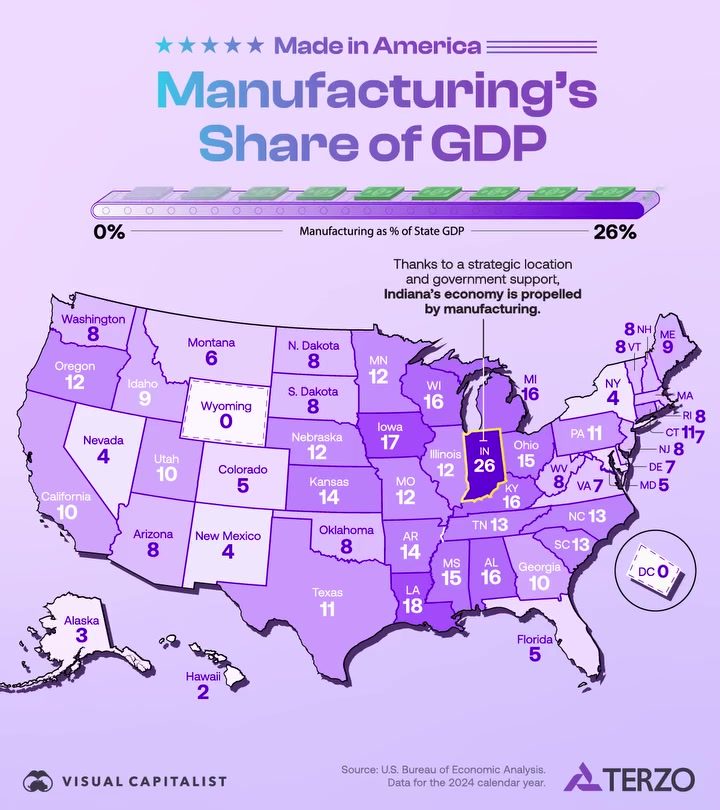
US Manufacturing GDP Share
Manufacturing plays a critical role in the U.S. economy, contributing significantly to the Gross Domestic Product (GDP) of many states. With rising tariffs aimed at promoting American-made goods, understanding which states rely most—and least—on manufacturing becomes increasingly important. This analysis breaks down the manufacturing share of GDP by state, providing insights into the regional economic landscape.
Context / Why this matters
The manufacturing sector is a cornerstone of the U.S. economy, supporting millions of jobs and driving innovation. States with a high manufacturing share of GDP often have robust industrial infrastructure, skilled labor, and policies that foster industrial growth. Conversely, states with a lower share may rely more on other sectors like services, technology, or agriculture. Understanding these dynamics is crucial for policymakers, investors, and businesses looking to navigate the economic landscape effectively.
Main discussion
Overall Manufacturing Contribution
Across the United States, manufacturing accounts for approximately 26% of the overall GDP. This figure highlights the sector's significant contribution to the national economy, making it a vital component of economic health and stability. However, this share varies widely across different states, reflecting diverse economic profiles and industrial strengths.
Top Manufacturing States
Several states stand out for their substantial manufacturing contributions. States like Illinois and Pennsylvania are particularly notable, with high percentages of their GDP derived from manufacturing. These states have long been hubs for industrial activity, boasting a wealth of resources, skilled labor, and established supply chains. For example, Illinois benefits from its central location and robust transportation infrastructure, while Pennsylvania's manufacturing sector is bolstered by its historical legacy in industries like steel and machinery.
Lower Manufacturing States
On the other end of the spectrum, some states have a much lower manufacturing share of GDP. States like California and New York, for instance, rely more heavily on the service sector, technology, and finance. These states have economies driven by innovation, media, and financial services, which contribute significantly to their GDP but do not rely as much on traditional manufacturing.
Emerging Trends
Recent data for the 2024 calendar year, sourced from the U.S. Bureau of Economic Analysis, shows emerging trends in manufacturing. States that have traditionally relied on sectors like agriculture and tourism are increasingly investing in manufacturing to diversify their economies. This shift is driven by a combination of factors, including government incentives, technological advancements, and a renewed focus on domestic production.
The Role of Tariffs
Rising tariffs on imported goods are designed to boost domestic manufacturing by making foreign products more expensive. These tariffs aim to promote American-made goods, potentially increasing the manufacturing share of GDP in states that have the infrastructure and workforce to support it. However, the impact of tariffs is complex, affecting both domestic producers and consumers in various ways.
Practical tips
For Investors
Investors looking to capitalize on the manufacturing sector should consider states with a high manufacturing share of GDP and a robust industrial infrastructure. These states are likely to benefit from policies aimed at promoting domestic production, potentially offering higher returns on investments in manufacturing-related stocks and bonds.
For Policymakers
Policymakers can use this data to inform decisions about economic development and industrial policy. States with lower manufacturing shares may want to explore ways to attract manufacturing investments, such as offering tax incentives or investing in workforce training programs.
For Businesses
Businesses considering expansion or relocation should evaluate the manufacturing landscape in potential locations. States with strong manufacturing sectors may offer better access to suppliers, skilled labor, and supportive regulatory environments. Additionally, understanding the tariff landscape can help businesses make informed decisions about sourcing and production.
Important takeaways
Manufacturing's share of GDP varies significantly across the United States, with some states relying heavily on the sector while others prioritize different economic activities. The data highlights the importance of state-level economic diversification and the impact of policies like tariffs on domestic production. For investors, policymakers, and businesses, understanding these trends is crucial for making informed decisions in a rapidly changing economic landscape.
Conclusion
The manufacturing sector remains a vital component of the U.S. economy, with wide-ranging implications for states across the nation. By examining the manufacturing share of GDP, we gain valuable insights into regional economic strengths and challenges. As tariffs and other policies continue to shape the economic landscape, staying informed about these trends will be essential for navigating the complexities of the U.S. manufacturing sector.
Watch the Reel
Questions readers ask
Which states have the highest manufacturing GDP share?
Illinois and Pennsylvania are among the states with the highest manufacturing GDP share. They have robust industrial infrastructure and a long history of industrial strength, contributing significantly to their overall economy. Other notable states include Indiana, Ohio, and Michigan.
How do tariffs impact states with high manufacturing GDP shares?
Tariffs can have a significant impact on states with high manufacturing GDP shares, both positively and negatively. They can boost American-made goods by making imports more expensive, potentially increasing demand for domestically produced items. However, they can also lead to higher production costs for manufacturers, potentially affecting profitability.
What factors contribute to a high manufacturing GDP share in a state?
Several factors contribute to a high manufacturing GDP share, including robust industrial infrastructure, a skilled workforce, and policies that support industrial growth. Additionally, states with strong historical ties to manufacturing and access to critical resources such as raw materials and transportation networks tend to have a higher manufacturing GDP share.
Which states have the lowest manufacturing GDP share?
While the article does not explicitly list the states with the lowest manufacturing GDP share, it implies that these states may rely more on other sectors such as services, tourism, or technology. Hawaii and Nevada are examples of states with lower manufacturing GDP shares.
Why is it important to understand the manufacturing share of GDP by state?
Understanding the manufacturing share of GDP by state is important for several reasons, including making informed policy decisions, attracting investment, and promoting regional economic development. This knowledge can help businesses and policymakers identify opportunities for growth and innovation, and allocate resources effectively.
Related deep dives
Similar reads based on topic and creator.

Recent articles
Fresh deep dives from the latest Reels we unpacked.




Comments
Be the first to comment.