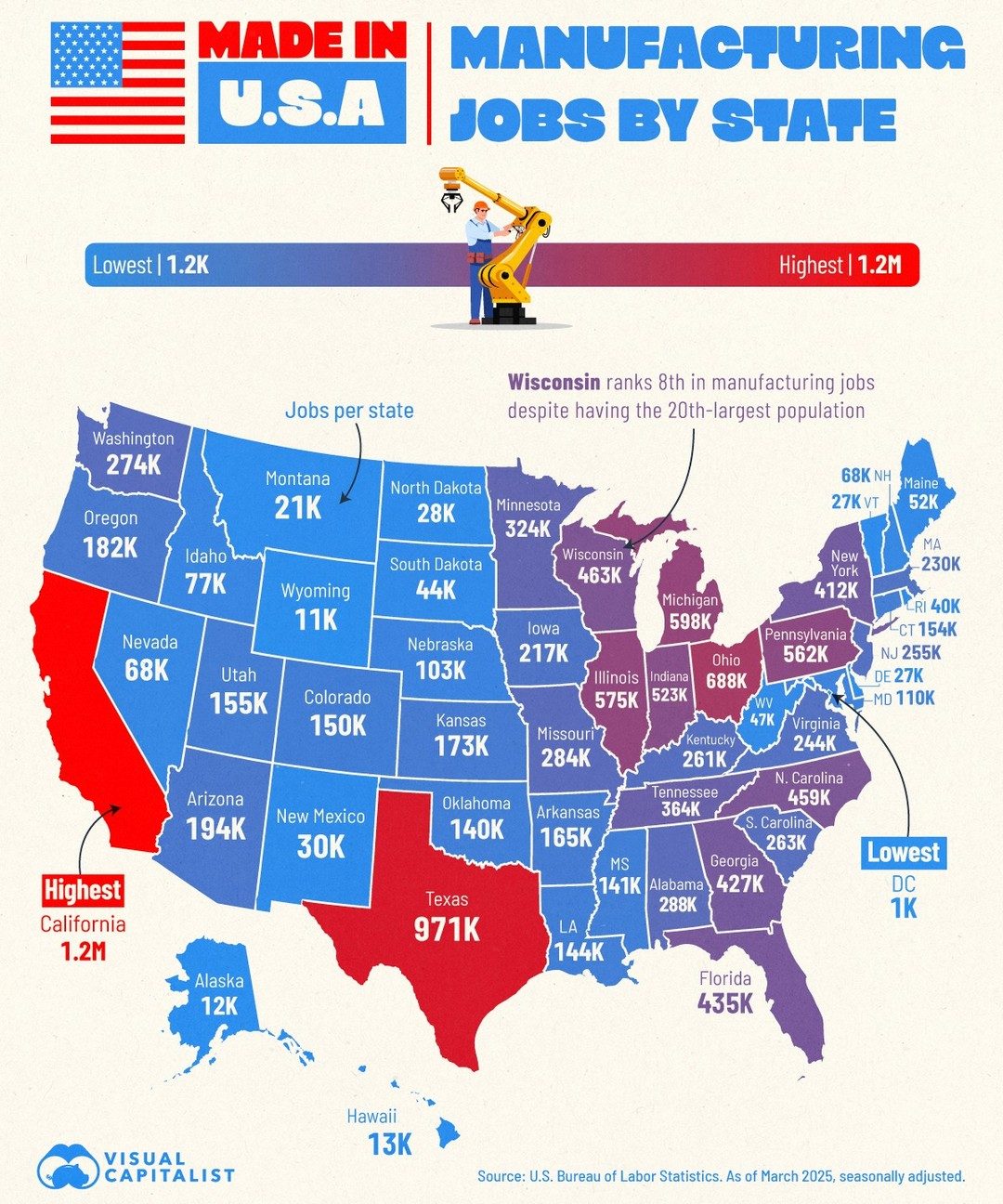
Manufacturing Jobs by State in 2025
Manufacturing jobs are a critical component of the U.S. economy, and their distribution across the nation varies significantly. By 2025, California will lead the country with an impressive 1.22 million manufacturing jobs, nearly doubling the number of the next highest state. At the other end of the spectrum, states like Wyoming, Alaska, and Washington, D.C. will have fewer than 12,000 manufacturing jobs each. This disparity highlights where the "Made in America" movement is most concentrated and where it has the greatest impact.
Why This Matters
Understanding the geographical distribution of manufacturing jobs is essential for several reasons. It provides insights into regional economic strengths and weaknesses, informs policy decisions, and helps businesses identify strategic locations for operations. The concentration of manufacturing jobs in certain states also reflects broader trends in industrial development and regional economic policies. For instance, California's leadership in manufacturing jobs is indicative of its diverse industrial base, including tech, aerospace, and automotive sectors.
Main Discussion
The Highest and Lowest Manufacturing Job Concentrations
Leading States
California stands out with 1.22 million manufacturing jobs, driven by its robust economy and diverse industrial sectors. Other states with high manufacturing job concentrations include Texas, Ohio, and Illinois. These states benefit from a mix of established industries and emerging sectors, such as renewable energy and advanced manufacturing technologies.
States with Fewer Manufacturing Jobs
In contrast, Wyoming, Alaska, and Washington, D.C. have the lowest number of manufacturing jobs, each with fewer than 12,000. These states' economies are often more reliant on other sectors, such as tourism, government services, or resource extraction. The low number of manufacturing jobs in these regions can be attributed to various factors, including a smaller population, geographical limitations, or a focus on different economic activities.
The Role of Population Size
Wisconsin's ranking is particularly notable. Despite having the 20th-largest population, it ranks 8th in manufacturing jobs. This anomaly reflects the state's strong industrial heritage and strategic investments in manufacturing infrastructure. Similarly, states like Iowa, Kansas, and Indiana also show a higher concentration of manufacturing jobs relative to their population size, highlighting the importance of economic diversification and industrial policy.
Regional Trends and Economic Diversification
The distribution of manufacturing jobs across states also reveals important regional trends. The Northeast and Midwest regions, historically known for their industrial bases, continue to hold significant manufacturing job numbers. States like Pennsylvania, Ohio, and Indiana are particularly strong in this regard. However, the South and West are also emerging as key players, with states like Texas, Georgia, and Arizona experiencing notable growth in manufacturing employment.
Practical Tips
For Policymakers
Policymakers can use this data to tailor economic development strategies and attract manufacturing investments. States with lower manufacturing job concentrations can focus on workforce development, infrastructure improvements, and tax incentives to encourage manufacturing growth. Additionally, fostering regional collaboration and supply chain integration can help smaller states benefit from the broader manufacturing ecosystem.
For Businesses
Businesses, especially those in the manufacturing sector, can leverage this information to make informed location decisions. By identifying regions with a strong manufacturing base and favorable economic conditions, companies can optimize their operations, reduce costs, and access a skilled workforce. Partnerships with local educational institutions and government agencies can also provide additional support and opportunities for growth.
For Job Seekers
For job seekers, understanding the distribution of manufacturing jobs can help in making career decisions. States with a high concentration of manufacturing jobs offer more opportunities and potentially higher wages. Additionally, these regions often have robust training programs and apprenticeships to develop a skilled workforce, making them ideal for those looking to enter or advance in the manufacturing sector.
Important Takeaways
- California Leads the Nation: California's 1.22 million manufacturing jobs in 2025 highlight its dominance in the sector.
- Regional Variations: There are significant regional variations in manufacturing job concentrations, reflecting diverse economic landscapes and industrial policies.
- Wisconsin's Anomaly: Wisconsin's high ranking in manufacturing jobs, despite a smaller population, underscores the impact of strategic investments and industrial heritage.
- Opportunities for Growth: States with lower manufacturing job numbers can use targeted policies and collaboration to foster growth in the sector.
- Economic Diversification: Successful manufacturing states often have a diverse industrial base and strategic economic policies.
Conclusion
The distribution of manufacturing jobs across the U.S. in 2025 paints a fascinating picture of economic strength, regional disparities, and opportunities for growth. California's leadership and the varying concentrations in other states offer valuable insights for policymakers, businesses, and job seekers alike. By understanding these dynamics, stakeholders can make informed decisions that drive economic development and foster a thriving manufacturing sector.
Watch the Reel
Questions readers ask
Which state is projected to have the most manufacturing jobs in 2025?
California is expected to have the highest number of manufacturing jobs by 2025, with over 1.22 million jobs. This figure significantly outpaces other states, making it a leader in the U.S. manufacturing industry.
Why are states like Wyoming and Alaska expected to have fewer manufacturing jobs in 2025?
States like Wyoming and Alaska are expected to have fewer manufacturing jobs in 2025 due to their smaller economies and less industrial infrastructure. Wyoming, for example, is projected to have fewer than 12,000 manufacturing jobs, reflecting its focus on other sectors and limited industrial development.
How does the 'Made in America' movement influence manufacturing job distribution in the U.S.?
The 'Made in America' movement has a significant impact on the distribution of manufacturing jobs, with states like California benefiting from increased investment in industrial growth. Conversely, states like Wyoming and Alaska, which have fewer resources and infrastructure for manufacturing, are less affected by this movement.
What are the implications of the regional disparities in manufacturing jobs for policy decisions?
Regional disparities in manufacturing jobs highlight the need for targeted policy decisions. States with fewer manufacturing jobs, such as Alaska and Wyoming, might need to develop initiatives to attract industrial investment in order to bolster their economies.
Which states are expected to have the least number of manufacturing jobs in 2025?
By 2025, states like Wyoming, Alaska, and Washington, D.C. are projected to have fewer than 12,000 manufacturing jobs each, making them the lowest in the rankings for manufacturing jobs in the country. This reflects their smaller economies and less developed industrial infrastructure.
Why are manufacturing jobs important for the U.S. economy?
Manufacturing jobs are crucial for the U.S. economy as they drive industrial growth, foster innovation, and create a wide range of employment opportunities. Understanding the geographical distribution of these jobs can provide insights into regional economic strengths and areas that may need support.
Recent articles
Fresh deep dives from the latest Reels we unpacked.




Comments
Be the first to comment.