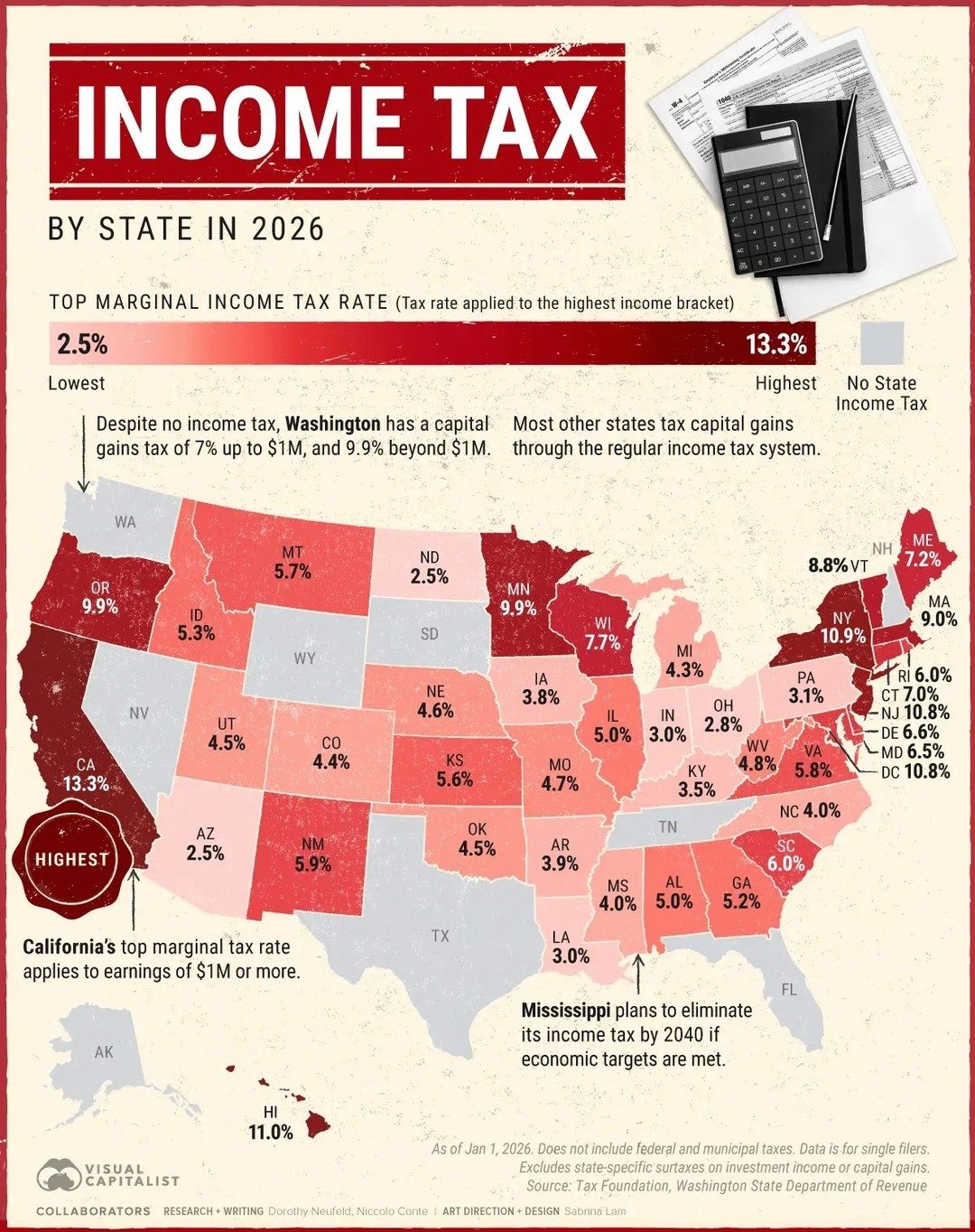
State Income Tax Rates
State income tax rates vary widely across the United States, with significant implications for personal finance and cost of living. Understanding these rates can help individuals and businesses make informed decisions about where to live, work, and invest. Let's delve into the top marginal income tax rates by state in 2026, highlighting the most notable variances and trends.
Context / Why this matters
Income tax rates are a critical component of state revenue and significantly impact residents' financial planning. For example, California leads the nation with the highest top marginal income tax rate at 13.3%. Additionally, while certain states impose significant income taxes, others like Texas, Florida, and Washington do not, offering a financial incentive for residents. Knowing these rates can help in evaluating potential moves, budgeting, and understanding the overall financial burden in different states.
Main discussion
Highest and Lowest Marginal Tax Rates
California stands out with the highest top marginal income tax rate at 13.3%. This rate is applied to the highest income bracket, making California one of the most tax-burdened states for high-income earners. On the other end of the spectrum, states like Texas, Florida, and Washington do not levy any income tax, making them attractive options for those looking to minimize their tax burden.
States with No Income Tax
Texas, Florida, and Washington are notable for having no state income tax. This absence of income tax can be a significant financial advantage, particularly for high-income earners. However, it's essential to note that these states often make up for lost revenue through other taxes, such as sales tax or property tax.
Washington has a unique tax structure. Although it does not have a traditional income tax, it does impose a capital gains tax. For earnings up to $1 million, the capital gains tax is 7%, and for earnings beyond $1 million, the rate increases to 9.9%. This approach offers a different kind of tax burden for wealthy individuals.
States Moving Toward Tax Elimination
States like Mississippi are considering the full elimination of income taxes, which could further widen the gap in tax burdens across the country. While Mississippi currently levies an income tax, the push to eliminate it reflects a broader trend among states aiming to reduce or eliminate income taxes to attract residents and businesses.
Mid-Range Tax Rates
States like Minnesota and North Carolina have tax rates that fall in the middle of the spectrum. Minnesota's top marginal income tax rate is 9.85%, while North Carolina's is 4.99%. These rates are significantly lower than California's but higher than states with no income tax. Understanding these mid-range rates can help individuals and businesses make more nuanced financial decisions.
Lowest Marginal Tax Rates
Several states, including Alaska, Florida, Nevada, New Hampshire, South Dakota, Tennessee, Texas, Washington, and Wyoming, have the lowest marginal tax rates, primarily because they do not levy an income tax. This makes them attractive options for those looking to minimize their tax burden, but it's crucial to consider other taxation aspects, such as sales and property taxes.
Practical tips
When contemplating a move to a new state or planning your finances, consider the following tips:
- Research Total Tax Burden: Look beyond income tax and consider other taxes, such as sales tax, property tax, and capital gains tax. A state with no income tax may still have a high overall tax burden.
- Evaluate Personal and Business Needs: Consider factors like cost of living, job opportunities, and quality of life. A lower tax rate may be less beneficial if it comes with higher living costs.
- Plan for Changes: Keep an eye on legislative changes. States may alter their tax policies, as seen with Mississippi's potential elimination of income tax.
Important takeaways
- California leads with the highest top marginal income tax rate at 13.3%.
- States like Texas, Florida, and Washington offer a significant tax advantage by not levying any income tax.
- Washington's capital gains tax is unique, with rates of 7% up to $1 million and 9.9% beyond that.
- Mississippi and other states are considering eliminating income taxes, which could impact future tax planning.
- Understanding the total tax burden, including sales and property taxes, is crucial for informed financial decisions.
Conclusion
State income tax rates play a pivotal role in personal finance and financial planning. Knowing the top marginal rates in 2026 can help you make informed decisions about where to live, work, and invest. Whether you're considering a move to a no-income-tax state like Texas or Florida, or you're navigating the complexities of high-income-tax states like California, understanding these rates can significantly impact your financial strategy.
Watch the Reel
Questions readers ask
Which states have the highest income tax rates in 2026?
In 2026, California will continue to have the highest top marginal income tax rate at 13.3%. Other states with notably high rates include Hawaii, New Jersey, and Oregon. These rates can significantly impact an individual's take-home pay and financial planning.
What are the benefits of living in a tax-free state?
Living in a tax-free state like Texas, Florida, or Washington can offer considerable financial advantages. These states do not impose a state income tax, which can lead to increased disposable income for residents and may influence decisions about relocation or investment.
How does a state's income tax rate affect personal finance?
A state's income tax rate can greatly influence personal finance by determining how much of an individual's income is retained after taxes. Higher tax rates can affect savings, investments, and overall cost of living, making it crucial for individuals to consider these rates when planning their finances.
Are there any significant changes to state income tax rates in 2026?
Some states may introduce changes to their income tax rates in 2026, although many will retain similar structures. For instance, changes can occur due to legislative updates or policy reforms, and residents should stay informed about these adjustments to better manage their financial outlook
Which states are considered the best for no income tax?
States like Texas, Florida, and Washington are considered among the best for no income tax. These states do not levy a state income tax, which can attract individuals and businesses seeking to maximize their financial resources, making them top choices for those looking to minimize tax liabilities.
Recent articles
Fresh deep dives from the latest Reels we unpacked.




Comments
Be the first to comment.