U.S. Home Price Growth
Exploring the U.S. housing market reveals significant trends in home price growth, shaped by various economic and demographic factors. Understanding these trends is crucial for homeowners, potential buyers, and investors navigating the real estate landscape.
Why This Matters
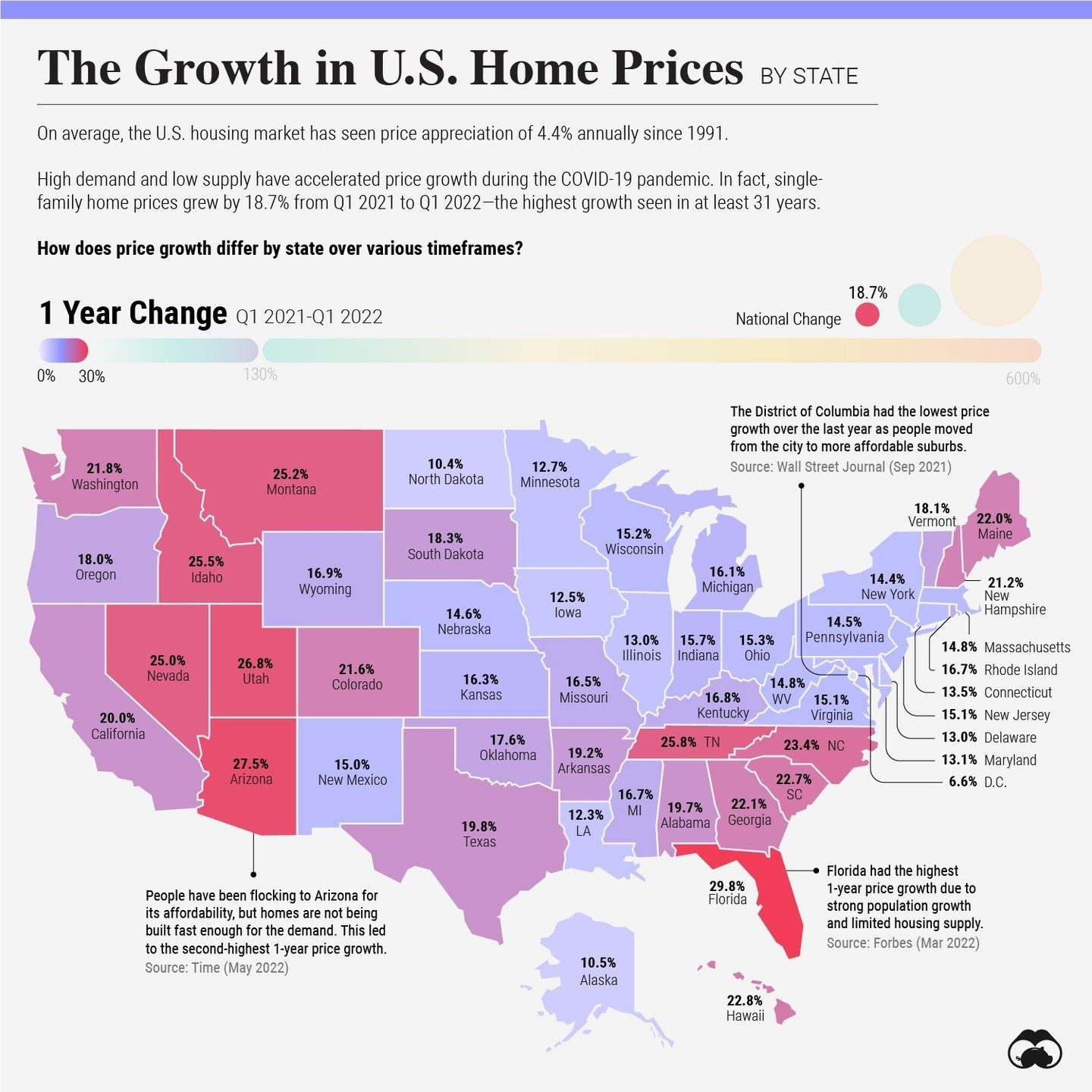
The U.S. housing market has seen substantial price appreciation, with an average annual growth of 4.4% since 1991. This trend has been amplified by the COVID-19 pandemic, which led to an 18.7% increase in single-family home prices from the first quarter of 2021 to the first quarter of 2022. This surge is the highest growth rate observed in at least 31 years. High demand and low supply dynamics have been pivotal in driving this explosive growth.
Factors Influencing Home Price Growth
Demand and Supply Dynamics
The COVID-19 pandemic has been a game-changer for the housing market. Lockdowns and remote work policies have led to a surge in demand for single-family homes. People sought more spacious living arrangements, prompting a significant shift in housing preferences. Simultaneously, the supply of new homes has struggled to keep pace, exacerbating the demand-supply imbalance and driving prices upward.
Migration Patterns
Migration patterns have also played a significant role in shaping home price growth. States like Washington, Oregon, and Montana have experienced some of the highest one-year price growth rates, with increases of 21.8%, 25.0%, and 25.2% respectively. This growth can be attributed to factors such as affordability and migration patterns. For instance, Florida has seen a mass migration of people, which has contributed to its 1-year price growth.
Long-Term Trends
Long-term trends also provide valuable insights. Since 1991, the District of Columbia has seen one of the highest long-term growth rates in home prices. This can be attributed to household growth and a relatively fixed housing supply, which has driven prices upward over the decades.
State-by-State Comparisons
One-Year Price Growth
- Washington: 21.8%
- Oregon: 25.0%
- Montana: 25.2%
- Idaho: 18.0%
- Wyoming: 16.9%
- Colorado: 21.6%
- Arizona: 20.0%
- Texas: 19.8%
- Nebraska: 16.3%
- Kansas: 16.5%
- Oklahoma: 17.6%
- Arkansas: 19.7%
- Louisiana: 12.3%
- Alabama: 19.7%
- Georgia: 29.8%
These figures highlight the varied impact of economic and demographic factors across different states. For example, Georgia's 29.8% price growth in one year underscores the intense competition in certain housing markets.
Five-Year Price Growth
North Dakota saw the lowest home price growth attributed to lower property taxes and migration patterns. These factors have kept the market relatively stable compared to other states.
Long-Term Price Growth
The District of Columbia has seen one of the highest long-term growth rates due to household growth and a relatively fixed housing supply. This trend has been consistent, making it a hot spot for real estate investment.
Practical Tips for Navigating the Market
For Homeowners
If you're a homeowner, maximizing your property's value is crucial. Keeping your home well-maintained and making strategic upgrades can help you stay competitive in a rapidly appreciating market. Additionally, staying informed about local market trends and economic indicators can help you make informed decisions about selling or refinancing.
For Buyers
For potential buyers, it's essential to act quickly and be prepared. This includes securing pre-approval for a mortgage, having a clear budget, and being flexible with your search criteria. Working with a knowledgeable real estate agent can also provide valuable insights and access to off-market opportunities.
For Investors
Investors should focus on high-growth areas with strong long-term prospects. Conducting thorough market research and considering factors such as affordability, migration trends, and local economic indicators can help you identify lucrative investment opportunities. Diversifying your portfolio across different states and property types can also mitigate risks and maximize returns.
Important Takeaways
The U.S. housing market's price growth has been shaped by a complex interplay of demand, supply, and migration patterns. Understanding these factors and staying informed about market trends is essential for making informed decisions. Whether you're a homeowner, potential buyer, or investor, a strategic approach can help you navigate the market effectively.
Conclusion
The U.S. housing market has experienced significant price growth, driven by high demand and low supply, exacerbated by the COVID-19 pandemic. States like Washington, Oregon, and Montana have seen remarkable one-year price increases, while the District of Columbia has maintained high long-term growth rates. For homeowners, buyers, and investors, understanding these trends and adopting a strategic approach is crucial for success in this dynamic market.
Watch the Reel
Questions readers ask
Which states experienced the highest home price growth in 2022?
Several states saw notable increases in home prices in 2022. Some of the most significant growth was observed in states like Florida, Arizona, and Idaho. These areas experienced substantial demand, partially driven by migration patterns and remote work opportunities. Idaho, for instance, saw a remarkable 30% increase in home prices from 2021 to 2022.
How has the pandemic influenced home price trends?
The COVID-19 pandemic significantly accelerated home price trends. The pandemic led to a surge in demand for single-family homes, as people sought more space and shifted towards remote work. This increased demand, combined with low supply, resulted in an 18.7% increase in home prices from the first quarter of 2021 to the first quarter of 2022, marking the highest growth rate in over three decades.
What role does supply and demand play in current home price trends?
Supply and demand dynamics are pivotal in shaping current home price trends. High demand, particularly for single-family homes, coupled with a low supply of available homes, has driven prices upwards. This imbalance has been exacerbated by factors such as low-interest rates and limited construction activity, leading to significant price appreciation.
Which regions have been most affected by migration patterns in the housing market?
Migration patterns have significantly impacted home prices in regions like the Sun Belt and Mountain West. States such as Florida, Texas, and Arizona have seen increased demand due to people relocating from higher-cost areas. This influx has contributed to substantial price growth, particularly in single-family homes, as new residents compete for a limited supply of homes.
How do state-by-state home price trends differ across the U.S.?
State-by-state home price trends vary widely across the U.S. For example, states in the Northeast and West Coast, such as California and New York, have historically high home prices but have seen more modest growth compared to other regions. In contrast, states in the South and Mountain West have experienced more dramatic increases, with some states like Idaho and Arizona showing exceptional growth rates.
Recent articles
Fresh deep dives from the latest Reels we unpacked.




Comments
Be the first to comment.