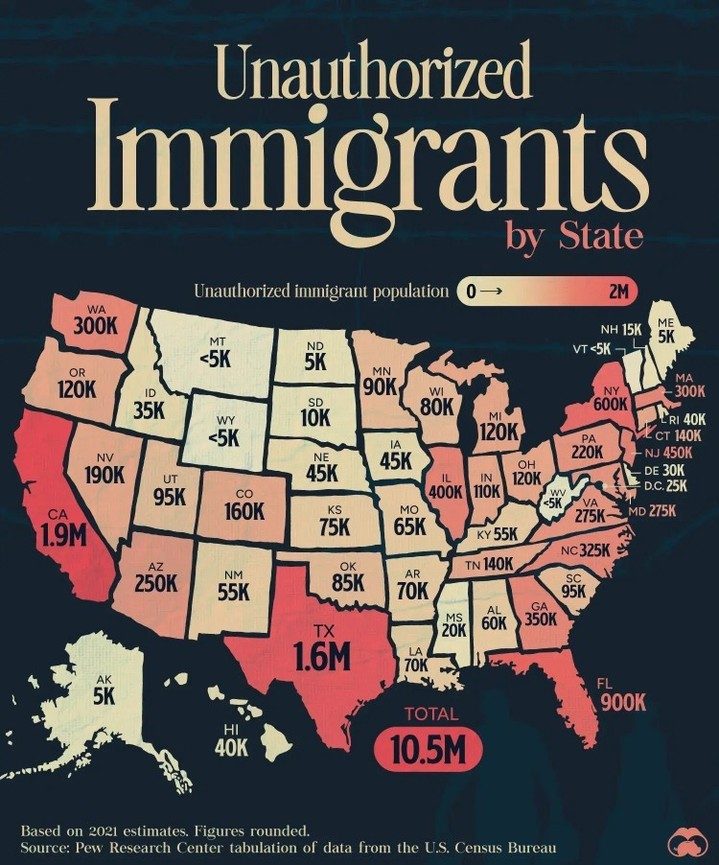
Unauthorized Immigrant Population by State
The landscape of unauthorized immigration in the United States reveals significant concentrations in key states, with California, Texas, and Florida housing over 40% of the total unauthorized immigrant population. This distribution highlights the regional dynamics and the diverse origins of these immigrants, as well as the complexities of immigration policies and enforcement.
Context / Why This Matters
Understanding the geographic distribution of unauthorized immigrants is crucial for policymakers, law enforcement, and social service providers. It informs resource allocation, policy development, and community support initiatives. Additionally, the changing demographics of unauthorized immigrants from various regions of the world underscore the need for a nuanced approach to immigration policy.
Main Discussion
Geographic Distribution
California, Texas, and Florida
California leads with the highest estimated unauthorized immigrant population, at 1.9 million. Texas follows closely with 1.6 million, and Florida has an estimated 900,000 unauthorized immigrants. These three states alone account for a substantial portion of the total 10.5 million unauthorized immigrants in the U.S. The concentration in these states can be attributed to several factors, including economic opportunities, established immigrant communities, and geographic proximity to border regions.
Regional Hotspots
Beyond the top three states, other regions also host significant unauthorized immigrant populations. For instance, states like New York, New Jersey, and Illinois have notable numbers, reflecting their status as major hubs for immigration historically. These states often have well-established immigrant communities, which can provide support networks for new arrivals.
Demographic Shifts
While Mexico remains the most common country of birth for unauthorized immigrants, there has been a notable rise in immigrants from other regions. This shift includes increased numbers from Central America, South America, Asia, Africa, and even Europe. This diversification is driven by various factors, including political instability, economic hardship, and environmental crises in countries around the world.
Policy Implications
The geographic and demographic shifts in unauthorized immigration have significant policy implications. Policies need to address the diverse needs of immigrants from different regions, taking into account cultural, linguistic, and economic differences. Additionally, enforcement strategies must be tailored to the specific challenges posed by unauthorized immigration in different areas.
Practical Tips
For Policymakers
- Data-Driven Policies: Utilize detailed data on unauthorized immigrant populations to inform policy decisions. This includes understanding the specific needs and challenges faced by immigrants in different regions.
- Community Engagement: Engage with local communities to develop policies that are both effective and humane. Collaboration with community leaders and organizations can help build trust and support for immigration policies.
- Targeted Enforcement: Tailor enforcement strategies to the specific circumstances of each region. This might involve increased border security in certain areas while focusing on community integration and support in others.
For Social Service Providers
- Cultural Competency: Develop programs that are culturally sensitive and responsive to the needs of immigrants from diverse backgrounds. This includes offering language support, cultural orientation, and mental health services.
- Resource Allocation: Allocate resources based on the specific needs of different regions. For example, areas with high concentrations of unauthorized immigrants may require more comprehensive support services, including healthcare, education, and legal assistance.
- Collaboration: Work with local governments, non-profits, and community organizations to provide a comprehensive network of support for unauthorized immigrants.
Important Takeaways
Geographical Concentration
The concentration of unauthorized immigrants in California, Texas, and Florida highlights the need for targeted policies and resources in these regions. Understanding the specific challenges and opportunities in these areas can help in developing more effective immigration strategies.
Demographic Diversity
The increasing diversity of unauthorized immigrants from various regions of the world requires a nuanced approach to policy and support. Policies need to be adaptable and responsive to the changing demographics of unauthorized immigration.
Policy and Enforcement
Effective immigration policies and enforcement strategies must be informed by data and tailored to the specific needs of different regions. This includes community engagement, targeted enforcement, and culturally sensitive support services.
Conclusion
The distribution of unauthorized immigrants in the United States is a complex issue that requires a comprehensive and nuanced approach. By understanding the geographic and demographic shifts, policymakers and service providers can develop more effective strategies to address the challenges and opportunities presented by unauthorized immigration. This includes targeted policies, community engagement, and culturally sensitive support services. Through a collaborative and informed approach, it is possible to create a more equitable and supportive system for all immigrants, regardless of their legal status.
Watch the Reel
Questions readers ask
Which states have the highest concentration of unauthorized immigrants?
California, Texas, and Florida have the highest concentrations, housing over 40% of the total unauthorized immigrant population in the U.S.
Why is it important to know the geographic distribution of unauthorized immigrants?
Understanding this distribution helps in policy development, and law enforcement strategies, and also allows for better resource allocation and planning of support initiatives.
What factors influence the distribution of unauthorized immigrants in the U.S.?
The distribution is influenced by regional dynamics, diverse origins of immigrants, and the complexities of immigration policies and enforcement in different states.
How does the concentration of unauthorized immigrants in certain states affect local communities?
It shapes community support initiatives, resource allocation, and the overall policy landscape in those regions, as highlighted by the data from 2021.
Where can I find the most recent estimates on the unauthorized immigrant population by state?
The Pew Research Center and the U.S. Census Bureau are reliable sources for the most recent estimates and data on the unauthorized immigrant population by state.
Why are California, Texas, and Florida significant in discussions about unauthorized immigration?
These states are significant because they account for a substantial portion of the nation's unauthorized immigrant population. This means policies and resources in these states have a considerable impact on the broader immigration landscape.
How has the origin of unauthorized immigrants in the U.S. changed over time?
The demographics of unauthorized immigrants have shifted, with an increasing number arriving from regions beyond Mexico. This change affects how states approach immigration policy and community support.
Recent articles
Fresh deep dives from the latest Reels we unpacked.




Comments
Be the first to comment.