Space Launch History
Space exploration has evolved dramatically since the launch of Sputnik 1 in 1957. The competitive landscape of space launches, particularly among the United States, the former Soviet Union, and China, has shaped the contours of the global space economy.
Context / Why This Matters
Space launches are more than just bold technological feats; they are strategic assets that influence global power dynamics. They enable advancements in satellite technology, pivotal for communication, navigation, science, and national defense. The U.S., China, and Russia—formerly the Soviet Union—have been at the forefront of this technological race.
The technological dominance in space launches plays a critical role in determining which countries can exert influence over satellite technology, essential for everything from GPS navigation to telecommunications. Understanding the historical context and current trends in space launches provides valuable insights into future developments.
The Evolution of Space Launches
The First Space Age: 1957-1991
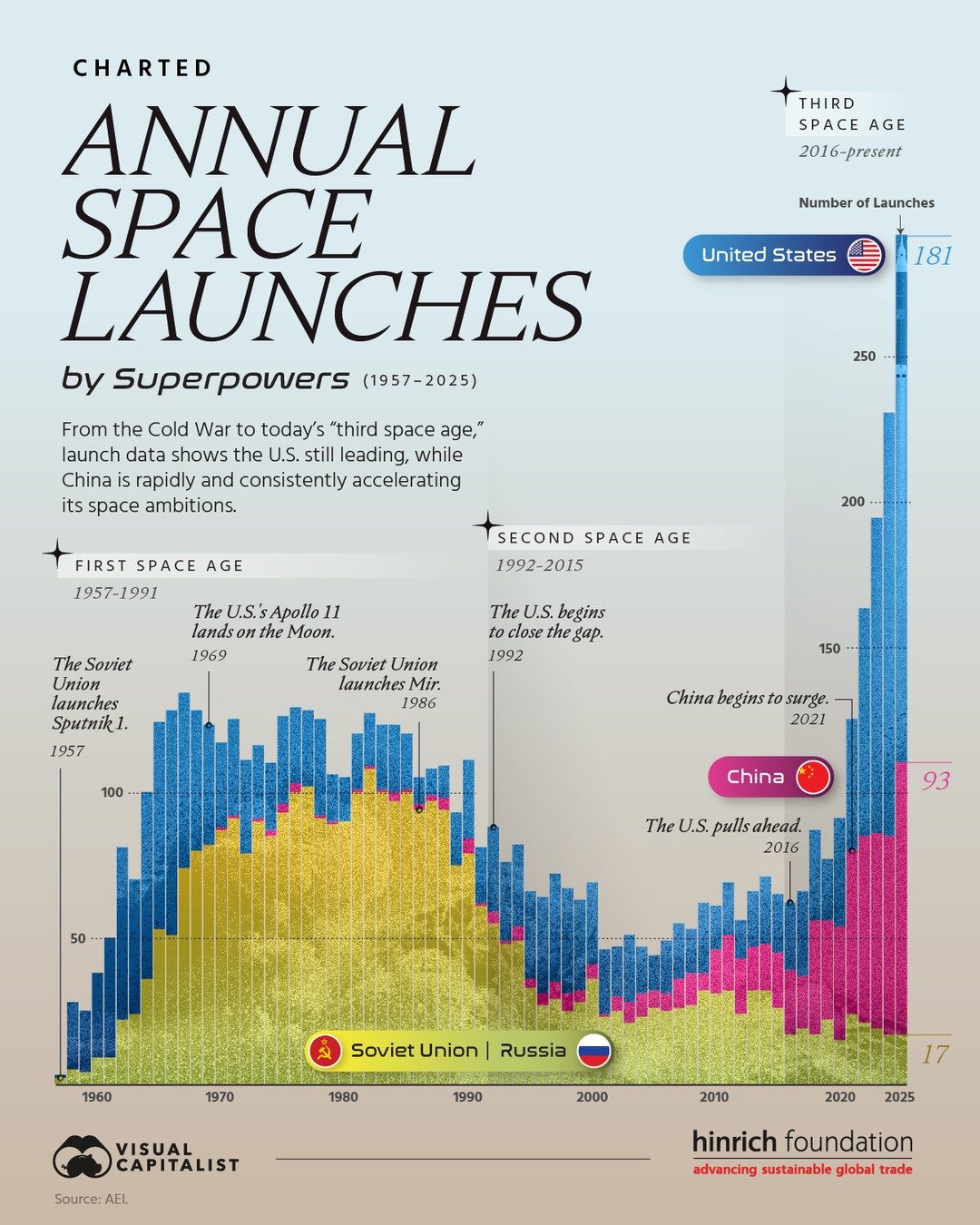
The First Space Age, spanning from 1957 to 1991, was marked by significant milestones. The Soviet Union's launch of Sputnik 1 in 1957 initiated the Space Race. This event underscored the strategic importance of space exploration and set the stage for future competitions. The U.S. responded with the Apollo 11 mission, landing the first humans on the moon in 1969. Throughout this period, the U.S. and the Soviet Union engaged in a series of technological and scientific achievements, including the Soviet Union's launch of the Mir space station in 1986.
The Second Space Age: 1992-2015
The Second Space Age, from 1992 to 2015, witnessed a shift in the dynamics of space exploration. The U.S. began to close the gap in space launches, while China emerged as a new contender, rapidly advancing its space program.
During this period, China achieved significant milestones, including the successful launch of its Shenzhou spacecraft and the establishment of its space station module. Meanwhile, the U.S. continued to invest heavily in the International Space Station (ISS) and maintained a high number of launches, albeit facing new challenges and competition from other space-faring nations.
The Third Space Age: 2015-Present
Today, we are in the midst of the Third Space Age, characterized by increasing global participation and private sector involvement. While the U.S. has continued to lead in the number of space launches, China is rapidly and consistently accelerating its space program. The U.S. achieved 181 launches in 2025, while China recorded 93, and Russia, 17.
Emerging Trends and Future Directions
The Rise of China
China's space program has seen a meteoric rise, marked by rapid technological advancements, large-scale missions, and significant investments. China's ambitious lunar exploration program, including landing on the far side of the moon, and its plans to establish a lunar base, highlight its ambitions in space exploration.
The Role of the Private Sector
Private companies, particularly in the United States, are playing an increasingly pivotal role in space exploration. Players like SpaceX, Blue Origin, and others are pushing the boundaries of what is possible, driving innovation, and reducing the cost of space launches. These companies are crucial contributors to the U.S.'s leadership in space launches, providing affordable and reliable launch services.
The Global Space Economy
As space launches become more frequent and accessible, the global space economy is growing. Satellites are essential for a wide range of applications, from environmental monitoring to national security. The increasing number of launches is driving innovation in materials science, propulsion technology, and more, creating new market opportunities.
Practical Tips
Understanding the historical context of space launches can offer valuable insights for both enthusiasts and professionals in the aerospace sector. Here are some practical tips for those interested in the space industry:
Stay Informed
Keep up with the latest developments in space exploration by following key players, both governmental and private, such as NASA, the Chinese National Space Administration (CNSA), and private companies like SpaceX and Blue Origin. Regularly checking news sources, academic journals, and industry reports can provide a comprehensive view of current trends and future directions.
Engage with the Community
Joining space exploration forums, attending conferences, and networking with professionals in the field can offer valuable perspectives. Engaging with the community can also provide access to new opportunities and collaborations, whether in research, policy, or technology development.
Investigate Key Technologies
Explore key technologies driving the space industry, such as reusable rockets, satellite constellations, and in-space manufacturing. Understanding these technologies can offer a deeper appreciation of the industry’s dynamics and future potential.
Important Takeaways
Space launches are not just about technological prowess but also about strategic advantage and economic growth. The historical context of space exploration, from the launch of Sputnik 1 to the current era of private sector involvement, highlights the evolving nature of the global space economy.
As the U.S. continues to lead in space launches, China's rapid ascent is reshaping the competitive landscape. The growing involvement of private companies is driving innovation and reducing costs, making space more accessible than ever before. The future of space exploration is poised for exciting developments, with new frontiers and opportunities on the horizon.
Conclusion
The history of space launches is a story of competition, innovation, and strategic advantage. Understanding the milestones and current trends in space exploration provides valuable insights into the future of the global space economy. By staying informed and engaged, enthusiasts and professionals alike can navigate the evolving landscape of this fascinating and dynamic field.
Watch the Reel
Questions readers ask
Which countries have been the most active in space launches between 1957 and 2025?
The United States, China, and Russia (formerly the Soviet Union) have been the most active in space launches during this period. These countries have consistently driven global space launch trends and technological advancements.
How did the Space Race influence the global space economy?
The Space Race, sparked by the launch of Sputnik 1 in 1957, catalyzed significant advancements in satellite technology. These advancements have been crucial for global positioning systems (GPS), telecommunications, and national defense, shaping the modern space economy.
What role do space launches play in global power dynamics?
Space launches are strategic assets that allow countries to exert influence over satellite technology, which is vital for communication, navigation, and defense. The ability to launch and maintain satellites in orbit is a key factor in determining a nation's global power and technological dominance.
How have space exploration trends evolved since the launch of Sputnik 1?
Space exploration has evolved from the initial competitive launches of the Space Race to a more collaborative and commercialized landscape. Today, space exploration involves both public and private entities, with a focus on sustainable space development and technological innovation.
What are the key differences in space launch trends between the U.S., China, and Russia?
Each of these countries has unique approaches to space exploration and launch technology. The U.S. is known for its collaborative public-private partnerships, China for its rapid technological advancements, and Russia for its legacy in space exploration and continuing innovation.
Why is satellite technology crucial for national defense?
Satellite technology is essential for national defense as it enables surveillance, secure communications, and precise navigation. Control over this technology provides nations with a strategic edge in monitoring global activities and defending their territories.
What can be expected from space launch trends between now and 2025?
Looking ahead, space launch trends are expected to continue growing, with increased involvement from commercial entities and advancements in reusable launch vehicles. Global cooperation and competition will further drive innovation in space exploration and satellite technology.
Recent articles
Fresh deep dives from the latest Reels we unpacked.




Comments
Be the first to comment.