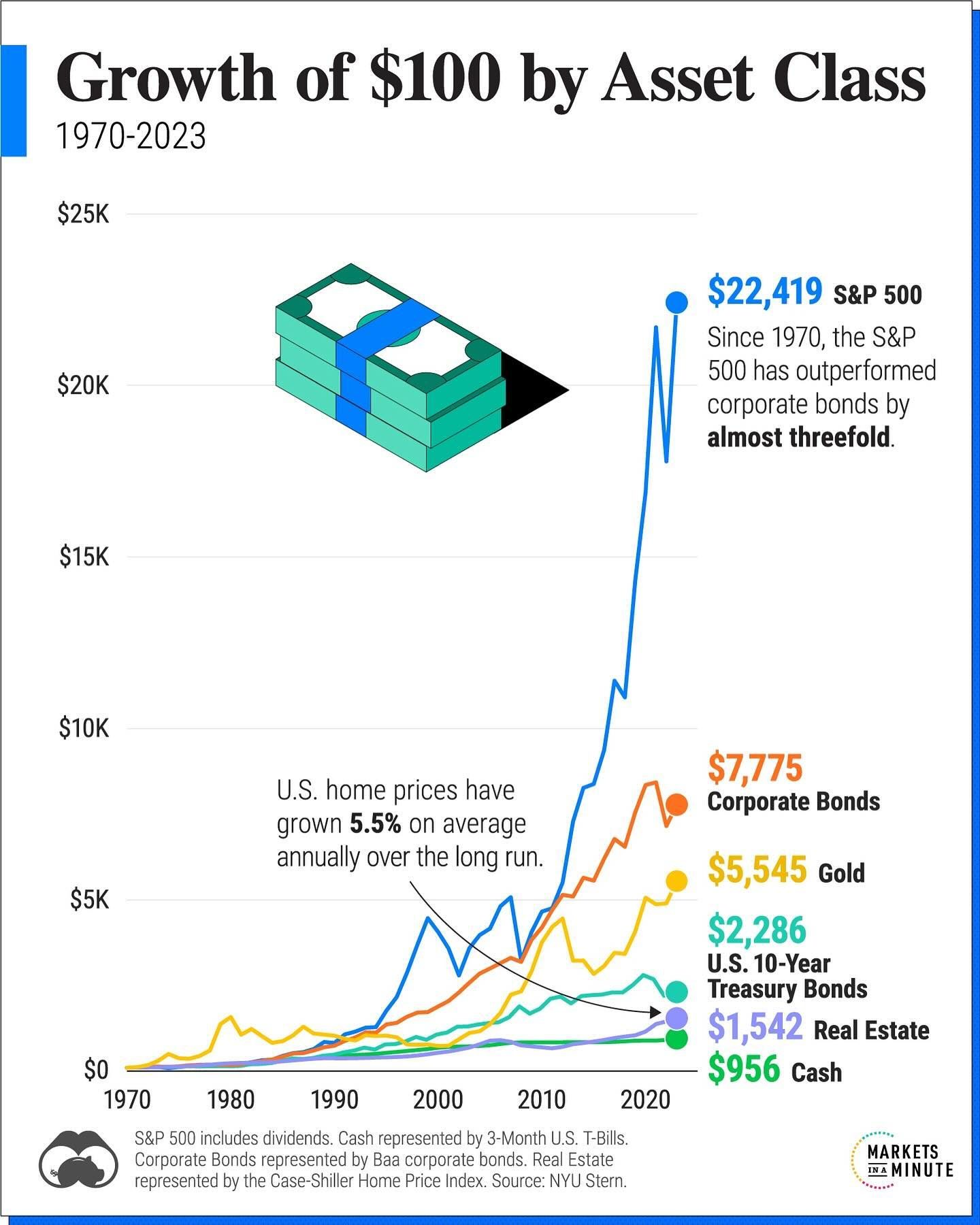
Asset Class Growth Comparison
Investing in the U.S. stock market has been a lucrative endeavor over the past decades. For example, a $100 investment in the S&P 500 in 1970 would be worth over $22,419 by 2023, highlighting the significant growth of this asset class. This growth is in stark contrast to other asset classes, such as corporate bonds, which experienced only a 65% increase.
Context / Why This Matters
Understanding how different asset classes perform over the long term is critical for investors looking to diversify their portfolios. The data from Aswath Damodaran at NYU Stern provides a clear picture of the growth trajectories of various asset classes, offering valuable insights for both novice and experienced investors.
Main Discussion
Stocks vs. Bonds
The S&P 500, which includes dividends, has shown remarkable growth over the past 50 years. A $100 investment in 1970 would have grown to $22,419 by 2023. This performance is almost three times better than that of corporate bonds, which would have grown to around $7,775 over the same period. Corporate bonds, represented by Baa corporate bonds, experienced a steady but comparatively modest growth rate.
Real Estate and Cash
Real estate, measured by the Case-Shiller Home Price Index, has also shown impressive results. A $100 investment in 1970 would have grown to $1,542 by 2023, representing a solid return. This is partly due to the average annual growth rate of 5.5% in U.S. home prices. Conversely, cash, represented by 3-Month U.S. T-Bills, has provided the lowest return, with a $100 investment growing to just $956.
Gold and Treasury Bonds
Gold has been a mixed performer. A $100 investment in 1970 would have grown to $5,545 by 2023, showing a significant increase but lagging behind the S&P 500. Treasury bonds, represented by U.S. 10-Year Treasury Bonds, have also fared well, growing to $2,286. This performance indicates the stability and reliability of Treasury bonds as a safe investment.
Practical Tips
When evaluating long-term investment strategies, consider the following practical tips:
- Diversification: A balanced portfolio can help mitigate risks and enhance returns. Include a mix of stocks, bonds, real estate, and other assets to diversify your investments.
- Historical Performance: While historical performance is not a guarantee of future success, it provides valuable insights. Analyze the trends and patterns of different asset classes to inform your investment decisions.
- Reinvestment: Reinvesting dividends and interest can significantly boost your returns over the long term. For instance, the growth of the S&P 500 includes reinvested dividends, which contribute to its impressive performance.
- Monitoring and Adjustment: Regularly review your portfolio and make adjustments as needed. Economic conditions, market trends, and personal financial goals can change, requiring you to adapt your investment strategies.
Important Takeaways
When investing in different asset classes, it is crucial to understand their individual performance and how they can contribute to a diversified portfolio. Here are some key takeaways:
- Stocks (e.g., S&P 500) have shown exceptional long-term growth, especially when dividends are reinvested.
- Bonds (e.g., corporate bonds, Treasury bonds) provide stability and steady returns, although they typically underperform stocks over the long term.
- Real Estate offers solid returns, with historical data indicating consistent growth in home prices.
- Gold can be a valuable addition to a portfolio, acting as a hedge against market volatility and inflation.
- Cash investments, while low-risk, offer minimal returns and are generally best used for short-term savings or as a buffer against market fluctuations.
Conclusion
The comparison of asset class growth from 1970 to 2023 provides a compelling case for the long-term benefits of diversified investment strategies. The S&P 500's impressive performance highlights the potential of stocks, while real estate and bonds offer alternative sources of income and stability. Understanding these dynamics can help investors make more informed decisions, balancing risk and reward to achieve their financial goals.
Watch the Reel
Questions readers ask
How much would a $100 investment in the S&P 500 in 1970 be worth in 2023?
A $100 investment in the S&P 500 in 1970 would grow to approximately $22,419 by 2023. This significant growth underscores the potential of long-term stock market investments.
Why did corporate bonds perform differently compared to the S&P 500 from 1970 to 2023?
Corporate bonds experienced a much lower growth rate compared to the S&P 500. A $100 investment in corporate bonds in 1970 would be worth around $1,650 by 2023, while the S&P 500 investment would be worth over $22,000. This difference is due to the higher volatility and risk associated with stocks, which can lead to higher returns over the long term.
What other asset classes were compared to the S&P 500 and bonds in the analysis?
The analysis compares the performance of the S&P 500 and corporate bonds with several other asset classes, including real estate, cash, gold, and Treasury bonds. These comparisons provide a comprehensive view of how different investment types have performed over the decades.
How does the performance of the S&P 500 compare to holding cash over the same period?
Holding cash from 1970 to 2023 would not yield significant growth, especially when considering inflation. In contrast, the S&P 500 not only grew substantially in nominal terms but also provided returns that outpaced inflation, making it a superior investment choice over holding cash.
What is the significance of understanding long-term asset class performance for investors?
Understanding long-term asset class performance is crucial for investors as it helps in making informed decisions about portfolio diversification. By knowing how different assets have performed historically, investors can better allocate their resources to balance risk and reward.
Recent articles
Fresh deep dives from the latest Reels we unpacked.




Comments
Be the first to comment.