S&P 500 Concentration
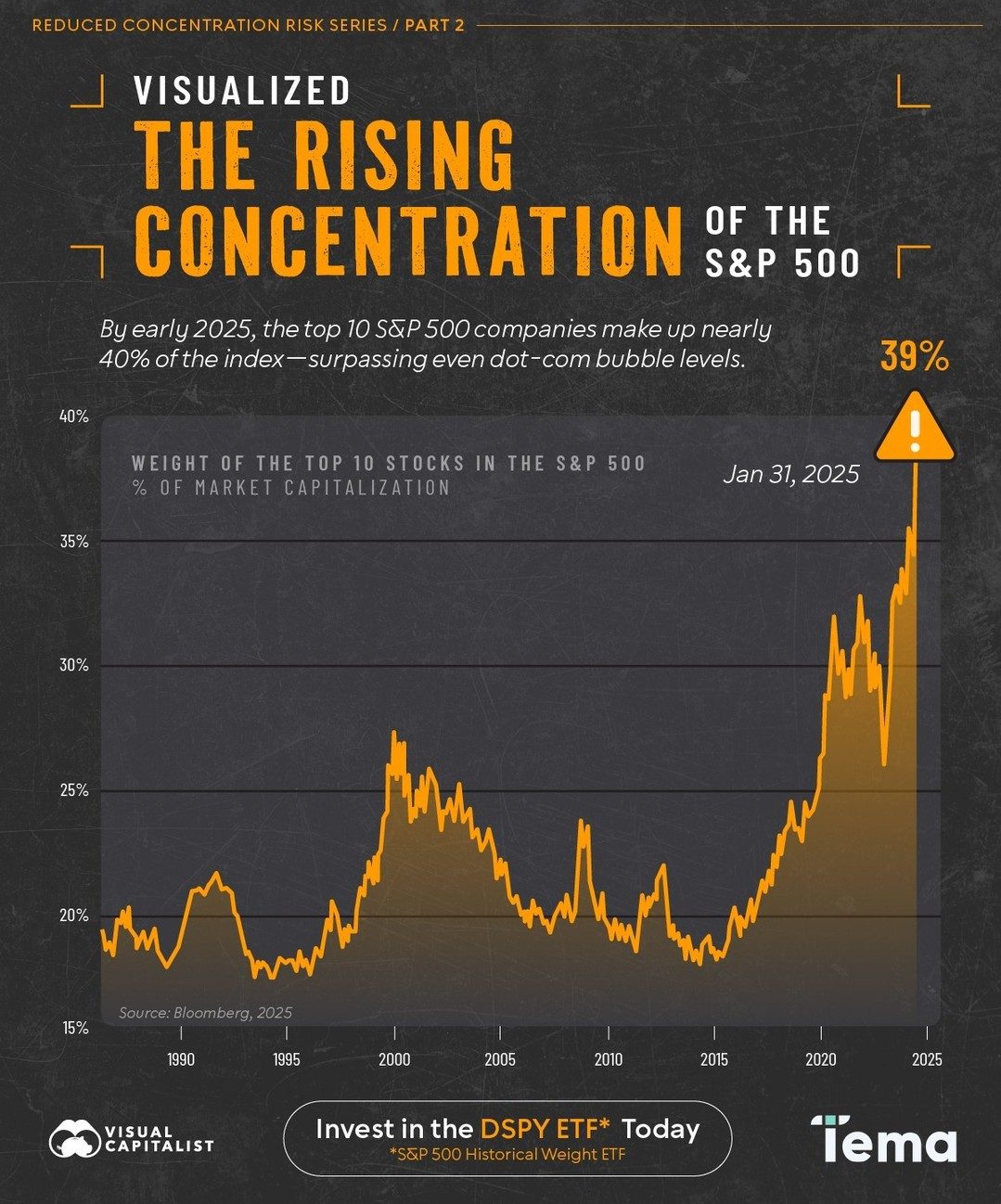
The rising concentration of the largest stocks in the S&P 500 has been a growing trend, with the top 10 companies projected to make up nearly 40% of the index by early 2025. This concentration surpasses even the peak levels seen during the dot-com bubble, raising important questions about market risk and investment strategies.
Why This Matters
Market concentration refers to the percentage of the total market capitalization held by the largest companies within an index. High concentration can indicate that a small number of companies dominate the market, which can have significant implications for investors and the broader economy. Understanding this trend is crucial for making informed investment decisions and managing risk.
The Rise in Concentration
Historical Context
The concentration of the S&P 500 has been on an upward trajectory since the 1990s. In the early 1990s, the top 10 companies made up a much smaller percentage of the index. However, by the early 2000s, this concentration began to rise, coinciding with the dot-com bubble. Since then, the trend has continued, with the top 10 companies steadily increasing their market share.
Key Milestones
- 1990s: The top 10 companies represented a smaller portion of the S&P 500.
- Early 2000s: The dot-com bubble saw a significant rise in concentration, driven by the growth of technology stocks.
- 2010s: The concentration continued to increase, with the top 10 companies becoming more dominant.
- Early 2025: Projections indicate that the top 10 companies will make up nearly 40% of the index, surpassing dot-com levels.
Current Trends
The visualization highlights how the market has grown more concentrated over time. This trend is driven by several factors, including the performance of large-cap stocks, the growth of technology and innovation sectors, and the impact of monetary policies.
Risks Associated with High Concentration
Market Risk
High concentration can increase market risk. When a small number of companies dominate the market, any adverse event affecting these companies can have a disproportionate impact on the overall market. This makes the market more volatile and susceptible to significant fluctuations.
Investment Risk
For investors, high concentration can mean higher risk. Investing in a concentrated market increases the exposure to individual companies, which can lead to higher risk and potential losses if those companies underperform. Diversification becomes more critical in such an environment, as it helps mitigate the impact of poor performance by individual stocks.
The DSPY ETF: A Potential Solution
One way to navigate this concentrated market is by investing in the DSPY ETF, or the SP 500 Historical Weight ETF. This ETF is designed to track the performance of the S&P 500 index while adjusting for historical concentration levels. By doing so, it aims to provide a more balanced and diversified investment strategy, reducing the risk associated with high concentration.
How It Works
The DSPY ETF adjusts the weight of the top 10 companies in the S&P 500 to reflect historical levels. This means that instead of having a disproportionate influence, the top 10 companies are given a more balanced weight in the ETF's portfolio. This approach helps to reduce the overall risk and volatility associated with high concentration.
Benefits
- Reduced Volatility: By balancing the weight of the top 10 companies, the DSPY ETF can help reduce volatility and provide a smoother investment experience.
- Diversified Exposure: Investing in the DSPY ETF allows investors to gain exposure to the S&P 500 while mitigating the risks associated with high concentration.
- Historical Performance: The ETF's strategy is based on historical performance data, providing a more stable and predictable investment option.
Practical Tips
Diversify Your Portfolio
Diversification is key to managing risk in a concentrated market. Consider spreading your investments across different sectors and company sizes to reduce exposure to any single company or sector.
Monitor Market Trends
Stay informed about market trends and concentration levels. Regularly reviewing the performance of the top 10 companies and understanding their impact on the overall market can help you make more informed investment decisions.
Consider ETFs
Investing in ETFs that focus on historical weighting, such as the DSPY ETF, can provide a more balanced investment strategy. These ETFs help reduce risk by balancing the weight of the top companies in the index.
Seek Professional Advice
Consulting with a financial advisor can provide valuable insights and guidance on navigating a concentrated market. A professional can help you develop a diversified investment strategy tailored to your risk tolerance and financial goals.
Important Takeaways
The rising concentration of the top 10 companies in the S&P 500 is a significant trend that has implications for both market and investment risk. By understanding this trend and taking proactive steps, such as diversifying your portfolio and considering ETFs like the DSPY, you can better manage risk and make more informed investment decisions.
Conclusion
The concentration of the S&P 500 is an important trend that investors should be aware of. By understanding the historical context, current trends, and potential risks, you can develop a more informed and balanced investment strategy. Diversification, monitoring market trends, and considering ETFs are practical steps that can help you navigate this concentrated market and achieve your financial goals.
Watch the Reel
Questions readers ask
What does the projected 40% concentration of the top 10 S&P 500 stocks by 2025 mean for investors?
A 40% concentration means that the performance of a smaller group of companies will have an outsized impact on the S&P 500's overall performance. This can amplify both gains and losses in the index, making it more volatile. This significant influence mandates that investors diversify their portfolios beyond the top 10 stocks.
How does the current S&P 500 concentration compare to previous market conditions, such as the dot-com bubble?
The projected 40% concentration of the top 10 S&P 500 stocks exceeds the levels seen during the dot-com bubble. This comparison highlights the current market's heavy reliance on a few large companies, similar to the tech-heavy market of the late 1990s, which ultimately led to a significant market correction.
What risks are associated with high concentration in the S&P 500?
High concentration in the S&P 500 can lead to increased market risk, as the performance of the index becomes heavily dependent on a few companies. This can result in significant market swings and potential bubbles, as seen in the past. Additionally, a downturn in these dominant companies could have severe impacts on the broader economy.
Which sectors are likely to dominate the top 10 S&P 500 stocks by 2025?
While specific predictions can vary, historical trends and current market dynamics suggest that sectors like technology, healthcare, and consumer discretionary are likely to continue dominating the top 10 S&P 500 stocks. These sectors have shown strong performance and innovation, contributing to the growth of leading companies.
What strategies can investors employ to mitigate the risks associated with S&P 500 concentration?
Investors can consider diversifying their portfolios across different sectors, market capitalizations, and geographies to reduce reliance on the top 10 S&P 500 stocks. Additionally, monitoring market trends and adjusting investment strategies accordingly can help manage concentration risk. Consideration can be given to smaller-cap or mid-cap stocks that may offer growth opportunities outside of the top 10.
What are the potential economic implications if the top 10 S&P 500 stocks make up 40% of the index?
If the top 10 stocks make up 40% of the S&P 500, it could lead to increased market volatility and potential bubbles. A downturn in these dominant companies could have severe impacts on the broader economy, including reduced consumer spending, lower employment, and decreased business investment.
Should investors be concerned about the current trend of increasing concentration in the S&P 500?
Increased concentration in the S&P 500 should be a consideration for investors, as it can significantly impact market performance and risk. While high concentration can lead to rapid gains, it also increases the likelihood of substantial losses. Investors should stay informed about market trends and consider diversifying their portfolios to navigate this environment effectively.
Recent articles
Fresh deep dives from the latest Reels we unpacked.




Comments
Be the first to comment.