Understanding S&P 500 Sector Performance through the Business Cycle
The performance of sectors within the S&P 500 fluctuates significantly as the business cycle evolves. From the peak of an expansion to the trough of a recession, different phases of the cycle impact sectors uniquely. By examining historical data, we can identify trends and patterns that help investors understand which sectors tend to outperform during each phase. This analysis covers the business cycle phases, sector performance, and key insights to consider.
Context: Why This Matters
The S&P 500 is a widely followed stock market index that includes 500 leading companies in major industries. Understanding its sector performance through different phases of the business cycle can provide valuable insights for investors. The business cycle, comprising recession, recovery, expansion, and slowdown, influences economic indicators and investor sentiment. By analyzing how different sectors perform during these phases, investors can make more informed decisions about where to allocate their capital.
Sector Performance through the Business Cycle
The Phases of the Business Cycle
The business cycle consists of four main phases:
- Recession: Defined by a decline in economic activity, typically characterized by falling GDP, increased unemployment, and reduced business and consumer spending.
- Recovery: The period following a recession where the economy begins to grow again, marked by increasing output, employment, and income.
- Expansion: This phase follows recovery, characterized by robust economic growth, rising employment, and increasing consumer and business confidence.
- Slowdown: The economy starts to decelerate, but it remains positive. This phase often precedes a recession.
Sector Performance during Each Phase
The performance of S&P 500 sectors varies significantly across these phases. Here’s a closer look at how different sectors fare during each phase:
-
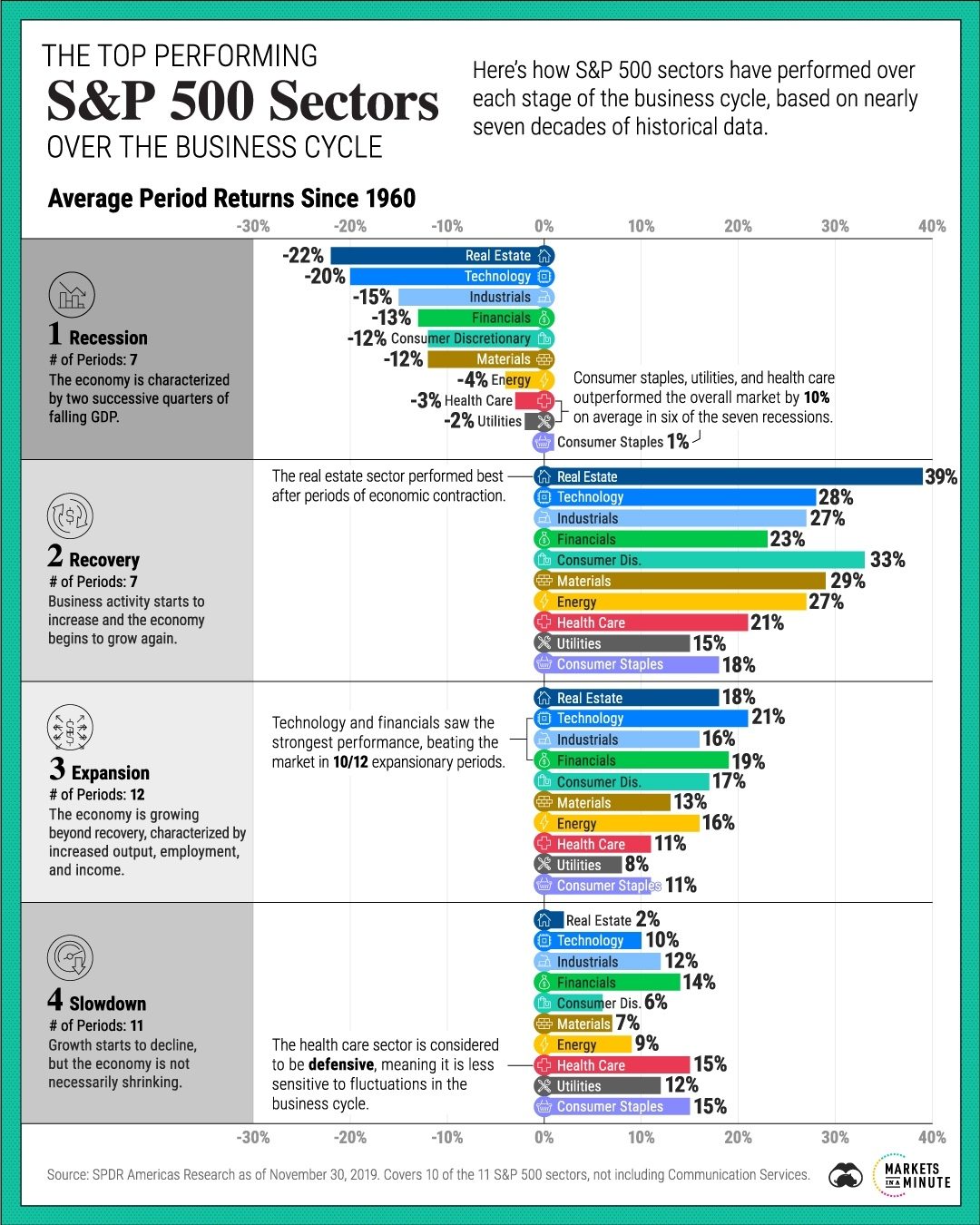
Recession: During recessions, defensive sectors such as healthcare, consumer staples, and utilities often outperform. These sectors are less sensitive to economic fluctuations and are considered stable investments. Historically, these sectors have outperformed the overall market by about 10% on average in six out of the seven recessions since 1960.
-
Recovery: The recovery phase typically sees a broad-based rally across sectors, as investor confidence and economic optimism return. Historically, sectors like Consumer Discretionary, Industrials, and Technology have shown strong performance during recoveries.
-
Expansion: During expansions, sectors like Technology and Financials tend to perform exceptionally well. These sectors benefit from increased consumer spending, higher corporate earnings, and a favorable investment environment. Technology and financials have seen robust performance in 10 out of 12 expansionary periods since 1960.
-
Slowdown: As the economy starts to decelerate, sectors that benefit from consumer spending and economic growth, such as Consumer Discretionary and Industrials, may see reduced performance. Defensive sectors, like Consumer Staples and Healthcare, may continue to perform relatively well.
Key Insights
Several key insights emerge from the analysis of S&P 500 sector performance through the business cycle:
-
Defensive Sectors: Healthcare, Consumer Staples, and Utilities tend to outperform during recessions and slowdowns. These sectors are less sensitive to economic fluctuations, making them attractive during uncertain times.
-
Cyclical Sectors: Industries such as Consumer Discretionary, Industrials, and Technology perform well during expansions and recoveries. These sectors benefit from increased consumer confidence and economic growth.
-
Technology and Financials: These sectors have historically shown strong performance during expansionary periods. Technology benefits from increased innovation and spending, while Financials thrive on higher interest rates and increased economic activity.
Practical Tips
Investing based on the business cycle involves a few practical steps:
-
Diversify: Maintain a diversified portfolio to spread risk across different sectors. This approach can help mitigate the impact of economic downturns.
-
Monitor Economic Indicators: Keep an eye on key economic indicators, such as GDP growth, unemployment rates, and consumer confidence, to anticipate changes in the business cycle.
-
Sector Rotation: Consider rotating your portfolio to take advantage of sectors that are likely to perform well in the current phase of the business cycle.
-
Invest in Defensive Sectors: During recessions and slowdowns, allocate a portion of your portfolio to defensive sectors to protect against market volatility.
-
Stay Informed: Stay updated on technological advancements and global events that can impact sector performance.
Important Takeaways
-
Sector Performance Varies: The performance of S&P 500 sectors fluctuates significantly through the business cycle, with each phase impacting sectors differently.
-
Defensive Sectors: Healthcare, Consumer Staples, and Utilities tend to outperform during recessions and slowdowns.
-
Cyclical Sectors: Consumer Discretionary, Industrials, and Technology perform well during expansions and recoveries.
-
Economic Indicators: Key economic indicators can help anticipate changes in the business cycle and inform investment decisions.
Conclusion
Understanding how S&P 500 sectors perform through the business cycle provides valuable insights for investors. By recognizing the specific performance trends of various sectors during different phases of the cycle, investors can make more informed decisions and better navigate market fluctuations. Whether in a recession, recovery, expansion, or slowdown, staying informed and adaptable can lead to more successful investment strategies.
Watch the Reel
Questions readers ask
What are the typical phases of a business cycle and how do they affect S&P 500 sectors?
The business cycle generally includes four phases: expansion, peak, contraction (or recession), and trough. During expansion, sectors like technology and consumer discretionary often perform well. Conversely, during contractions, sectors such as utilities and consumer staples tend to be more resilient.
Which S&P 500 sectors tend to outperform during a recession?
Historically, sectors like consumer staples, utilities, and healthcare have shown resilience during recessions. These sectors often provide essential goods and services, making them less sensitive to economic downturns. Conversely, sectors such as consumer discretionary and industrials may struggle.
How can investors use sector performance data during different business cycle phases?
Investors can use historical sector performance data to make informed decisions about capital allocation. By identifying which sectors typically outperform during each phase, investors can adjust their portfolios accordingly. For example, shifting towards defensive sectors during a recession or cyclical sectors during an expansion.
What is the average sector performance during the recovery phase of the economy?
During the recovery phase, sectors that benefit from increased economic activity, such as consumer discretionary, industrials, and financials, tend to perform well. These sectors often see improved revenues and earnings as businesses and consumers increase spending.
Which S&P 500 sectors historically benefit the most from expansion periods?
During expansion periods, sectors that thrive on economic growth and consumer confidence, such as consumer discretionary, technology, and industrials, often outperform. These sectors benefit from increased consumer spending, higher corporate investments, and overall economic optimism.
How do top-performing sectors during recession recovery differ from those in full economic expansion?
During recession recovery, sectors like consumer discretionary, industrials, and financials tend to lead as they benefit from the initial surge in economic activity. In contrast, during full economic expansion, sectors such as technology and healthcare may also excel due to sustained growth and innovation.
Related deep dives
Similar reads based on topic and creator.


Recent articles
Fresh deep dives from the latest Reels we unpacked.




Comments
Be the first to comment.