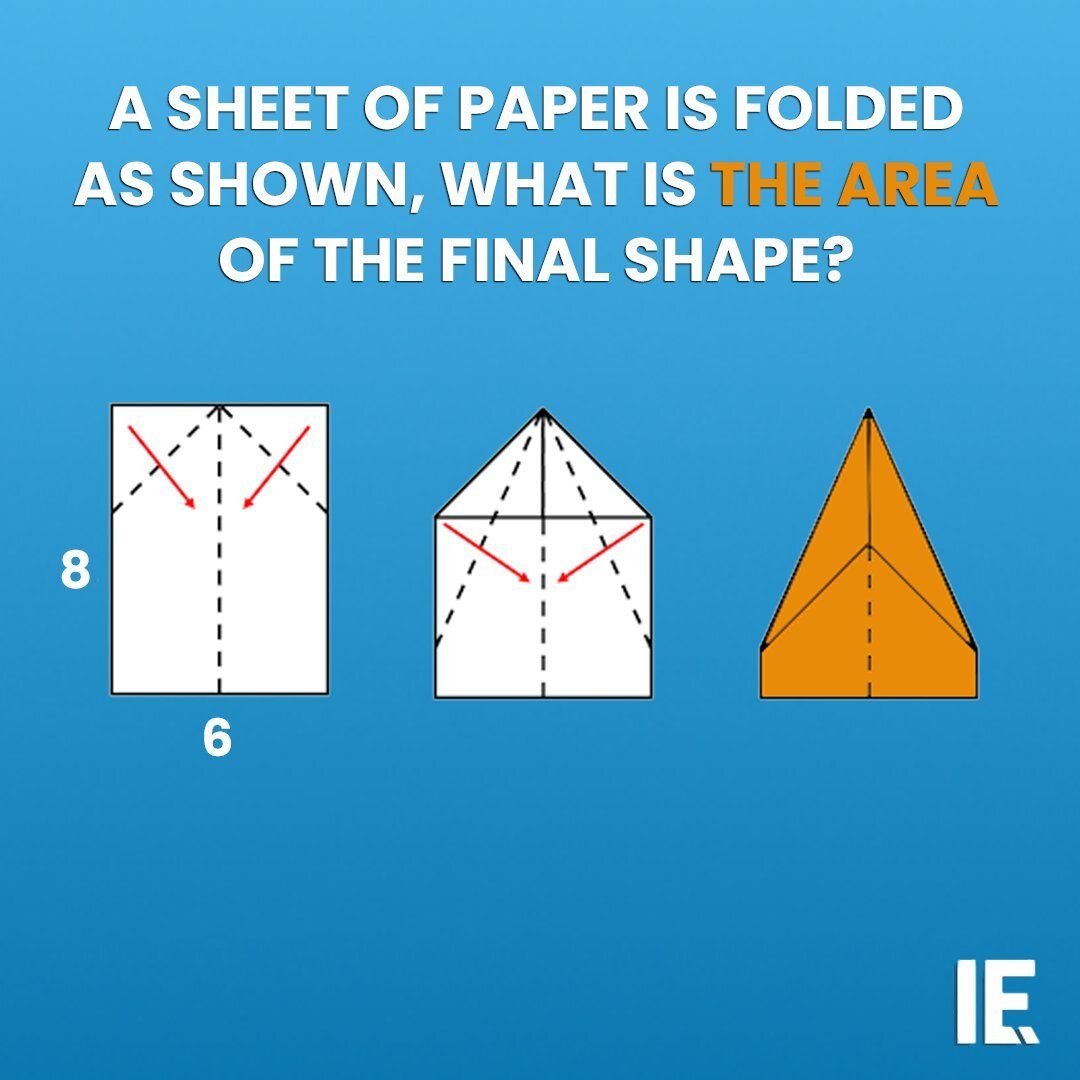
Paper Folding Problem: A Mathematical Challenge
Paper folding is a common activity that often sparks interest in mathematical problems and geometric transformations. A key example is the problem of folding a rectangular sheet of paper into a specific shape. This mathematical challenge involves understanding how the original dimensions of a 6 by 8 sheet of paper transform into a final triangular shape after two perfect folds. This article will explore the geometric principles behind this problem and provide insights into calculating the area of the final triangle.
Why This Matters
Understanding the transformation of shapes through folding is not only a fun mental exercise but also a practical skill that has applications in various fields. For example, engineers and designers often use folding techniques to create intricate designs and optimize space in packaging. Additionally, solving such problems can improve spatial reasoning skills, which are valuable in many disciplines, including mathematics, physics, and engineering. By mastering the principles of paper folding, one can better grasp the concept of geometric transformations and develop a deeper understanding of how shapes and dimensions interact.
The Geometry of Paper Folding
Initial Shape and Dimensions
To start, consider a rectangular sheet of paper with dimensions 6 by 8 units. This is the initial shape that will undergo two perfect folds. The goal is to determine the area of the final triangular shape after the folds are made. Understanding the initial dimensions and how they are affected by the folds is crucial for solving this problem.
Transforming the Rectangle
The first step in solving the problem is to visualize the folding process. When a rectangle is folded, it creates a crease that changes the shape of the paper. The specific folds mentioned in this problem create a triangle from the original rectangle. Understanding how this transformation occurs is essential. To simplify, consider the folds as straight lines that divide the rectangle into smaller sections.
Calculating the Area
To calculate the area of the final triangular shape, the height and base of the triangle need to be determined. The dimensions of the original rectangle (6 by 8) provide the base and height required for the calculation. By carefully analyzing the folds, it is possible to deduce the dimensions of the final triangle.
The Mathematical Formula
The area of a triangle is calculated using the formula:
[ \text{Area} = \frac{1}{2} \times \text{base} \times \text{height} ]
Given the dimensions of the original rectangle, the base and height of the triangle can be derived from the folding lines. Let's break down the process to determine the correct measurements.
Practical Tips for Solving the Problem
Visualize the Folds
Visualizing the folding process is the first step in solving the problem. Create a rough sketch of the rectangle and mark the folds to see how the paper transforms into a triangle. This visualization will help in understanding the dimensions of the final shape.
Measure the Dimensions
Measure the dimensions of the original rectangle and the resulting folds. Use a ruler to ensure accuracy, as precise measurements are crucial for calculating the area of the final triangle.
Understand the Folding Mechanics
Understand how the folds affect the dimensions of the paper. Each fold creates a new crease that changes the shape and size of the paper. Analyze how these folds alter the original dimensions to form the final triangular shape.
Apply the Formula
Once the dimensions of the triangle are known, apply the area formula:
[ Area = \frac{1}{2} \times base \times height ]
Verify the Calculations
Verify the calculations by checking the measurements and the folding process. Ensure that the dimensions and the area calculations are correct.
Important Takeaways
The paper folding problem highlights the importance of geometric transformations and spatial reasoning. By understanding how a rectangle transforms into a triangle through folding, one can gain insights into the principles of geometry and mathematics. This problem is a practical example of how mathematical concepts can be applied to real-world scenarios, making it a valuable exercise for anyone interested in learning more about shapes and dimensions.
Conclusion
The paper folding problem provides a fascinating challenge that combines geometry, mathematics, and spatial reasoning. By solving this problem, one can improve their understanding of geometric transformations and develop valuable problem-solving skills. The key to success lies in careful visualization, accurate measurement, and the application of mathematical formulas. This problem is not only a fun mental exercise but also a practical skill that can be applied in various fields.
Watch the Reel
Questions readers ask
How do you fold a 6x8 sheet of paper into a perfect triangle?
To fold a 6x8 sheet of paper into a perfect triangle, first fold the paper in half along the 8-inch side to form a 4x8 rectangle. Then, fold the resulting rectangle in half again along the 4-inch side to form a perfect 4x4 square. Finally, fold the square in half diagonally to create a perfect triangle.
What are the dimensions of the triangle formed by folding a 6x8 paper?
When you fold a 6x8 sheet of paper into a triangle as described, the resulting triangle will have sides that are 8 inches and 6 inches, with the hypotenuse being the diagonal of the 4x4 square, which is approximately 5.66 inches. The triangle is a right-angled triangle with a height of 4 inches.
How do you calculate the area of the triangle formed from a 6x8 paper?
To calculate the area of the triangle formed from a 6x8 paper, you can use the formula for the area of a right-angled triangle: Area = 1/2 * base * height. In this case, the base is 8 inches and the height is 4 inches. So, the area is 1/2 * 8 * 4 = 16 square inches.
What are the practical applications of calculating the area of a triangle from a 6x8 paper fold?
The practical applications of understanding how to calculate the area of a triangle from a 6x8 paper fold are seen in various engineering and design fields. This mathematical exercise can help in creating precise designs, optimizing space, and solving real-world problems involving geometric transformations. For example, engineers might use this to design packaging or structures.
Why is it important to understand geometric transformations in paper folding?
Understanding geometric transformations in paper folding is crucial because it helps in visualizing and predicting how shapes change during the folding process. This skill can help in creating precise folds, optimizing material use, and solving complex problems in fields like engineering and design. It can also help in outsmarting paper folding challenges to create intricate designs.
Can folding a 6x8 paper into a triangle help solve engineering problems?
Yes, folding a 6x8 paper into a triangle can help solve engineering problems by providing a hands-on approach to understanding geometric transformations. This exercise can enhance problem-solving skills and spatial reasoning, which are essential for tackling real-world engineering challenges. Engineers can use this skill to design efficient and effective solutions in various applications.
How can you fold a 6x8 sheet of paper into a triangle without measuring?
To fold a 6x8 sheet of paper into a triangle without measuring, you can use the paper's edges and symmetry as guides. First, fold the paper in half along the longer side (8 inches) and crease it well. Next, unfold and fold it in half along the shorter side (6 inches) and crease it well. Finally, fold the resulting rectangle in half diagonally to form the triangle. This method ensures precise folds without the need for measurements.
Related deep dives
Similar reads based on topic and creator.

Recent articles
Fresh deep dives from the latest Reels we unpacked.




Comments
Be the first to comment.