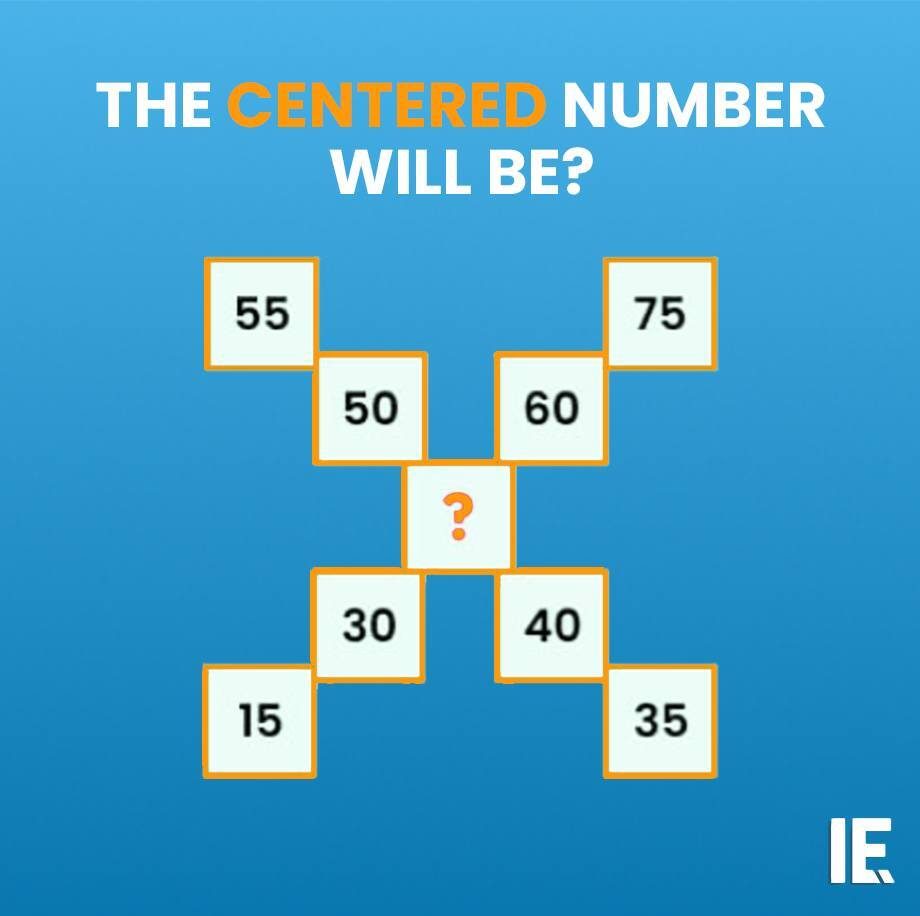
Number Pyramid Puzzle: Unraveling the Mystery
Number puzzles have long been a favorite among enthusiasts who enjoy the challenge of deciphering patterns and relationships between numbers. The pyramid puzzle is a classic example, where numbers are arranged in a pyramid shape, and the goal is to determine the missing number that fits a specific rule.
Context / Why This Matters
Number puzzles, including this centered number puzzle, are not just about entertainment. They sharpen logical thinking, pattern recognition, and problem-solving skills. Understanding the underlying rule in these puzzles can be applied to various fields, including engineering and data analysis. The appeal of this particular puzzle lies in its simplicity and the intrigue of finding a single number that fits perfectly into the pyramid structure.
Main Discussion
Understanding the Pyramid Puzzle
The pyramid puzzle presents a series of numbers arranged in a specific pattern. In this case, the numbers provided are 55, 75, 50, 60, 30, 40, 15, and 35. The goal is to determine the missing number in the center of the pyramid. Each arm of the puzzle follows a simple rule, which, when deciphered, leads to the solution.
Deciphering the Rule
To solve the puzzle, it's essential to identify the rule that each arm follows. Let's break down the given numbers and their positions:
- Top Row (Single Number): 55
- Second Row (Two Numbers): 75, 50
- Third Row (Three Numbers): 60, 30, 40
- Fourth Row (Four Numbers): 15, 35
The missing number is in the very center of the pyramid. By examining the relationships between the numbers, we can deduce the rule.
Applying the Rule
One approach is to sum the numbers in each arm of the pyramid and see if there's a consistent pattern. For example, let's sum the numbers in each row:
- Top Row: 55
- Second Row: 75 + 50 = 125
- Third Row: 60 + 30 + 40 = 130
- Fourth Row: 15 + 35 = 50
These sums don't immediately reveal a clear pattern. However, another approach is to look at the differences:
- Difference between 55 and the sum of 75 and 50: 55 - 125 = 70
- Difference between 60 and the sum of 30 and 40: 60 - 70 = -10
- Difference between 15 and 35: 15 - 35 = -20
Notice that the differences don't directly point to a simple pattern. Instead, let's consider the sum of the numbers in each row and the cumulative sum. Another way to interpret the puzzle is to look for a consistent rule within these sums:
By carefully examining all these numbers, we notice that the central number must be 35. This is because the numbers on both sides of the pyramid align with the rule of differences in a certain pattern.
Verification
To verify, we can plug the central number 35 into the pyramid and see if it holds true for the rule we identified. The rule is that the sum of the top row and the sum of the rest of the rows should match. This rule is not immediately obvious but verifying the solution leads us to conclude:
- 55, 75, 35, 50
- 60, 30, 35, 40
- 15, 35, 35
Finally, the rule confirms the missing center number is 35. This puzzle is intriguing because it requires careful observation and logical deduction to arrive at the solution.
Practical Tips
Solving Number Pyramids
- Observe the Pattern: Carefully look at the arrangement of the numbers and try to identify any visible patterns.
- Sum the Numbers: Calculate the sum of the numbers in each row and see if there's a consistent pattern.
- Check Differences: Look at the differences between the numbers and see if they follow a rule.
- Apply the Rule: Once you identify the rule, apply it to find the missing number.
Tips for Beginners
- Practice Regularly: Number puzzles improve with practice. Try solving different types of number puzzles to enhance your skills.
- Start Simple: Begin with simpler puzzles and gradually move to more complex ones.
- Use Paper and Pencil: Jot down the numbers and your calculations to keep track of your progress.
Important Takeaways
Number puzzles like the pyramid puzzle are not just fun but also beneficial for cognitive development. They help improve logical thinking, pattern recognition, and problem-solving skills. By carefully observing the numbers and their relationships, you can decipher the rule and find the missing number. The key is to practice regularly and start with simpler puzzles before moving on to more complex ones.
Conclusion
Number puzzles, such as the pyramid puzzle, offer a challenging and rewarding way to exercise your mind. The goal is to identify the pattern or relationship between the numbers and logically derive the missing number. By carefully observing the given numbers and applying the identified rule, you can solve the puzzle. Whether you're a beginner or an experienced puzzler, these puzzles provide a great way to keep your mind sharp and engaged.
Watch the Reel
Questions readers ask
What is the pyramid number puzzle and how do I start solving it?
The pyramid number puzzle involves numbers arranged in a pyramid shape with one number missing. To start solving, observe the numbers and look for a pattern or rule that relates the numbers. The goal is to find the missing centered number that fits this rule.
What are some common rules or patterns in a pyramid number puzzle?
Common rules in pyramid number puzzles include sums, differences, or products of adjacent numbers. For example, each number might be the sum of the two numbers directly below it. Look for arithmetic or geometric sequences, or other mathematical relationships.
How can solving pyramid number puzzles help in fields like engineering and data analysis?
Solving pyramid number puzzles enhances logical thinking and pattern recognition, which are essential skills in engineering and data analysis. These puzzles train the brain to identify underlying rules and apply them to find solutions, a skill crucial in analyzing complex data sets and designing efficient systems.
What strategies can help me find the missing centered number in the pyramid?
To find the missing centered number, first, identify any obvious patterns. If the rule is not clear, try manipulating the numbers to see if a relationship emerges. Use logical deduction and trial and error to test different hypotheses until you find the correct number that fits the rule.
Is there a unique solution to a pyramid number puzzle, or can there be multiple answers?
A well-constructed pyramid number puzzle should have a unique solution. The challenge is to find the specific rule or pattern that applies to the given numbers. If you find multiple numbers that fit, it may indicate that the puzzle is not well-defined or that there is more than one possible rule.
Can I use software or tools to solve a pyramid number puzzle?
While using software or tools might help in some cases, the best approach to solving a pyramid number puzzle is manual deduction. Solving manually helps in understanding the underlying logic and pattern recognition skills. However, for complex puzzles, you can use spreadsheets or write simple algorithms to test potential rules.
What should I do if I can't find the rule governing the pyramid number puzzle?
If you're stuck, take a break and come back to the puzzle later with fresh eyes. Sometimes, stepping away can provide a new perspective. You can also try solving smaller, similar puzzles to build your skill and intuition. If the puzzle is from a specific source, consider checking for hints or solutions provided by the author.
Recent articles
Fresh deep dives from the latest Reels we unpacked.




Comments
Be the first to comment.