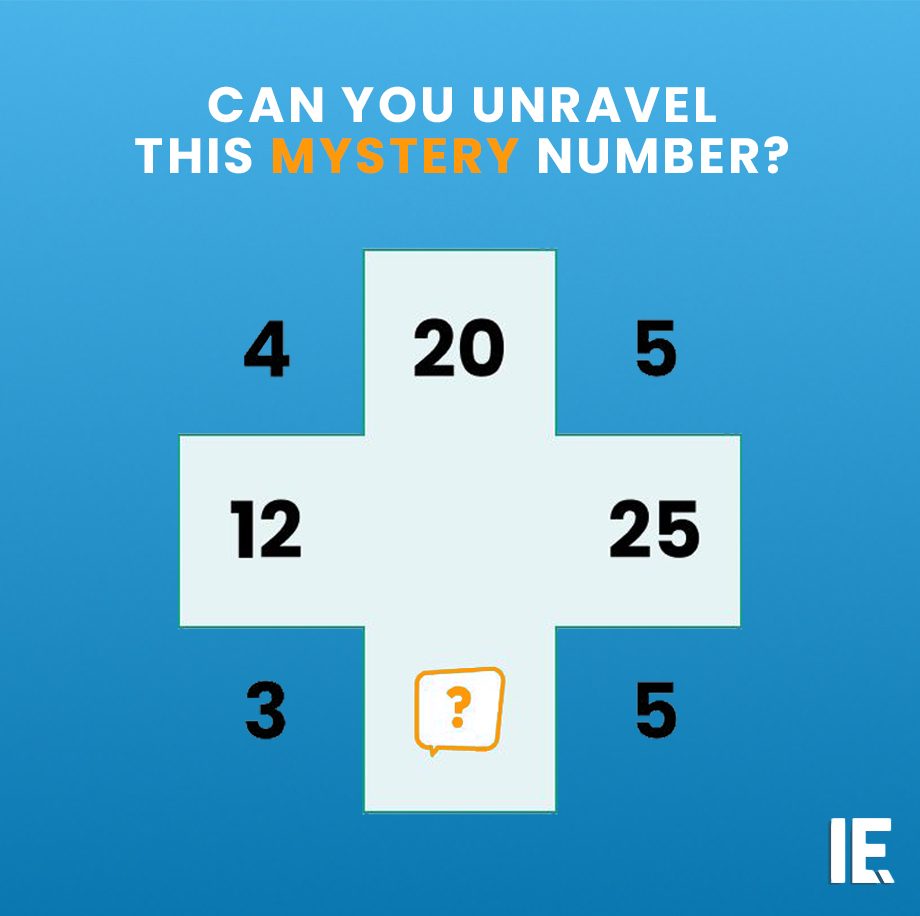
Number Puzzles: Unraveling the Mystery
Number puzzles, particularly those arranged in a cross shape, are a classic way to challenge and sharpen logical reasoning. These puzzles often involve identifying a pattern or relationship between given numbers to deduce a missing value. The challenge is to discern a simple math rule that connects the numbers across each side of the cross.
Context / Why This Matters
Number puzzles, especially those visually engaging with a crisp design and clear color contrast, are not just for entertainment. They serve as effective intellectual exercises that can improve cognitive skills, foster problem-solving abilities, and enhance pattern recognition. Whether you're a student looking to sharpen your math skills or an adult aiming to stay mentally sharp, number puzzles offer a fun and engaging way to do so.
Main Discussion
The Layout and Elements
The puzzle features a cross shape with numbers arranged around it. The numbers provided are 4, 20, 5, 12, 25, 3, and 5. The missing number is represented by a question mark, leaving it up to the solver to determine the correct value.
Identifying the Pattern
The key to solving this puzzle lies in understanding how the numbers connect across each side of the cross. A closer inspection reveals that there might be a simple mathematical rule governing the arrangement. This rule could involve addition, subtraction, multiplication, or any other basic arithmetic operation.
Analyzing the Numbers
To find the pattern, start by examining the numbers on each side of the cross. Consider the numbers in pairs and look for a consistent operation that links them. For instance, if you focus on the numbers 4 and 20, you might notice that they are not directly related through simple addition or subtraction. This suggests that the rule might involve a more complex relationship.
The Math Rule
One possible approach is to consider the sum of the numbers on each side of the cross. However, given the diverse values and the presence of a missing number, it is more likely that the rule involves a relationship between the products or ratios of the numbers. For example, if you look at the numbers 12 and 25, they might be related through multiplication or division.
Solving the Puzzle
To solve the puzzle, you need to identify a mathematical relationship that applies consistently to all pairs of numbers. This might involve some trial and error, but the goal is to find a rule that works for all given numbers and allows you to deduce the missing value.
Step-by-Step Approach
- List the Numbers: Write down all the numbers provided: 4, 20, 5, 12, 25, 3, and 5.
- Identify Possible Relationships: Consider common arithmetic operations and see if any of them consistently apply to the pairs.
- Test the Hypothesis: Once you have a potential rule, apply it to the numbers to see if it holds true for all pairs.
- Deduce the Missing Number: Use the identified rule to determine the value of the missing number.
Practical Tips
- Start with Simple Operations: Begin by testing basic arithmetic operations like addition, subtraction, multiplication, and division. These are often the simplest rules to identify.
- Look for Patterns: Pay attention to any consistent patterns or relationships between the numbers. This could involve looking at the numbers in pairs or groups.
- Use a Process of Elimination: If a rule doesn't work for one pair, eliminate it and move on to the next possible relationship.
- Visualize the Cross: Sometimes, drawing the cross and placing the numbers can help you see the pattern more clearly. This visual aid can be especially useful for spatial thinkers.
- Break Down the Problem: If the puzzle seems too complex, break it down into smaller parts. Solve for one side of the cross at a time and then look for the overall pattern.
Important Takeaways
- Puzzles Enhance Logical Reasoning: Engaging with number puzzles can significantly improve your logical reasoning and problem-solving skills.
- Patterns Are Key: Look for consistent patterns or relationships between the numbers. This is often the key to solving the puzzle.
- Practice Makes Perfect: The more puzzles you solve, the better you'll become at recognizing patterns and applying mathematical rules.
- Stay Patient and Persistent: Solving number puzzles can be challenging, but with patience and persistence, you can unravel even the most complex mysteries.
Conclusion
Number puzzles, particularly those with a cross shape, offer a fun and engaging way to challenge your mind and improve your cognitive skills. By identifying the pattern or relationship between the given numbers, you can deduce the missing value and solve the puzzle. Whether you're a seasoned solver or a beginner, these tips and strategies will help you unravel the mystery of number puzzles and enhance your problem-solving abilities. So, next time you encounter a number puzzle, dive in with curiosity and a keen eye for patterns, and see if you can uncover the hidden mathematical rule!
Watch the Reel
Recent articles
Fresh deep dives from the latest Reels we unpacked.




Comments
Be the first to comment.